
Environmental Neglect in Washington CPS Cases: Where the Law Draws the Line
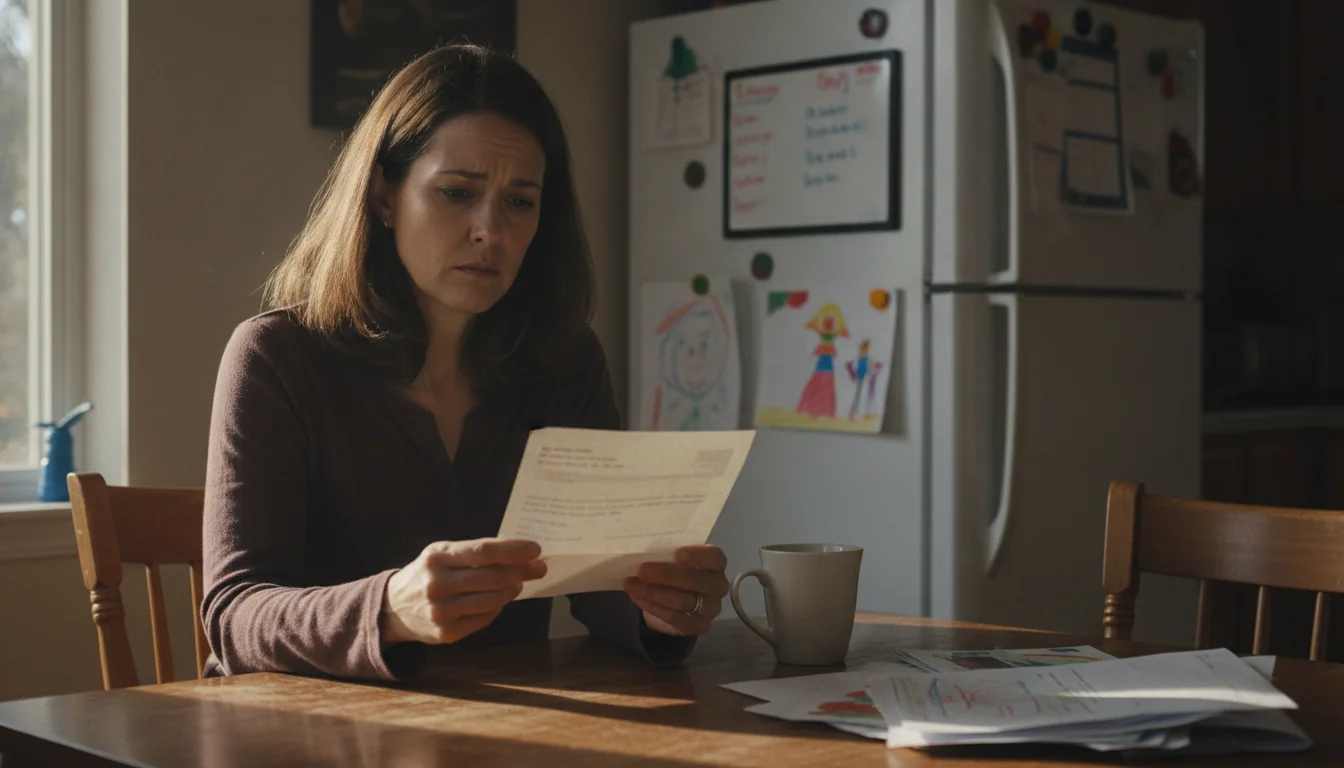
If a caseworker has walked through your home and used the phrase environmental neglect, you’re probably walking your own house in your head right now, room by room. Set that down for a minute. Washington law asks one narrow question about a home, and whether it is clean is not that question. The statute that answers it says in plain words that poverty, unstable housing, and a crowded home are not neglect.
That distinction is written into the definition CPS works from, into the rule caseworkers are trained on, and into the standard a judge applies before a child can be removed. Much of the general material online about dirty houses and CPS isn’t state-specific, and timelines that apply elsewhere don’t match Washington’s.
I’ve spent more than two decades practicing family law in Pierce County courtrooms. Here is what the law says, what a caseworker is looking at, and what you can do before the next contact.
Table of Contents
- If a caseworker is at your door right now
- What environmental neglect means under Washington law
- Poverty is not neglect, and Washington says so in three places
- How a caseworker sorts what they see in your home
- Your rights when a caseworker asks to come in
- The Washington investigation clock, start to finish
- If CPS asks a court to remove your child, the standard changed in 2023
- What to do before the caseworker comes back
- When a lawyer helps, and when the court appoints one
- FAQ
If a caseworker is at your door right now
You don’t have to decide everything in the next ninety seconds. You have more room than it feels like you have.
- Ask who they are and write it down. Get the caseworker’s name, their office, and a phone number. Note the date and time.
- Ask what the allegation is. You’re allowed to ask what specifically was reported. A caseworker may not give you every detail, but they can usually name the general concern.
- Know that entry is your call. A caseworker needs your permission, a warrant, a court order, or a real emergency to come inside. Saying “I’d like to talk to a lawyer first” isn’t obstruction and it isn’t a crime.
- Ask to reschedule if you need to. Offering a specific time in the next day or two reads very differently from refusing outright.
- Don’t sign anything you haven’t read. Safety plans and service agreements carry real consequences. You can ask for a copy and time to review it.
- Write down what was said, that same day. Memory blurs fast, and your notes may be the only contemporaneous record of the visit.
Handled calmly, these steps are what a parent taking the process seriously looks like, and that’s how courts tend to read them. For a fuller walkthrough of that first contact, see our guide on what to do when CPS shows up at your door.
What environmental neglect means under Washington law
“Environmental neglect” is agency shorthand. It doesn’t appear in chapter 26.44 RCW, in Washington’s criminal mistreatment statutes, or in any provision a judge applies. It’s a label caseworkers use internally for allegations about home conditions, and it carries no legal weight of its own.
The standard that does carry weight is negligent treatment. Under RCW 26.44.020(20), negligent treatment or maltreatment means “an act or a failure to act, or the cumulative effects of a pattern of conduct, behavior, or inaction, that evidences a serious disregard of consequences of such magnitude as to constitute a clear and present danger to a child’s health, welfare, or safety,” including conduct prohibited under the criminal mistreatment statutes.
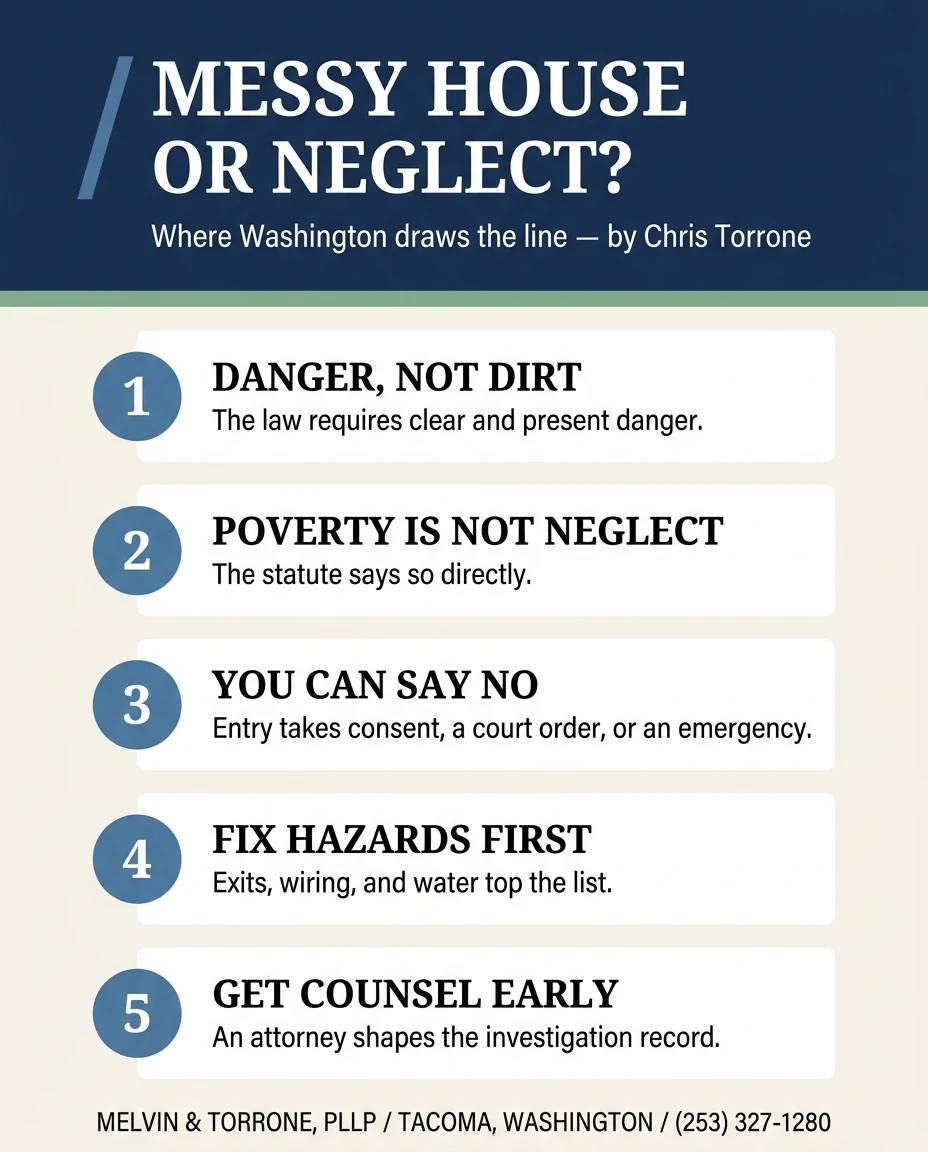
The definition never mentions cleanliness, square footage, or how many people share a room. It turns on one thing, which is whether there’s a clear and present danger to the child.
The agency rule fills in what that can look like. WAC 110-30-0030 adopts the same statutory definition and says negligent treatment may include:
- Failure to provide adequate food, shelter, clothing, supervision, or health care
- Acts or omissions resulting in injury, or a risk of injury, to a child’s physical, emotional, or cognitive development
- The cumulative effects of a pattern of conduct, behavior, or inaction by a parent or guardian
- The effects of chronic failure to perform basic parental functions
Two words in that list do a lot of work. “Adequate” means good enough rather than ideal, and “chronic” means a sustained pattern, so a single hard stretch doesn’t qualify.
The law cuts the other way in two places worth knowing. The same subsection of RCW 26.44.020 directs that evidence of a parent’s substance abuse, where it contributes to negligent treatment, “shall be given great weight” in deciding whether a clear and present danger exists. WAC 110-30-0030 adds that a child doesn’t have to suffer actual harm to be in circumstances that create one.
Poverty is not neglect, and Washington says so in three places
If money or housing is the real story behind the report, this is the section to read twice.
Washington has written the poverty exclusion into its law three separate times, in three separate places:
| Where it appears | What it excludes | What that means for you |
|---|---|---|
| RCW 26.44.020(20) | Poverty, experiencing homelessness, or exposure to domestic violence perpetrated against someone other than the child “does not constitute negligent treatment or maltreatment in and of itself.” The same subsection adds that siblings sharing a bedroom is not, in and of itself, neglect. | Being broke or being unhoused can’t be the neglect finding on its own. Neither can doubling up your kids in one room, or a partner’s violence directed at you rather than at your child. |
| WAC 110-30-0030 | ”Suspected or diagnosed disabilities do not, in and of itself, constitute negligent treatment or maltreatment.” | A parent’s disability, or a child’s, isn’t a finding. Neither is a mental health diagnosis standing alone. |
| RCW 13.34.065(5)(a)(ii)(B)(I) | Community or family poverty, isolation, single parenthood, age of the parent, crowded or inadequate housing, substance abuse, mental illness, and disability “does not by itself constitute imminent physical harm.” | At the removal hearing, the judge can’t treat inadequate housing as the danger. The state has to show a specific condition causing specific harm. |
These are exclusions, not immunity. The statute says poverty isn’t neglect “in and of itself,” which means the state can still build a case if it points to a particular condition and a particular danger flowing from it. What the law forbids is one shortcut. The state cannot look at a poor household and call the poverty itself the harm. That shortcut is common enough that the legislature wrote against it three times, and if it shows up in your case it’s worth naming out loud.
How a caseworker sorts what they see in your home
A caseworker walking through your home is sorting what they see into two piles, and the sorting is done by hazard rather than by housekeeping.
Ordinary life, not evidence of anything:
- Dishes in the sink, laundry piled up, toys across the floor
- A small apartment, shared bedrooms, more people than bedrooms
- Worn furniture, patched walls, a house that needs repairs the landlord has not made
- A thin week before payday
Conditions that raise a real safety question:
- No running water, no working heat in cold months, no electricity
- Exposed wiring, holes in a floor, a blocked exit or a doorway you cannot get a child through
- Accessible drugs, drug paraphernalia, or an unsecured firearm
- Animal or human waste inside the living space
- Infestation heavy enough to be a health problem rather than a nuisance
- No safe place for a child to sleep
Every item on the second list traces to a specific way a child gets hurt, whether that’s a fire, a fall, or a night with nowhere safe to sleep.
The room usually matters less than the child. Investigators look at whether a child is fed, clothed for the weather, supervised, and getting medical care. A cluttered home with a well-cared-for child and a hazardous home with an unsupervised toddler are two different cases.
Your rights when a caseworker asks to come in
A CPS caseworker generally needs your consent, a warrant, a court order, or a genuine emergency to enter your home. That requirement comes from the Fourth Amendment, and in the Ninth Circuit, which covers Washington, the controlling case is Calabretta v. Floyd, 189 F.3d 808 (9th Cir. 1999).
In Calabretta, a social worker and a police officer pressured their way into a family’s home to investigate a child abuse report without a warrant and without an emergency. The Ninth Circuit held they were not entitled to qualified immunity, writing that the principle “that government officials cannot coerce entry into people’s houses without a search warrant or applicability of an established exception to the requirement of a search warrant is so well established that any reasonable officer would know it.” The court refused to carve out a social worker exception to that rule.
Caseworkers are not police officers. They have different training and a different job. Calabretta settles one narrow thing. The warrant requirement doesn’t disappear because the person at the door works for a child welfare agency.
The emergency exception is real and it is narrow. Under Calabretta it covers the situation where officials have probable cause to believe a child has been abused and the child would be injured, or couldn’t be taken into custody, if they had to stop and get a court order first.
A few practical points that come up constantly:
- Declining entry isn’t a crime, and it isn’t evidence of anything.
- Children can be interviewed without a parent’s permission. RCW 26.44.030 requires that parental notification of a child interview happen “at the earliest possible point in the investigation that will not jeopardize the safety or protection of the child or the course of the investigation,” which isn’t the same as advance notice.
- Nobody has to sign a safety plan on the spot. Asking for a copy and time to read it is reasonable.
The tradeoff is worth understanding before the moment arrives. Declining entry often moves a case toward a court order rather than ending it, and it can read as uncooperative to the person who will write the report about your family. That’s an uncomfortable trade, and I won’t pretend otherwise.
This one is yours to decide, and it’s worth ten minutes with an attorney before you decide it cold. We cover it in more depth in do I have to let CPS into my home.
The Washington investigation clock, start to finish
General articles often cite timelines that don’t apply here. These are the Washington deadlines.
| Stage | Washington deadline | Source |
|---|---|---|
| First in-person contact with the child, emergent report | 24 hours from when the report was received | WAC 110-30-0070 |
| First in-person contact, non-emergent report | 72 hours from when the report was received | WAC 110-30-0070 |
| Investigation completed | 60 calendar days | WAC 110-30-0070; DCYF Policy 2331 |
| Outer limit on the investigation | 90 days from the date the report was received, with a narrow protocol exception | RCW 26.44.030(13)(a) |
| Protective custody without a court order | No more than 72 hours, excluding Saturdays, Sundays, and holidays | RCW 13.34.060(1) |
| Request review of a founded finding | 30 days after DCYF notifies you that you are named in a founded report | RCW 26.44.125(1) |
At the end, DCYF closes the investigation as founded or unfounded. Washington doesn’t use “substantiated,” which is the word you’ll see in most out-of-state articles. Founded means there was enough information to believe abuse or neglect likely happened. Unfounded means there wasn’t.
A founded finding isn’t a criminal conviction and it doesn’t by itself take your children. It does go into a state record that follows you into background checks and professional licensing, which is why that 30-day window matters so much. We walk through that process in our guide to CPS founded findings in Washington and in how long a founded finding stays on your record.
If CPS asks a court to remove your child, the standard changed in 2023
If a case reaches the point where the state asks a judge to remove a child, the rules are stricter than they were a few years ago, and the change was aimed squarely at cases that start with home conditions.
The Keeping Families Together Act, House Bill 1227, took effect July 1, 2023 and rewrote the removal standard in RCW 13.34.065. Under the current statute, the court must release the child to the parent unless it finds reasonable cause to believe removal is necessary to prevent imminent physical harm. Four things follow from that:
- The harm has to be imminent and physical. A general worry about how the household is going doesn’t meet that standard.
- There has to be a causal relationship between the particular conditions in the home and imminent physical harm to the child. A judge can’t point at the house in general.
- The court has to weigh the harm of removal itself. Taking a child out of a home does damage of its own, and under the current law that damage goes on the scale.
- Prevention services have to be on the table, along with whether they would prevent or eliminate the need for removal.
The definition of that last term is where it gets useful. RCW 13.34.030 defines prevention services as preservation services “and other reasonably available services, including housing assistance, capable of preventing the need for out-of-home placement while protecting the child.” Housing assistance is named in the statute. Where housing is the concern driving a case, it’s among the services the court is directed to consider, and documentation of what you’ve already applied for is what puts that question in front of the judge.
Two clocks start if a case is filed. The shelter care hearing, where the judge makes that first placement decision, has to happen within 72 hours, excluding Saturdays, Sundays, and holidays. The fact-finding hearing, where the court decides whether the allegations are true, has to be held no later than 75 days after the petition is filed unless the court finds exceptional reasons for a continuance.
A better statute changes the argument you get to make, not the outcome. Judges still weigh evidence, caseworkers still write reports, and how a situation is presented in that first 72-hour hearing shapes everything after it. The law puts parents in a stronger position than before 2023, but someone still has to make the argument. We break down that first hearing in detail in our piece on the 72-hour shelter care hearing in Pierce County.
What to do before the caseworker comes back
Between now and the next visit, work in order of danger. The laundry is last.
A rough order of priority, from most to least safety-relevant:
- Heat, running water, and working electricity
- Exits and pathways, so every door and hallway is clear
- Sleeping space, so each child has a safe place to sleep
- Exposed wiring, broken glass, holes in floors, anything a child can fall through or into
- Anything a child can reach that would hurt them: medications, chemicals, drugs, firearms
- Waste, spoiled food, and infestation
- Everything else
Build the record while you do it:
- Photograph conditions before and after you fix them. Dates matter.
- Keep every message to your landlord about a repair, and every reply, or the absence of one.
- Save every application for housing assistance, utility help, rental aid, or a shelter bed, including the ones that were denied.
- Write down what you asked the caseworker and what they told you, each time.
- Ask the caseworker, in writing if you can, what specific condition concerns them. A vague worry is hard to answer, but a named hazard is something you can fix and photograph.
That paper trail is evidence. When the statute directs a court to consider prevention services and whether housing support would prevent removal, a folder of applications and repair requests can be what raises that question.
A common pattern in these cases is a parent who was already trying. They had called about the mold, they were on a waitlist, a new place was weeks away. All of it was real. None of it was in the file, and the file is what the court sees. So write it down, even when it feels like paperwork stacked on top of everything else.
When a lawyer helps, and when the court appoints one
Almost every parent asks about a free lawyer first. Under RCW 13.34.090, a parent has the right to be represented by counsel “at all stages of a proceeding in which a child is alleged to be dependent,” and if indigent, to have counsel appointed by the court.
The catch is in the words “a proceeding.” That right attaches once a dependency case exists in court. During the investigation, before anything has been filed, there’s no proceeding and no appointed attorney. Most of the important facts in a case get written down during that gap.
What an attorney does in that window:
- Reads the actual allegation instead of guessing at it
- Handles communication with the caseworker so you aren’t improvising under pressure
- Reviews any safety plan or service agreement before you sign it
- Frames what you’ve already fixed, and what you’ve already asked for, as a record rather than a story
- Prepares for a shelter care hearing on the assumption it might happen, rather than building that argument in 72 hours
Melvin & Torrone, PLLP is a Tacoma firm founded by Rob Melvin and Chris Torrone, and we handle CPS dependency and administrative matters across the South Puget Sound, including Pierce, Kitsap, Thurston, and Lewis counties. We also practice criminal defense, which matters here. Allegations about a home sometimes generate a criminal referral alongside the CPS case, and the two affect each other. You can read more about that overlap in CPS investigations and criminal charges, or see our CPS dependency practice.
If a caseworker has been to your home, or you think one is coming, talk to an attorney before the next conversation rather than after it.
FAQ
Can CPS take my kids because my house is messy?
Not for messiness alone. Washington defines neglect as conduct creating a clear and present danger to a child’s health, welfare, or safety, and a court can order removal only to prevent imminent physical harm that is causally connected to a specific condition in the home. Dishes and clutter are not that. A home with no heat, no water, no safe place to sleep, or a blocked exit is a different question.
Is environmental neglect a crime in Washington?
No. “Environmental neglect” doesn’t appear in chapter 26.44 RCW or in Washington’s criminal mistreatment statutes. It’s agency shorthand for allegations about home conditions. A CPS investigation is a civil child welfare process rather than a criminal charge, though the same underlying facts sometimes prompt a separate referral to law enforcement.
Do I have to let a CPS caseworker into my home?
No, not automatically. Under Ninth Circuit law governing Washington, a caseworker generally needs your consent, a warrant, a court order, or a genuine emergency to enter. You can decline, and declining isn’t a crime. In practice, declining often leads the agency to ask a court for an order rather than ending the investigation.
How long does a CPS investigation take in Washington?
Washington rules require the investigation to be completed within 60 calendar days, and RCW 26.44.030 sets a 90-day outer limit from the date the report was received in most cases. The first in-person contact happens much sooner, within 24 hours for emergent reports and 72 hours for non-emergent reports.
Can CPS remove my child because we are living in a motel or a car?
Housing status by itself isn’t a legal basis for removal in Washington. RCW 13.34.065 states that community or family poverty, single parenthood, and crowded or inadequate housing do not by themselves constitute imminent physical harm, and RCW 26.44.020 says experiencing homelessness isn’t negligent treatment in and of itself. The state would still have to identify a specific condition and a specific imminent physical harm flowing from it.
Do I get a free lawyer during a CPS investigation?
Usually not during the investigation. RCW 13.34.090 gives a parent the right to counsel at all stages of a dependency proceeding, including an appointed attorney for a parent who is indigent, but that right attaches once a dependency case has been filed in court. During the investigation phase, you’d need to hire your own attorney.
About the author. Chris Torrone is a founding partner of Melvin & Torrone, PLLP in Tacoma, Washington. He has practiced family law and CPS dependency in Pierce County courts for more than two decades, and he writes about the parts of the process that families are rarely told in advance. The firm handles family law and criminal defense across the South Puget Sound.
The client stories in this article are illustrative composites based on common situations; they do not describe specific clients or promise any particular result. This article is attorney advertising and shares general information only, not legal advice. Reading it or contacting Melvin & Torrone, PLLP does not create an attorney-client relationship. Every situation is different, so talk with a licensed attorney about yours.

Chris Torrone
Founding Partner, Melvin & Torrone PLLP
Chris Torrone is a dedicated advocate for clients facing family crises and criminal charges. With 20 years of experience practicing in Pierce County courts, Chris has built a reputation for meticulous case preparation and creative problem-solving in high-stakes litigation.