
What Happens at a Permanency Planning Hearing in Washington

A permanency planning hearing is where a Washington judge decides the direction of your dependency case: whether your child comes home, whether the plan shifts to adoption or guardianship, and what happens over the next twelve months. It isn’t the hearing where parental rights are terminated. Termination is a separate case with its own petition and a higher burden of proof.
I want to say that clearly at the top, because it’s the thing parents get wrong most often. By the time the permanency planning notice arrives, most parents have spent close to a year inside a Pierce County dependency case that explains very little, and the word permanency lands like a verdict. It’s a checkpoint instead, and it’s one of the few points in a dependency case where preparation can shape what the court has in front of it.
Torrone’s Takeaways
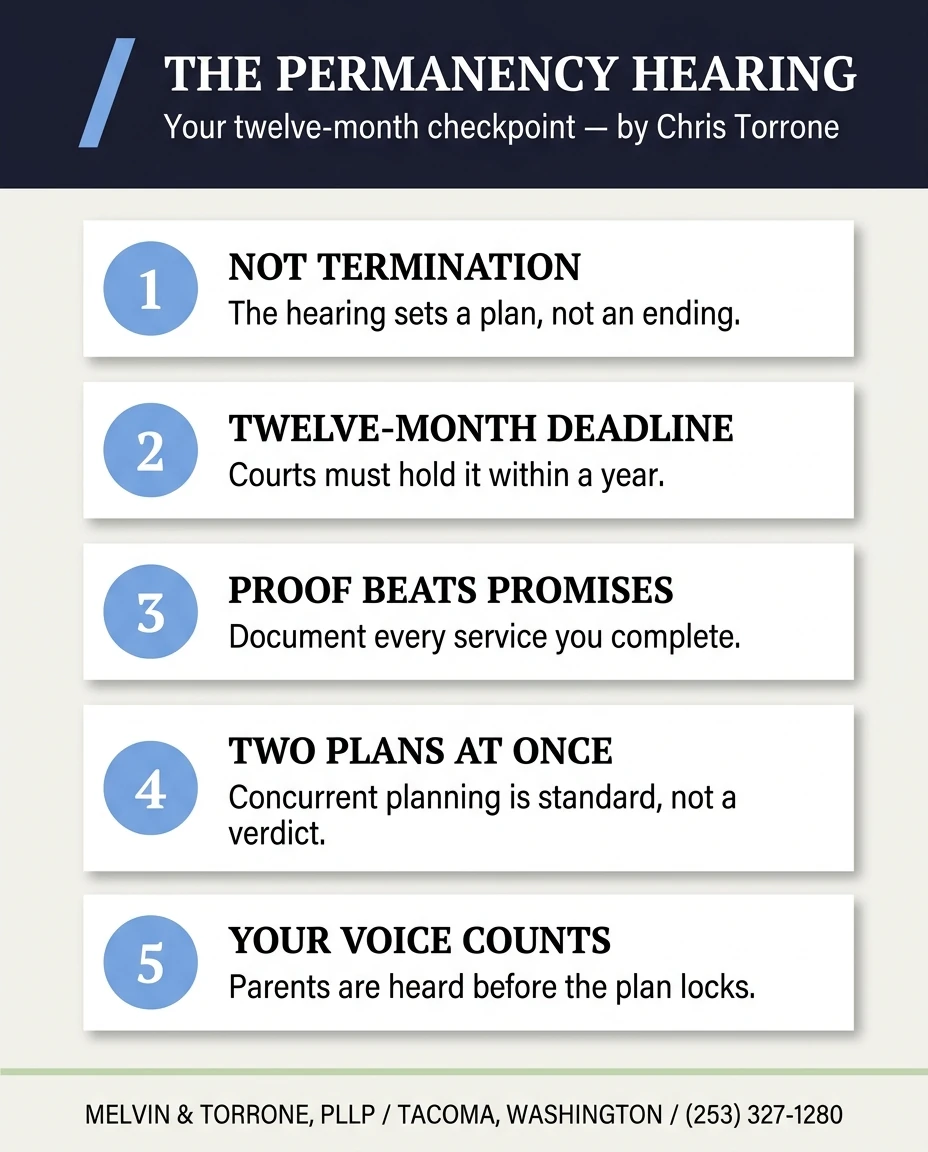
- The hearing decides the plan, not your rights. Termination is a separate proceeding.
- The written permanency plan reaches the parties at least 14 days before the hearing, and a party who disagrees has until seven days before to file a responsive report. Almost nobody tells parents about that second deadline.
- Nine months, twelve months, and fifteen months are three different clocks. Confusing them costs parents preparation time they can’t get back.
- An order directing the department to file a termination petition is a filing order. Good cause exceptions exist, and several of them turn on documentation.
- A plan change to adoption doesn’t end services or visitation. The statute says so in plain words.
- The judge has a required findings list. Treat it as the agenda and give your attorney evidence for each line.
Table of Contents
- Torrone’s Takeaways
- Before the Hearing: What to Gather and What to Read
- What a Permanency Planning Hearing Actually Decides
- The Timeline That Leads to This Hearing
- Nine Months, Twelve Months, Fifteen Months: Three Clocks Parents Confuse
- The Permanency Options on the Table
- The 15 of 22 Month Rule and the Good Cause Exceptions
- What the Judge Has to Find, and How You Give Your Attorney Something to Argue
- Your Voice at the Hearing
- FAQ
- Conclusion
Before the Hearing: What to Gather and What to Read
Start with the document because the document drives the hearing. Under RCW 13.34.136, the department must submit the written permanency plan to all parties and the court not less than 14 days before the scheduled hearing. A party who disagrees with the proposed plan must provide a responsive report to the department, the other parties, and the court at least seven days before the hearing. That second deadline is the one almost no parent hears about, and it’s the most actionable date in this whole process.
The permanency planning statute adds its own filing rule. RCW 13.34.145 requires the agency with custody of the child to submit a written permanency plan to the court no later than 10 working days before the permanency planning hearing and to mail a copy to every party and their legal counsel. Ask your attorney for it the day it arrives and read the whole thing, including the parts written for the court rather than for you.
Parents and their attorneys generally read the plan for four things:
- The primary permanency goal and the concurrent alternative goal, and whether either one changed since the last review.
- The list of services the department says it offered, checked against the services actually received, referred, or placed on a waitlist.
- The description of visitation, including frequency, supervision level, and any visits recorded as missed.
- Any statement about progress or barriers that a document can contradict.
Then there’s the record itself. Courts at this stage work largely from paper, and most of that paper already exists in a drawer, an email account, or a provider’s file:
- Completion certificates, discharge summaries, and progress letters from every evaluation, class, and treatment program.
- Attendance logs, including sign-in sheets and provider notes for programs still in progress.
- Clean UA results with dates, in a single chronological set rather than loose slips.
- Proof of housing and income: a lease, a rent receipt, pay stubs, a benefits letter.
- A visitation log with the date, length, and location of every family time visit, plus every visit the department canceled or failed to arrange.
- Emails and texts with the caseworker, especially any asking for a referral, a schedule change, or help with transportation.
The visitation log matters more than parents expect. The department keeps its own record, and when the two records disagree at a hearing, the version supported by contemporaneous notes is the one that can be checked.
What a Permanency Planning Hearing Actually Decides
At the hearing the court does two concrete things. It orders the permanency plan implemented, either as the department wrote it or as the court modifies it, and it decides where your child lives next. If the reason your child was removed under RCW 13.34.130 no longer exists, the court can order your child returned home. If it doesn’t, the court orders continued out-of-home care for a limited, specified period while the plan moves forward.
Everything else the hearing does flows from those two decisions:
- Sets or confirms the primary permanency goal and the concurrent alternative goal.
- Records findings about whether the department, the providers, and the parents have complied with the case plan.
- States a projected date for return home, adoption, guardianship, or another permanent placement.
- Determines whether the 15 of 22 month termination analysis applies, and if it does, whether good cause exists.
- Schedules the next permanency planning hearing, which by statute follows at least once every twelve months until a goal is achieved or the dependency is dismissed.
If the court does return your child home, the case doesn’t close that day. The department provides casework supervision for at least six months. A review hearing follows, where the court decides whether continued court involvement is still needed.
The Timeline That Leads to This Hearing
The permanency planning hearing isn’t the first time you’ve been in that courtroom. Washington’s Department of Children, Youth, and Families publishes the sequence in its own parent guide, and the pacing explains why the permanency hearing feels sudden even though it was scheduled from the beginning.
| Stage | Typical timing | What the court is doing |
|---|---|---|
| Shelter care hearing | Within 72 hours of removal, excluding weekends and holidays | Deciding whether your child stays out of the home right now |
| Fact-finding hearing | No later than 75 days after the dependency petition is filed | Deciding whether the allegations are true |
| Disposition hearing | Usually about 90 days after the petition, following fact-finding | Ordering the services you must complete |
| First dependency review | Six months from the start of the placement episode, or no more than 90 days from the disposition order, whichever comes first | Reviewing progress and the visitation plan |
| Permanency planning hearing | By twelve months of placement | Setting the permanent plan |
| Ongoing review hearings | At least every six months | Checking progress against the plan |
The review hearing cadence comes from RCW 13.34.138, which requires the court to review a dependent child’s status at least every six months. The permanency planning hearing sits on top of that cadence rather than replacing it, which is why parents often have a review hearing and a permanency planning hearing within a few months of each other and can’t tell which one they’re walking into. Ask your attorney which hearing is on the calendar, because the preparation is different.
Nine Months, Twelve Months, Fifteen Months: Three Clocks Parents Confuse
Three numbers govern this stage of a dependency case and they do three different things. Parents lose weeks of preparation because a caseworker, a relative, or a website collapsed them into one deadline.
| The number | What it actually is | Where it comes from |
|---|---|---|
| Nine months | The point at which a child’s time in out-of-home care makes a permanency planning hearing required | RCW 13.34.145(1)(a) |
| Twelve months | The outside deadline for holding that hearing, measured from the start of the current placement episode | RCW 13.34.145(1)(a), matching the federal permanency hearing requirement |
| Fifteen months | The statute’s stated preference for achieving a permanency goal, and the front edge of the 15 of 22 month termination analysis | RCW 13.34.145(1)(c) and (5) |
On the fifteen month figure, the statute says it plainly. Permanency planning goals should be achieved at the earliest possible date, preferably before the child has been in out-of-home care for 15 months. That’s a goal for the system rather than a countdown on anyone’s rights.
The clock parents most often get wrong is the federal one. Federal law under the Adoption and Safe Families Act requires a permanency hearing no later than twelve months after a child is considered to have entered foster care and separately requires a termination petition once a child has been in foster care for 15 of the most recent 22 months. Those are two different rules. Parents regularly arrive at a permanency planning hearing believing that twelve months in care means their rights end that morning, because that’s the version they were told. Which date your own clock runs from depends on the facts of your case, so work through the actual dates with your attorney rather than with a calculator.
The Permanency Options on the Table
The permanency plan itself is governed by RCW 13.34.136, which requires the plan to be developed no later than 60 days after the department assumes responsibility for providing services, or at the time of the disposition hearing under RCW 13.34.130, whichever comes first. The plan names a primary goal and usually a concurrent alternative goal, which is why a case can work toward reunification and toward adoption at the same time. That’s called concurrent planning and it’s standard practice rather than a signal about you.
| Permanency goal | What it means in practice |
|---|---|
| Return home | Your child returns to a parent, guardian, or legal custodian |
| Adoption | Including tribal customary adoption where it applies |
| Guardianship | Under chapter 13.36 RCW, or guardianship of a minor under RCW 11.130.215 |
| Long-term relative or foster care | Available as a plan goal only for a child aged 16 to 18, and only by written agreement between the parties and the care provider |
| Responsible living skills program | Successful completion of the program as the permanent outcome |
| Independent living | Available for a child aged 16 or older, with transition services identified |
The age limits above govern the plan goal, not where a child can live. Younger children are still placed with relatives and in foster homes; the statute simply won’t let long-term foster care be written down as the permanent answer for them.
Here is the part that keeps parents in the fight. Washington law is explicit on this point. Approving a permanency plan that does not contemplate returning a child to the parent does not relieve the department of its obligation to provide reasonable services intended to effectuate that return, including visitation rights. Family time at that stage is a statutory obligation rather than a reward for agreeing with the plan.
A composite example, drawn from the kinds of situations that come through dependency court rather than from any one family: a parent finishes inpatient treatment late in the first year, moves into transitional housing, and arrives at a permanency planning hearing where the department has already written adoption as the concurrent goal. The parent reads that word and stops attending visits, believing the case is over. Months of visitation disappear from the record, and the visitation record is one of the things the court looks at directly. The plan changed, and the department’s visitation obligation didn’t.
The 15 of 22 Month Rule and the Good Cause Exceptions
Once a child has been in out-of-home care for 15 of the most recent 22 months since the dependency petition was filed, the court must order the department to file a petition to terminate parental rights unless the court finds good cause not to. Two things about that sentence matter more than the rest.
First, the count isn’t a simple stopwatch. It excludes any period the child was a runaway from placement, and it excludes the first six months of any trial home visit, so a trial return home neither resets the clock nor counts against a parent for its first six months. Second, an order directing the department to file is an order to start a case. The termination proceeding that follows brings its own petition, its own evidence, and a burden the state has to carry.
RCW 13.34.145 names seven good cause exceptions and says in its own words that the list isn’t limited to them. The court reviews any good cause finding again at each later hearing, so this isn’t a one-time reprieve:
- The child is being cared for by a relative.
- The department hasn’t provided the services necessary for the child to return safely home.
- The department has documented a compelling reason that filing a termination petition wouldn’t serve the child’s best interests.
- The parent is incarcerated, or prior incarceration is a significant factor in why the child has been in care for 15 of the last 22 months, and the parent maintains a meaningful role in the child’s life while the department hasn’t documented another reason to file.
- The parent is participating in a dependency treatment court, or in a long-term substance abuse or dual diagnosis treatment program, and is complying with it.
- The parent filed a declaration of financial inability to pay for court-ordered services and the department was unwilling or unable to pay for them.
- The department hasn’t yet met with the caregiver to discuss guardianship as an alternative to adoption, or the court has determined guardianship is appropriate.
Several of these turn on the written record rather than on argument at the hearing. Exception two is a documentation question. Records of a referral that never came, a waitlist that swallowed six months, or a provider outside any reasonable travel distance are the kind of evidence that bears on it, with dates attached. Exception six exists because parents get billed for court-ordered evaluations they can’t afford, and the statute contemplates a filed declaration of financial inability rather than an informal complaint.
Exception seven is the most recent addition and the one parents hear about least. House Bill 1747, effective June 9, 2022, brought guardianship into this analysis as an alternative to termination and adoption. The same statute takes a second run at it from a different direction: when a child has lived with a foster parent or relative for more than six months before the hearing, the court is directed to instruct the department to discuss guardianship with the parents and the caregiver. If nobody has raised guardianship and your child is placed with a relative, bring it to your attorney before the hearing rather than after.
What the Judge Has to Find, and How You Give Your Attorney Something to Argue
When the primary permanency goal hasn’t been achieved, RCW 13.34.145 requires the court to make explicit findings on a specific list. Parents tend to experience a permanency hearing as a judgment on their character. It runs closer to an audit against a fixed checklist, and a checklist can be prepared for.
| What the court must find | What can be put in front of it |
|---|---|
| Whether the placement is necessary and appropriate | Relative or kin placement options identified by name, with contact information |
| The extent of compliance by the department, the providers, the parents, the child, and the guardian | Completion certificates and attendance logs, plus dated proof of referrals requested and not received |
| Efforts to involve appropriate service providers for the special needs of the child and the parents | Records of therapy, school, medical, or parent-directed services arranged or requested |
| Progress toward eliminating the causes of placement | Treatment discharge summaries, clean UA sets, housing and employment documentation |
| The likely date the child returns home or another permanent placement is achieved | A realistic remaining-steps list an attorney can propose as a timeline |
For a child in placement 15 of the last 22 months, the court makes an additional set of findings covering whether the plan is appropriate, whether reasonable efforts were made, and what specific circumstances stand in the way of each permanent option. The phrase reasonable efforts is doing real work there. It points at the department rather than at the parent, and it’s one of the few places in a dependency case where the record of what the state failed to do carries the same weight as the record of what a parent did.
Your rights at this hearing are the rights you’ve had throughout the case. RCW 13.34.090 gives any party the right to be represented by an attorney, to introduce evidence, to be heard on their own behalf, to examine witnesses, to receive a decision based solely on the evidence at the hearing, and to an unbiased fact finder. A parent who can’t afford counsel because of indigency has the right to have counsel appointed.
Your Voice at the Hearing
Most of what a parent says to the judge arrives through their attorney and through the documents they supplied. That isn’t a demotion. A permanency planning hearing is usually short and the calendar is crowded, so a well-organized packet delivered days in advance does more than an improvised speech.
Still, there are moments where your own voice matters, and they’re worth deciding in advance:
- Whether you address the court directly is a strategic call to make with your attorney, and it changes entirely if you have a related criminal matter, because anything you say is on the record.
- If you’re participating in Youth and Family Meetings, the department’s own parent guide describes those meetings as where permanency goals and the family time plan get developed. Say what you want there, on the record before the hearing.
- If you’re incarcerated, the statute directs the court to weigh whether you maintain a meaningful role in your child’s life. That includes letters, calls, visits, efforts to work with the department on the service plan, and the barriers the facility itself placed on contact or programming. Records of attempted contact, including attempts a facility denied, bear on that finding.
- If your circumstances changed recently, even a couple of weeks ago, tell your attorney as soon as it happens. A plan filed well before the hearing can’t reflect a later change, and there are procedural ways to put new information in front of the court.
In Pierce County, dependency and other juvenile matters are heard at Pierce County Juvenile Court, Remann Hall, 5501 Sixth Avenue in Tacoma. Confirm the courtroom and the time with your attorney or the clerk before your date. Dependency calendars move. A missed hearing is expensive to undo.
FAQ
1. Is a permanency planning hearing the same thing as a termination trial?
No. A permanency planning hearing sets the direction of your case and orders a permanency plan implemented. Termination of parental rights is a separate proceeding with its own petition, its own trial, and a higher burden of proof. Even an order directing the department to file a termination petition is a filing order rather than a ruling on your rights.
2. When will my permanency planning hearing be scheduled?
Under RCW 13.34.145, the hearing is required once a child has been in out-of-home care for at least nine months, and it must happen no later than twelve months after the current placement episode began. Courts commonly set it near the twelve month mark. Which date the clock runs from depends on the facts of a case, so confirm your dates with your attorney.
3. Can I see the permanency plan before the hearing?
Yes. RCW 13.34.136 requires the department to submit the written permanency plan to all parties and the court not less than 14 days before the scheduled hearing. A party who disagrees with the proposed plan must provide a responsive report to the department, the other parties, and the court at least seven days before the hearing. Ask your attorney for the plan the day it arrives.
4. What does the 15 of 22 months rule actually mean?
If a child has been in out-of-home care for 15 of the most recent 22 months since the dependency petition was filed, the court must order the department to file a termination petition unless the court finds good cause not to. The count excludes time a child was a runaway and the first six months of any trial home visit. RCW 13.34.145 names seven good cause exceptions and says the list isn’t exhaustive.
5. Does the department stop offering me services if the plan changes to adoption?
No. Washington law is explicit that approving a permanency plan which does not contemplate returning a child to the parent does not relieve the department of its obligation to provide reasonable services intended to effectuate that return, including visitation rights. Services and family time continue unless a court order says otherwise.
6. Do I get to speak at the permanency planning hearing?
RCW 13.34.090 gives any party the right to be represented by an attorney, to introduce evidence, to be heard on their own behalf, to examine witnesses, and to receive a decision based solely on the evidence at the hearing. Whether you testify is a strategic decision to make with your attorney, particularly if you have a related criminal matter.
7. What if I’m incarcerated during my permanency planning hearing?
The statute directs the court to consider whether an incarcerated parent maintains a meaningful role in the child’s life. It weighs letters, calls, visits, efforts to work with the department on the service plan, and the barriers the facility itself imposes on contact and programming. Records of attempted contact, including attempts a facility denied, are relevant to that finding.
8. Where are Pierce County dependency hearings held?
Pierce County juvenile matters, including dependency and permanency planning hearings, are heard at Remann Hall, 5501 Sixth Avenue in Tacoma. Confirm your courtroom and time with your attorney or the clerk before your hearing date, because dependency calendars move and a missed hearing is difficult to undo.
9. What happens if the court returns my child home at the hearing?
The court can order a child returned home when the reason for removal under RCW 13.34.130 no longer exists. The department then provides casework supervision for at least six months, followed by a review hearing where the court decides whether continued court involvement is still necessary.
10. Can guardianship be an alternative to termination in my case?
It can be. When a child has lived with a foster parent or relative for more than six months before the hearing, RCW 13.34.145 directs the court to instruct the department to discuss guardianship with the parents and the caregiver as an alternative to termination and adoption. Whether the department has yet met with the caregiver about guardianship is also one of the listed good cause exceptions.
Conclusion
A permanency planning hearing is a checkpoint, and it’s one you can prepare for. The statute says when the plan arrives, what the judge has to find, and which exceptions exist. Every item on that list is something a parent and an attorney can build a record for, starting the day the notice shows up rather than the week of the hearing.
If your child has been in out-of-home care for close to a year and a permanency planning hearing is on the calendar, talk with a CPS dependency attorney about your dates, your service plan, and what the plan in front of the court actually says. Book a free consultation to walk through it.
The client stories in this article are illustrative composites based on common situations; they do not describe specific clients or promise any particular result. This article is attorney advertising and shares general information only, not legal advice. Reading it or contacting Melvin & Torrone, PLLP does not create an attorney-client relationship. Every situation is different, so talk with a licensed attorney about yours.

Chris Torrone
Founding Partner, Melvin & Torrone PLLP
Chris Torrone is a dedicated advocate for clients facing family crises and criminal charges. With 20 years of experience practicing in Pierce County courts, Chris has built a reputation for meticulous case preparation and creative problem-solving in high-stakes litigation.