
Juvenile Defense in Washington: What Happens After Your Child Is Arrested
Juvenile Defense in Washington: What Happens After Your Child Is Arrested
If the police picked up your son or daughter today, you’re probably reading this at an hour when nobody at the courthouse is answering the phone. You have an officer’s business card, maybe a piece of paper with a date on it, and no idea what any of it means. Juvenile defense in Washington runs on a separate track from adult criminal court, with its own statute, its own vocabulary, and its own deadlines.
The decisions that shape where a case lands get made early. Some of them happen before a charge is ever filed, and some of them are made by your child in a room you aren’t in. I’ve spent over two decades in Pierce County courtrooms, and the sequence below is the one I walk parents through in a first phone call.
What follows is that sequence in order, from the first police contact through sealing the record years later. Every legal statement links to the statute it comes from, so you can read the law yourself.
The First 24 Hours: What to Do Tonight
- Tell your child to stop talking and ask for a lawyer. Statements taken without the required attorney consultation are inadmissible, but anything your child says on their own, unprompted, can still be used. Silence protects them.
- Don’t tell your child to cooperate or waive anything. Once a child is twelve or older, only the child can waive their rights. Your instruction to “just be honest with the officer” doesn’t protect them.
- Find out where your child is being held. In Pierce County, detained youth go to Remann Hall at 5501 6th Avenue in Tacoma. Detention, diversion, and the courtrooms share that complex.
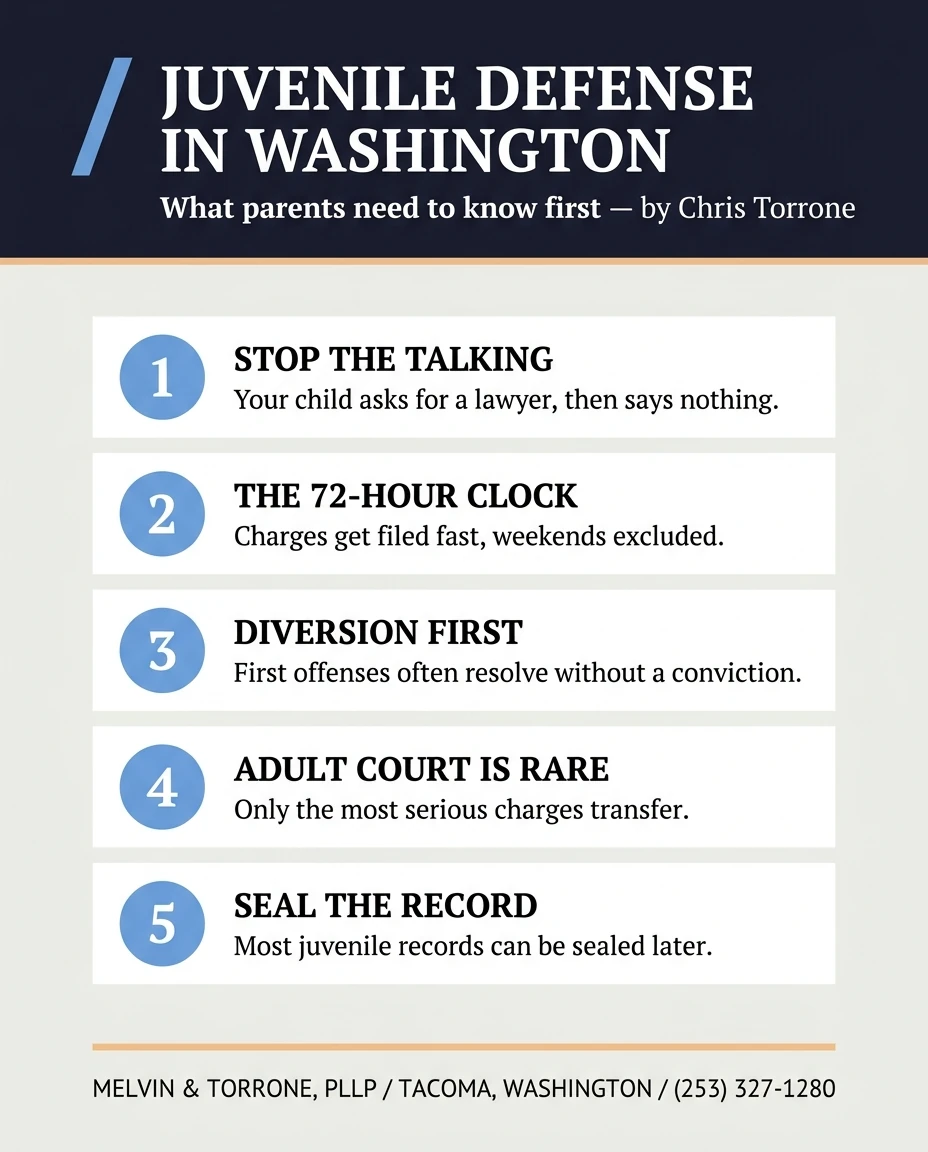
- Know the clock. The state has 72 hours, not counting weekends and holidays, to file charges or release your child, and a detention hearing follows on the same schedule. The law’s default favors release.
- Call a defense attorney before the first hearing. The earliest decisions in a juvenile case, including some made before any charge is filed, shape where it lands.
Each of these is covered in detail below, with the statute behind it.
What Washington Law Requires Before Police Can Question Your Child
Before your child can waive any constitutional right, law enforcement has to give them access to an attorney. Under RCW 13.40.740, that consultation cannot be waived. It has been the law since January 1, 2022, and it’s the most useful thing a parent can know on the first night.
Three situations trigger it. An officer questioning a juvenile during a custodial interrogation. An officer detaining a juvenile on probable cause of involvement in criminal activity. An officer asking a juvenile to consent to a search of the child, their property, their home, or a vehicle they control. The statute’s definition of a law enforcement officer expressly includes school resource officers, so a conversation in a school office is covered by the same rule as one in a patrol car.
Skipping the consultation has consequences. Statements taken in violation of the rule are not admissible in juvenile court or in adult criminal court. RCW 13.40.740 gives evidence obtained in violation of the consultation right the same treatment, with narrow exceptions.
Three things survive anyway. A statement made after your child actually consulted counsel and then gave an express, knowing, and voluntary waiver. A statement used to impeach your child’s later testimony. And anything your child says spontaneously, without being asked.
That last exception is where families get hurt. A frightened fifteen-year-old who starts explaining himself in the back of a patrol car isn’t protected by this statute. Neither is a phone call from detention. Tell your child to stop talking and ask for a lawyer.
You can’t make this decision for them either. Waiver of a right under the juvenile code has to come from the juvenile once the child is twelve or older, so a parent telling a child to cooperate doesn’t satisfy the statute and doesn’t protect the child.
Two narrow exceptions let an officer question without providing attorney access. One applies when the officer believes the juvenile is a trafficking victim, and anything learned that way cannot be used to prosecute that juvenile. The other applies to an imminent threat to someone’s life, and questioning is limited to what protecting that life requires.
The First 72 Hours If Your Child Is Held at Remann Hall
If your child is in custody, you’re on a statutory clock. RCW 13.40.050 gives the state 72 hours, excluding Saturdays, Sundays, and holidays, to file the information or release your child. A detention hearing on whether continued detention is necessary follows within another 72 hours on the same exclusion. Other sources describe this as a hearing by the end of the next court day. The statute is what governs.
Pierce County holds detained youth at the juvenile court complex known as Remann Hall, at 5501 6th Avenue in Tacoma. Detention, the diversion program, and the courtrooms share the same complex, so the hearing usually happens in the building where your child is being held.
The default at that hearing favors release. Even after the court finds the case properly before it, the statute directs release on personal recognizance unless the court finds detention necessary. When detention isn’t necessary, the court has to impose the most appropriate alternative instead. Those alternatives include placing your child with a designated supervising adult, travel restrictions, regular reporting to the juvenile court, or a requirement to return to detention during specified hours.
Walk in prepared for two of them. If you’re available, the court is required to consult you before deciding whether to detain or release. The supervision plan you can describe out loud becomes part of that record. Your child can also be released only to a responsible adult or to the department, so somebody has to be there in person.
How Pierce County Decides Whether to Charge or Divert
Nobody at the scene decides whether your child gets charged. Police refer the complaint to the prosecutor, and RCW 13.40.070 requires the prosecutor to screen it for two things. Whether the alleged facts fall within the court’s jurisdiction, and whether probable cause exists. The filing decision comes after that, and it falls into three buckets.
The prosecutor must file when the charge is a sex offense or a violent offense, with assault in the second degree and robbery in the second degree carved out. The prosecutor must divert when the case is legally sufficient, the offense is a misdemeanor, gross misdemeanor, or violation, and it’s your child’s first offense. Everything else is discretionary. There the statute lets the prosecutor weigh the length, seriousness, and recency of your child’s history along with the circumstances of the offense.
Age matters at the threshold too. Washington law makes children under eight incapable of committing a crime, and children from eight through eleven are presumed incapable unless the state proves the child understood the act and knew it was wrong. That presumption is the whole case in a young-child referral, and it’s frequently missing from summaries that say only that charges start at age eight.
Pierce County’s diversion program handles youth ages 8 through 17 with no prior criminal history arrested for offenses like trespassing, shoplifting, simple assault, possession of alcohol or marijuana, and malicious mischief. Community Accountability Boards hear the cases. The boards are staffed with screened, trained volunteers from the community where your child lives, and the superior court appoints them with three to seven members each. Your child, you, two or three board members, and a court consultant sit in the room together, usually in the evening.
Some Pierce County cases never touch the courthouse at all. The Washington State Minority and Justice Commission’s 2025 Statewide Youth Diversion Report describes Our Sisters’ House receiving referrals directly from the Pierce County Prosecuting Attorney’s Office through an online system. A youth can complete that diversion without a formal interaction with juvenile court or a probation counselor.
One finding in that report matters more than any other for a first case. Researchers at the Washington State Center for Court Research found that two or more prior referrals, regardless of the charge, is the strongest predictor of whether a youth receives a formal diversion. In Pierce County, among white youth facing a misdemeanor, the probability of a diversion agreement was 49 percent with one or fewer prior referrals and 20 percent with two or more. The same report documents that this drop isn’t the same size for every racial and ethnic group, and names Pierce County as a place where the difference can be measured with unusual confidence.
The practical meaning is straightforward. The first case is the one where the most doors are still open.
What a Diversion Agreement Actually Commits Your Child To
A diversion agreement is a contract, and Washington caps what can go in it. RCW 13.40.080 limits the agreement to some combination of up to 150 hours of community restitution, restitution capped at the victim’s actual loss, up to 10 hours of counseling, and up to 20 hours of positive youth development, restorative justice, or educational sessions. Community restitution cannot be performed during school hours. Counseling can go up to 30 hours if an assessment identifies a mental health or chemical dependency need.
The agreement can’t exceed six months. It can be extended by another six months only at your child’s request.
Parents are usually surprised that they don’t control this decision. A parent cannot decline a diversion agreement on a child’s behalf and can’t prevent a child from entering one. The right to counsel attaches before the first intake interview, not after, and your child can be represented at intake and at any termination hearing. Your child also keeps the right to refuse diversion and be referred to court at any point before signing.
In my practice the recurring pattern looks like this. A family gets a call about a first shoplifting referral. They arrive at intake relieved that it isn’t court, they sign in the room, and months later they learn the hours and the counseling condition were both negotiable within the statutory caps. Nothing improper happened. Nobody told them the intake was a stage where advocacy belongs.
The record question has a better answer than most parents fear. Under the definitions in the Juvenile Justice Act, a successfully completed diversion may not be considered part of your child’s criminal history. Pierce County’s own diversion brochure still tells families the opposite. The statute is the current law, and it’s worth asking your attorney to confirm how the local court is applying it.
Confidentiality is the other reason diversion matters, and it leads directly into something most families get wrong about juvenile court.
When a Washington Teenager Can Be Charged as an Adult
Much of what circulates online about this still describes the pre-2018 list. Today, only three things send a 16 or 17 year old to adult court automatically. Under RCW 13.04.030, juvenile court jurisdiction does not apply when the offense is a serious violent offense, a violent offense paired with a specific prior record, or rape of a child in the first degree.
That middle category is narrow and defined. It requires one or more prior serious violent offenses, or two or more prior violent offenses, or three or more of any combination of class A felonies, class B felonies, vehicular assault, and manslaughter in the second degree. All of them must have been committed after your child’s thirteenth birthday and prosecuted separately.
In 2018 the legislature passed Engrossed Second Substitute Senate Bill 6160, chapter 162 of the 2018 laws. It struck robbery in the first degree, drive-by shooting, burglary in the first degree with a prior offense, and any violent offense committed while armed with a firearm from the automatic list. Rape of a child in the first degree is the only named offense that survived. If you read that a first-degree robbery charge sends your 17 year old to adult court here, you’re reading something written before June 2018.
Even an automatic case has two doors. The prosecutor and your child can agree to juvenile court jurisdiction and move the proceeding back with the court’s approval. Juvenile court also keeps residual jurisdiction up to age 25 for the purpose of returning a case for disposition when your child turned 18 during the adult court proceedings.
A judge can also transfer a case after a decline hearing, and that door is narrower than families expect. RCW 13.40.110 allows a decline motion to be set only in three situations. Your child was at least 15 at the time of the offense and is charged with a serious violent offense. Your child was 14 or younger and is charged with murder in the first or second degree. Or your child is charged with custodial assault while already serving a minimum juvenile sentence to age 21. The judge transfers only on a finding that declination is in the best interest of the juvenile or the public, and those findings have to be in writing.
I’ll be direct about the limit of all this. If the charge as filed falls inside one of the automatic categories, no argument about your child’s maturity or family support changes the forum on day one. The work moves to the charge itself, which is a harder fight than a decline hearing.
What Sentencing Looks Like in Juvenile Court
For a first offense in most categories, the standard range isn’t confinement at a state facility. Washington sets juvenile dispositions on a grid. For a youth with no prior adjudications, the standard range across offense categories B and below is what the code calls local sanctions, according to the Caseload Forecast Council’s 2025 Juvenile Disposition Guidelines Manual.
Local sanctions has a precise definition. The juvenile code defines it as one or more of the following: zero to 30 days of confinement, zero to 12 months of community supervision, or zero to 150 hours of community restitution. The grid’s two axes are the current offense category and the number of prior adjudications. That’s another reason the first case carries so much weight.
Most families have never heard of the mechanism that comes next. RCW 13.40.127 makes a juvenile eligible for a deferred disposition unless the child is charged with a sex or violent offense, has any felony in their criminal history, has a prior deferred disposition or deferred adjudication, or has two or more adjudications. When your child is eligible, the statute creates a strong presumption that the deferred disposition will be granted. The case is then continued for up to a year while your child is on community supervision.
The trade deserves plain language. To get a deferred disposition, your child stipulates to the facts in the police report, acknowledges that the report will support a finding of guilt if they fail, and waives the right to a speedy disposition and the right to call and confront witnesses. When a case is genuinely defensible, giving all of that away can be the wrong trade. That judgment call is the reason to have counsel before the disposition date rather than at it.
One more thing to prepare for. Juvenile matters are decided by a judge rather than a jury, and the general public and press are permitted to attend any hearing unless the court closes it for good cause. The statute states a presumption that hearings will be open. In my experience families arrive expecting juvenile court to be confidential, and it’s one of the harder surprises to absorb in a hallway five minutes beforehand.
School, Records, and What Follows Your Child Afterward
Every consultation reaches the same two questions. Will the school find out, and how long does this follow my kid.
The court notifies a school only in specific circumstances. RCW 13.04.155 requires the court to notify the school district only for an adjudication involving a violent offense, a sex offense, a firearms crime under chapter 9.41, or unlawful possession or delivery of a controlled substance. It applies only where the person is 21 or younger and hasn’t received a high school diploma or its equivalent. What the district receives is exempt from public disclosure and cannot be passed along except as specifically allowed by law and by the federal student privacy statute. A shoplifting referral or a first minor-in-possession doesn’t trigger it.
On records, Washington moved to a mostly automatic system. At the disposition hearing, RCW 13.50.260 requires the court to schedule an administrative sealing hearing. It’s set for the first regular sealing date after the latest of your child’s eighteenth birthday, the anticipated end of probation, or the anticipated release or completion of parole. Your child doesn’t have to attend. The court seals the record if your child is off supervision for the case and has paid the restitution owed to the individual victim, excluding anything owed to an insurer.
Three categories are excluded from that automatic path: a most serious offense, a sex offense under chapter 9A.44, and a drug offense as defined in the sentencing reform act. Those require a motion later. By motion, class B, class C, gross misdemeanor, and misdemeanor offenses and diversions can be sealed after two consecutive years in the community without a new conviction. Class A offenses take five. If your child is acquitted after a fact-finding or the charges are dismissed with prejudice, the court seals the record immediately.
What sealing does deserves an exact statement. Once a record is sealed, the proceedings are treated as if they never occurred, and your child may answer accordingly to any inquiry about the events.
What This Costs You as the Parent, and When the Criminal Case Is Not the Only Case
Your own financial exposure sits outside your child’s case, and it’s easy to miss. RCW 4.24.190 makes a parent living with a minor child liable for up to $5,000 when the child willfully or maliciously destroys property or inflicts personal injury. In a shoplifting case, RCW 4.24.230 makes the parent or guardian of an unemancipated minor liable to the store for the retail value of the merchandise up to $1,425. Add a penalty of no less than $100 and no more than $650, plus the store’s reasonable attorney fees and court costs. A criminal conviction isn’t a prerequisite, which is why a demand letter from a retailer’s collection firm sometimes arrives while the juvenile case is still open.
One piece of good news is genuinely current. Washington used to require parents to pay toward the costs of their child’s support, treatment, and confinement under RCW 13.40.220. The legislature repealed that statute in 2022. An older article telling you the state will bill you for detention is describing a law that no longer exists.
One more reason my firm handles both criminal defense and family law shows up right here. A single incident involving a teenager frequently produces more than one legal proceeding at the same time. A juvenile offender case can arrive alongside a CPS referral, a change to a parenting plan, or a protection order petition. Those proceedings run on different standards of proof, with different rules about what you and your child can be asked.
The composite I see most often involves separated parents. Something happens at one house, an assault referral goes to the prosecutor, and a motion to modify residential time is filed the same month. A statement made to smooth over the family law side can land in the criminal file. A defense strategy built without knowing about the parenting plan can create a problem in front of a different judge. Tell whoever is defending your child about every open family matter at the first meeting, including the ones that feel unrelated.
Frequently Asked Questions
Can my child be charged as an adult in Washington?
Only in narrow circumstances. A 16 or 17 year old goes to adult court automatically for a serious violent offense, a violent offense paired with a specific prior record, or rape of a child in the first degree. A judge can also transfer a case after a decline hearing, but a decline motion can be set in only three situations defined by statute. Robbery in the first degree and drive-by shooting came off the automatic list in 2018.
Does my child need a lawyer if the case is going to diversion?
The right to counsel attaches before the first diversion intake interview, and your child can be represented at intake and at any termination hearing. Diversion conditions are negotiable within the statutory caps, and the intake is where that negotiation happens. Nothing in the process requires a family to know the caps in advance, which is why the intake is worth preparing for.
Will a juvenile record follow my child for life in Washington?
Usually not, for most offenses. The court schedules an administrative sealing hearing at disposition, timed to the latest of your child’s eighteenth birthday, the end of probation, or release from custody. Most serious offenses, sex offenses, and drug offenses are excluded from that automatic path and require a later motion. Once a record is sealed, the proceedings are treated as if they never occurred.
Can I be made to pay for what my child did?
You can be sued civilly for up to $5,000 for willful or malicious property damage or injury. A store can separately pursue you in a shoplifting case for the merchandise value up to $1,425, plus a penalty and its attorney fees. Washington repealed the statute that required parents to pay toward detention and treatment costs in 2022.
How long does a juvenile case take in Pierce County?
Pierce County filed 544 juvenile offender cases in 2025 and resolved 560, according to the state’s annual caseload report. About 61 percent were resolved within four months, 78 percent within six months, and 91 percent within nine months. The state time standard recommends 90 percent within four months.
About the Author
Chris Torrone is a founding partner at Melvin & Torrone, PLLP in Tacoma, Washington. He has spent more than two decades representing families in Pierce County courtrooms across both criminal defense and family law, including juvenile offender matters at Remann Hall. The firm was formed by combining an established criminal defense practice with an established family law practice, which is why its attorneys handle the overlapping proceedings a single incident can set off. Melvin & Torrone, PLLP serves Tacoma and the surrounding communities of Pierce, Kitsap, Thurston, and Lewis counties.
If your child has been arrested in Pierce County and you want to understand the options, our juvenile defense practice handles these cases every week. Request a consultation.
The client stories in this article are illustrative composites based on common situations; they do not describe specific clients or promise any particular result. This article is attorney advertising and shares general information only, not legal advice. Reading it or contacting Melvin & Torrone, PLLP does not create an attorney-client relationship. Every situation is different, so talk with a licensed attorney about yours.
Sources
- RCW 13.04.030, Juvenile court, exclusive original jurisdiction, exceptions
- RCW 13.04.155, Notification to designated recipient of adjudication or conviction
- RCW 13.40.020, Definitions
- RCW 13.40.050, Detention procedures
- RCW 13.40.070, Complaints, screening, filing information, diversion
- RCW 13.40.080, Diversion agreement
- RCW 13.40.110, Hearing on question of declining jurisdiction
- RCW 13.40.127, Deferred disposition
- RCW 13.40.140, Juveniles entitled to usual judicial rights
- RCW 13.40.740, Juvenile access to an attorney
- RCW 13.50.260, Sealing hearings, sealing of records
- RCW 4.24.190, Action against parent for willful injury to person or property by minor
- RCW 4.24.230, Liability for conversion of goods from a store, adults, minors, parents
- RCW 9A.04.050, People capable of committing crimes, capability of children
- RCW 13.40.220 disposition, repealed by 2022 c 145 s 2
- Engrossed Second Substitute Senate Bill 6160, Chapter 162, Laws of 2018
- Pierce County Juvenile Court, Diversion Program handout
- Washington State Minority and Justice Commission, Statewide Youth Diversion Report 2025
- Caseloads of the Courts of Washington, Juvenile Offender Case Management Statistics, 2025 Annual Report
- Washington State Caseload Forecast Council, 2025 Juvenile Disposition Guidelines Manual

Chris Torrone
Founding Partner, Melvin & Torrone PLLP
Chris Torrone is a dedicated advocate for clients facing family crises and criminal charges. With 20 years of experience practicing in Pierce County courts, Chris has built a reputation for meticulous case preparation and creative problem-solving in high-stakes litigation.