
Felony vs. Misdemeanor in Washington: What Your Charge Actually Means
Felony vs. Misdemeanor in Washington: What the Classification Actually Decides
If you were arrested this week and nobody has told you what you’re actually charged with, you haven’t missed anything yet. In Washington, the felony vs. misdemeanor line gets drawn after the arrest, by a deputy prosecuting attorney who reads the police report, applies a written filing standard, and decides on a clock measured in hours. The word the officer used at the scene describes a suspected offense, and the charging document is separate. It may or may not follow.
That single decision sets your maximum exposure, the size of the fine, which courthouse you report to, and what a conviction does to your rights years after the sentence ends. I’ve handled criminal cases in Pierce County courtrooms since I opened Torrone Law in 2011, and the thing most people in that pre-charge stretch don’t realize is that a decision is still being made about them.
Torrone’s Takeaways
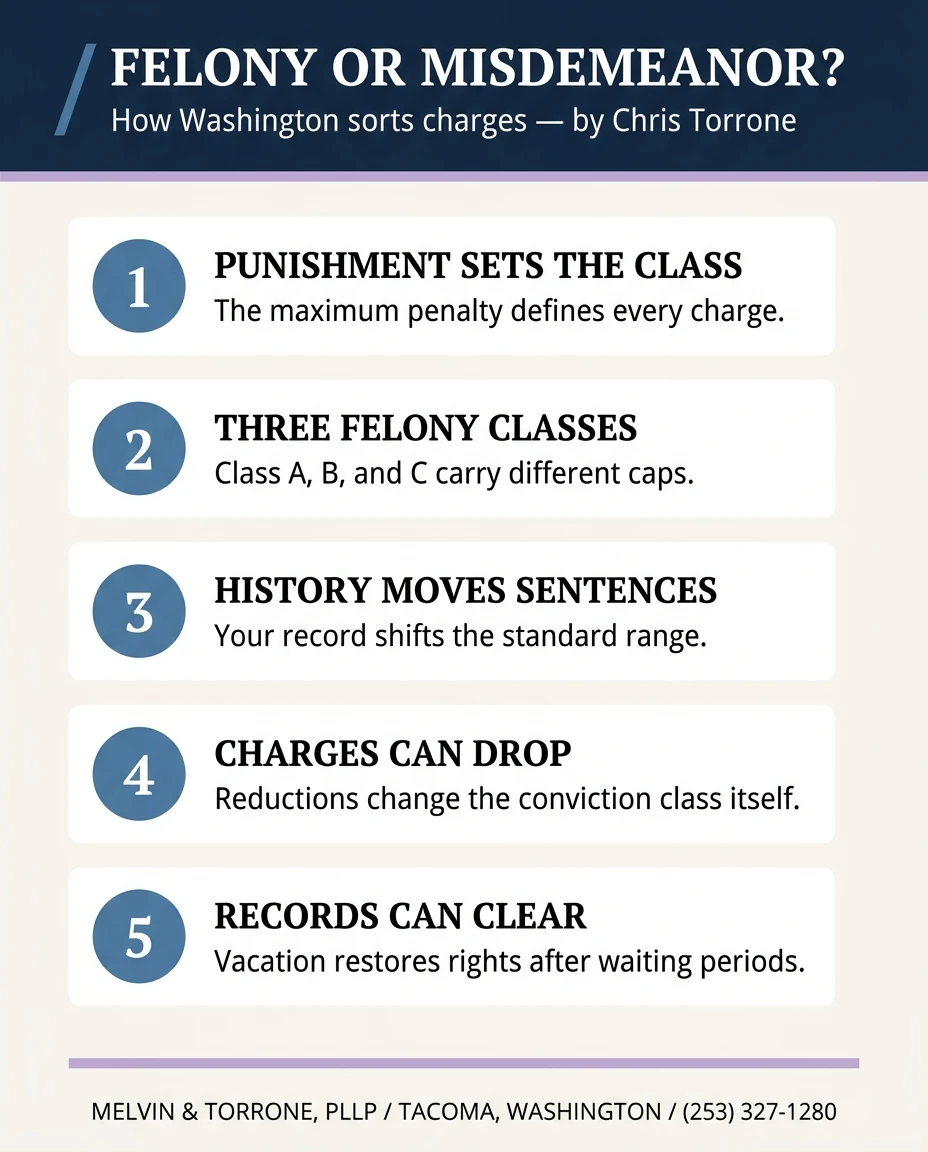
- Washington has five levels, and each one states a maximum, not a likely sentence. A gross misdemeanor tops out at 364 days and a $5,000 fine. A class C felony tops out at five years.
- A deputy prosecuting attorney decides the classification, not the arresting officer, and the decision is often still open for the first few days.
- Nobody can be held or kept on release conditions past 72 hours without a filed charge, and weekends and holidays don’t count toward those 72 hours.
- Being released without charges doesn’t end anything. The state can still file later, within the statute of limitations.
- The felony sentencing grid, not the statutory maximum, produces the actual range. At the bottom of the grid with no criminal history, that range is measured in days.
- Since January 1, 2022, a Washington felony conviction suspends your right to vote only while you’re in total confinement. You can vote on community custody.
- Washington vacates convictions rather than expunging them. Class C waits five years, class B waits ten, misdemeanors wait three, and DUI never qualifies.
Table of Contents
- Torrone’s Takeaways
- What to Do in the First 72 Hours
- The Five Levels: Misdemeanor, Gross Misdemeanor, and Three Felony Classes
- Who Actually Decides Whether It Is a Felony
- The Sentencing Grid: How a Felony Class Becomes an Actual Sentence Range
- Which Court Your Case Lands In, and Why It Matters in Pierce County
- What a Conviction Costs After the Sentence Ends
- Can You Get It Off Your Record? Washington Calls It Vacating
- Where This Leaves You
- Frequently Asked Questions
What to Do in the First 72 Hours
The pre-charge window is the only stretch of a criminal case where the charge doesn’t exist yet, and what happens during it shapes the record everything else gets built on. What follows is general information about how these cases work in Washington, not advice about any particular case.
- Talk about the incident only with a lawyer. Statements to the arresting officer, to a detective who calls a week later, or to a friend who was there can all end up in a report.
- Treat every jail phone call as recorded and every jail visit as monitored. Calls with your attorney are protected by attorney-client privilege. Calls with your brother are evidence.
- Write down your own timeline while it’s fresh. Times, locations, who was present, what was said, and what you were doing before and after.
- Leave the complaining witness alone, directly and through other people. Where a no-contact order is already in place, a text message asking to talk can become a separate criminal charge.
- Understand what consent does. Consent is one of the ways a search happens without a warrant, and whether it was given, and how, often becomes a contested issue later.
- Find out whether a charging document has actually been filed, and in which court. The paperwork you were handed at release will name a courthouse and a date.
- Know that the timing of counsel matters. Whether a defense attorney is involved before or after the first appearance changes what can still be done with the file.
That last one matters more than it sounds. Once a charge is filed, the work shifts to defending it, and before it’s filed a defense attorney can sometimes bring context, records, or a witness account to the filing prosecutor while the decision is still open.
That window is short. It’s often already closed by the time someone calls me, and nobody in the prosecutor’s office is required to listen to what gets brought in. The alternative is learning what happened only after the charging decision has been made.
The Five Levels: Misdemeanor, Gross Misdemeanor, and Three Felony Classes
Washington sorts crimes into five levels, and the number attached to each level is the maximum that level allows. Under RCW 9A.20.021, which sets the maximum term and fine for each class of crime defined in Washington’s criminal code, those maximums run as follows.
| Level | Maximum confinement | Maximum fine | Where served |
|---|---|---|---|
| Misdemeanor | 90 days | $1,000 | County jail |
| Gross misdemeanor | 364 days | $5,000 | County jail |
| Class C felony | 5 years | $10,000 | State correctional institution |
| Class B felony | 10 years | $20,000 | State correctional institution |
| Class A felony | Life | $50,000 | State correctional institution |
Two things about those numbers matter as much as the numbers. Each level is written as confinement, or a fine, or both, so a court can impose either one alone or the two together up to the maximum for that class. And the maximum belongs to the class, which is why two people charged with entirely different class C felonies read the same five-year figure, though the statute defining a particular crime can set a different maximum of its own.
The 364-day figure has a specific reason behind it. The legislature cut the gross misdemeanor maximum by exactly one day in 2011, and the findings note published with that bill says why. A maximum sentence of a full year could, under federal law, trigger automatic deportation of a lawfully present immigrant, a domestic violence victim, or a political refugee, even when all or part of the sentence to total confinement is suspended. That one day is the whole difference for a person whose immigration status is on the line.
Two smaller rules fill in the gaps. Under RCW 9A.20.010, any crime that’s neither a felony nor a misdemeanor is a gross misdemeanor, and the statute defining each felony states its own class. A judge doesn’t assign it later. The fines listed above apply to adult offenders only.
Read those numbers as the top of the range. A class C felony carries a five-year maximum, and what a court can actually impose in a particular case comes out of the sentencing grid covered below, which builds a standard range from the seriousness of the offense and the person’s criminal history.
Who Actually Decides Whether It Is a Felony
A deputy prosecuting attorney decides, working from a written evidentiary standard and a court-rule deadline. The arresting officer books you on a suspected offense and forwards a report. Under RCW 36.27.020, the county prosecuting attorney appears for and represents the state and prosecutes people charged with felonies, and no charge exists until that office files a document called an information.
The deadlines come from CrR 3.2.1, the superior court rule governing preliminary appearances:
- A person arrested without a warrant gets a judicial determination of probable cause no later than 48 hours after arrest. Weekends and holidays can count toward those 48 hours.
- A detained person must be brought before the superior court as soon as practicable, and in any event before the close of business on the next court day.
- Absent a filed information or indictment, or the person’s own consent in writing or on the record, nobody can be held in jail or kept on conditions of release for more than 72 hours. Weekends and holidays don’t count toward those 72 hours.
- If nothing is filed by that deadline, the person is released from jail and any release conditions come off.
Work a Friday night arrest through that and the picture changes. The probable cause review can happen over the weekend, but the 72-hour filing clock stops running Saturday and Sunday, so a Friday booking can put the filing deadline in the middle of the following week. Families sit through four days assuming the case is dead, and then the information gets filed on Wednesday.
Walking out of the jail without charges doesn’t end the case. The prosecutor can still file later, any time within the statute of limitations for the offense. What expired was the deadline on your detention. The deadline on the charging decision is measured in years.
The filing standard itself is public, and it sets two different bars depending on the crime. Under RCW 9.94A.411, the state’s prosecuting standards separate crimes against persons from everything else. For a crime against persons, the prosecutor files if the evidence would convince a reasonable and objective fact finder to convict even after the defense puts up its most plausible argument. For a property crime or anything else, the bar is higher, because that same weighing has to make conviction probable.
The crimes-against-persons list is broader than most people assume, covering assault in the third degree, assault in the fourth degree in one subsection, vehicular assault, vehicular homicide, robbery in both degrees, hate crime, and intimidating a witness.
The same statute lets a prosecutor decline to file even when the evidence is technically sufficient, where prosecution would serve no public purpose, would defeat the purpose of the law, or would decrease respect for the law. It lists examples, including a violation too technical or insubstantial to matter, a complaining witness acting from improper motives, and a victim who asks the office to drop a case involving little or no injury or a non-violent property loss. That discretion is written into the statute, which is why the pre-charge window is worth using.
The Sentencing Grid: How a Felony Class Becomes an Actual Sentence Range
For a classified felony, the sentence comes out of a grid. The statutory maximum from the last section marks the outer edge, and the grid sets the standard sentence range the court works inside. Washington’s Sentencing Reform Act builds that range from two axes, a seriousness level assigned to the offense that runs from I at the bottom to XVI at the top, and an offender score from 0 to 9 or more built from criminal history. Find the row and the column, and the cell is your standard range.
A few real cells from RCW 9.94A.510, the sentencing grid, all at an offender score of 0:
| Seriousness level | Standard range, offender score 0 |
|---|---|
| Level I | 0 to 60 days |
| Level II | 0 to 90 days |
| Level III | 1 to 3 months |
| Level IV | 3 to 9 months |
| Level XV | 240 to 320 months |
The grid uses months, except in a few low cells that use days, and a cell reading 12+ means one year and one day. The offender score is where criminal history enters the calculation, and it’s the axis that usually moves most between two people charged with the same offense.
So a class C felony carries a five-year maximum in the code, while a level I offense with no criminal history sits in a standard range topping out at 60 days. I’ve watched people arrive at a first consultation having read the five-year number online and braced themselves for it, when the grid for their actual offense and history stopped well under two months. I’ve also had the opposite conversation, where the offense looked minor and the offender score was the real problem, and nobody had told them that either.
The counterweight is just as real. The grid climbs fast as the offender score rises, so a third or fourth felony at the same seriousness level is a different conversation entirely.
Many felony sentences to Department of Corrections custody also carry mandatory supervision after release. Under RCW 9.94A.701, community custody runs three years for most sex offenses and for serious violent offenses, 18 months for a violent offense that doesn’t meet the serious violent definition, and one year for a crime against persons or a felony drug offense. A short standard range can still carry years of supervision behind it, which is worth understanding before anyone makes decisions about a serious felony charge.
Which Court Your Case Lands In, and Why It Matters in Pierce County
The classification routes the case. Felonies go to superior court. Misdemeanors and gross misdemeanors go to a court of limited jurisdiction, which in practice means a municipal or district court. Which specific courthouse you report to depends on where the alleged conduct happened and which office files the paperwork. In the Pierce County courts I appear in, that routing usually looks like this:
- Any felony filed in the county goes to Pierce County Superior Court
- A city case arising in Tacoma goes to Tacoma Municipal Court
- A city case arising in Lakewood goes to Lakewood Municipal Court
- A city case arising in Puyallup goes to Puyallup Municipal Court
- Misdemeanors from unincorporated county areas go to Pierce County District Court
That’s the practical routing, and it isn’t something you can look up in a single statute. The paperwork you were handed at release is the reliable answer for your own case. One consequence is that identical conduct in two neighboring places can be handled by two different prosecuting offices that file differently and run on different schedules. A gross misdemeanor in municipal court is a genuinely different experience from a felony in superior court, even when the underlying facts look similar on paper.
The consequence that hits families hardest is quieter. A domestic violence gross misdemeanor can be running in a municipal court at the same time a parenting plan is moving through superior court, in front of judges who never speak to each other. The no-contact order entered in the criminal case will shape what’s possible in the family case, including where you sleep and when you see your children.
A pattern I warn families about, drawn from cases like many we handle: the order out of one courthouse and the parenting plan out of the other say two different things, and someone ends up sleeping in his car until the two get reconciled. Our firm handles the criminal side and the family side together for exactly that reason.
What a Conviction Costs After the Sentence Ends
Start with the point a lot of published material still gets wrong. Under RCW 29A.08.520, as amended by House Bill 1078, chapter 10 of the 2021 session laws, effective January 1, 2022, the right to vote is automatically restored after a Washington felony conviction as long as the person is not serving a sentence of total confinement under Department of Corrections jurisdiction. Someone on community custody can vote. Jail imposed as a sanction for a community custody violation does not count as total confinement either.
If your registration was cancelled while you were confined, you’ve to reregister before you vote.
That replaced an older rule requiring a court to restore the right, and plenty of pages published since 2022 still describe the old version. A misdemeanor conviction doesn’t affect voting rights at all, because the restoration statute is triggered only by a felony.
Here is what a conviction does to the rest of your life:
- Jury service. Under RCW 2.36.070, a person convicted of a felony is not competent to serve as a juror until civil rights are restored.
- Firearms, felony side. RCW 9.41.040 makes unlawful possession of a firearm in the first degree a class B felony when the person has a prior serious offense, and second-degree unlawful possession covers any other felony.
- Firearms, misdemeanor side. That same statute also strips firearm rights after a listed set of misdemeanor and gross misdemeanor domestic violence, stalking, harassment, and protection-order offenses. Losing your firearm rights doesn’t require a felony.
- Firearm restoration. Under RCW 9.41.041, a petition becomes available after five consecutive years in the community without a conviction for any crime that prohibits firearm possession, and three years for other nonfelony crimes. No petition is available at all after a felony sex offense, a class A felony, or a felony carrying a maximum of at least 20 years.
- Professional licensing. Licensing boards make this call. Nursing, real estate, insurance, commercial driving, and childcare each set their own rules about what a conviction triggers, and the sentencing court has no say in them.
Sex offense classifications live in chapter 9A.44 RCW. Rape in the first and second degree and rape of a child in the first and second degree are class A felonies. Rape in the third degree and rape of a child in the third degree are class C. Child molestation runs class A, B, or C by degree. Those classifications drive registration and restoration questions for decades.
Can You Get It Off Your Record? Washington Calls It Vacating
Sometimes. There’s a waiting period, and some convictions can never be cleared at all. Washington doesn’t use the word expungement for this. It vacates a conviction, and the eligibility rules sit in two separate statutes depending on which side of the felony line you’re on.
For misdemeanors and gross misdemeanors, RCW 9.96.060 sets the conditions:
- Three years must have passed since the later of release from supervision or probation, release from total and partial confinement, or the sentencing date
- No new conviction in the three years before you apply
- All terms of the sentence complete, including financial obligations
- No criminal charges pending against you in any state, federal, or tribal court
- Domestic violence offenses run on a five-year clock measured from when you completed the original conditions of the sentence, including any ordered treatment, and they carry additional conditions
For felonies, the path runs through RCW 9.94A.640 and starts one step earlier:
- A certificate of discharge under RCW 9.94A.637 comes first, issued once every requirement of the sentence including all legal financial obligations is complete. If one doesn’t issue on its own, you can file a motion asking for it.
- A class C felony waits five years, measured from the later of release from community custody, release from full and partial confinement, or the sentencing date, with no new conviction anywhere in those five years
- A class B felony waits ten years, measured the same three ways, with no new conviction anywhere in those ten years
- No charges may be pending against you in any court when you apply
Then the exclusions, which are where most people find their answer:
- The statute provides waiting-period paths for class B and class C felonies only, so a class A felony has no route to vacation
- Felony DUI and felony physical control can’t be vacated, and neither can misdemeanor DUI or physical control
- Violent offenses and crimes against persons are barred, with a narrow carve-out for three offenses:
- Assault in the second degree
- Assault in the third degree, when not committed against a law enforcement or peace officer
- Robbery in the second degree
- Each of those three only where no firearm, deadly weapon, or sexual motivation enhancement applied
- Misdemeanor and gross misdemeanor offenses under the obscenity, sexual exploitation of children, and sex offense chapters are barred, except failure to register
Most people who call me about clearing a record find their answer somewhere in that exclusions list, and I would rather tell them in ten minutes than have them spend a year assuming.
Three caveats sit alongside all of it. Vacation is discretionary, so the statute says the court may vacate once you clear every bar, not that it will. Vacating a conviction doesn’t restore firearm rights on its own, and that runs through a separate petition under a separate statute. And a conviction vacated on or after July 28, 2019 still counts as a prior conviction for charging a later recidivist offense that itself occurs on or after that date.
What you get is substantial. Once your conviction is vacated, the penalties and disabilities from the offense come off, and you can answer no when a job application asks whether you’ve been convicted of that crime.
Where This Leaves You
Two people can be arrested on the same block on the same night, on facts that look nearly identical to anyone watching, and end up with a gross misdemeanor filed against one and a class C felony filed against the other. What separates those two files is which subsection the conduct fits, whether the alleged offense sits on the crimes-against-persons list with its lower filing bar, what the police report actually documents, and what the filing prosecutor knew when the deadline arrived.
Three things are worth holding onto while your own case is still moving:
- The classification sets your maximum exposure, which courthouse you report to, and what follows the sentence, and it gets decided after the arrest
- The filing decision is the only part still genuinely open in the first days
- Every deadline in here is already running, whether or not anyone has explained it to you
If you or someone in your family is sitting in that gap right now, bring the paperwork and the timeline to someone who works these courts. You can book a free consultation with Melvin & Torrone, PLLP, or call the office at (253) 327-1280.
Frequently Asked Questions
How long can police hold you in Washington before charges are filed?
Seventy-two hours, and weekends and holidays don’t count toward that total. Under CrR 3.2.1(f)(1), nobody can be detained in jail or held to conditions of release beyond 72 hours without a filed information or indictment, unless the person consents. If nothing is filed by the deadline, the person is released and the release conditions come off. The state can still file later within the statute of limitations.
Can a felony charge be reduced to a misdemeanor in Washington?
The charging decision belongs to the prosecuting attorney, and RCW 9.94A.411 gives that office written discretion over it, including discretion to decline a case where the evidence is technically sufficient but prosecution would serve no public purpose. Nothing in the statutes entitles anyone to a reduction, and no lawyer can tell you what a particular office will do with a particular file. What a defense attorney can do is put the facts, the records, and the legal issues in front of the person making that decision.
Do you lose your right to vote for a felony in Washington?
Only while serving a sentence of total confinement under Department of Corrections jurisdiction. Once you’re out, the right is automatically restored under RCW 29A.08.520, including while you’re on community custody. Jail imposed as a sanction for a community custody violation does not count as total confinement. If your registration was cancelled while you were confined, reregister before you vote.
Is a DUI a felony or a misdemeanor in Washington?
Most Washington DUIs are gross misdemeanors, which means up to 364 days in jail and a fine of up to $5,000. RCW 46.61.502 makes it a class B felony when the person has three or more prior offenses within 15 years, or a previous conviction for vehicular homicide or vehicular assault while under the influence, or a previous felony DUI.
Which one your case is depends on what’s actually on your driving record, and that’s the first document to pull. Either way, neither version can be vacated. A Tacoma DUI defense attorney can read the abstract with you.
What’s the difference between a gross misdemeanor and a misdemeanor?
A gross misdemeanor carries up to 364 days in county jail and a fine of up to $5,000. A plain misdemeanor caps at 90 days and $1,000. The odd 364 exists because the legislature shaved one day off the maximum in 2011 so that a suspended gross misdemeanor sentence wouldn’t trigger automatic federal deportation consequences.
How long before I can vacate a misdemeanor in Washington?
Generally three years, measured from the later of release from supervision or probation, release from total and partial confinement, or the sentencing date. You also need no new conviction in the prior three years, every sentence term including financial obligations complete, and no charges pending anywhere. Domestic violence offenses use a five-year clock, and DUI convictions never qualify.
About the Author
Chris Torrone is the Founding Partner of Melvin & Torrone, PLLP, in Tacoma, Washington. He founded Torrone Law in 2011 and later merged the practice with Rob Melvin’s to form Melvin & Torrone, PLLP, where the firm handles criminal defense and family law together for clients across Pierce, Kitsap, Thurston, and Lewis counties. His practice regularly involves cases in Pierce County Superior Court and the county’s municipal and district courts. The office is at 950 Pacific Ave, Suite 720, Tacoma, WA 98402, and the phone number is (253) 327-1280.
Sources
- RCW 9A.20.010, Classification and designation of crimes
- RCW 9A.20.021, Maximum sentences for crimes committed July 1, 1984, and after
- CrR 3.2.1, Procedure following warrantless arrest, preliminary appearance
- RCW 9.94A.411, Evidentiary sufficiency
- RCW 36.27.020, Duties of prosecuting attorney
- RCW 9.94A.510, Table 1, Sentencing grid
- RCW 9.94A.701, Community custody, offenders sentenced to the custody of the department
- Chapter 9A.44 RCW, Sex offenses
- RCW 46.61.502, Driving under the influence
- RCW 29A.08.520, Felony conviction, restoration of voting rights
- RCW 2.36.070, Qualification of juror
- RCW 9.41.040, Unlawful possession of firearms, penalties
- RCW 9.41.041, Unlawful possession of firearms, restoration of right to possess
- RCW 9.94A.637, Discharge upon completion of sentence, certificate of discharge
- RCW 9.94A.640, Vacation of offender’s record of conviction
- RCW 9.96.060, Vacating records of conviction for misdemeanor and gross misdemeanor offenses
The client stories in this article are illustrative composites based on common situations; they do not describe specific clients or promise any particular result. This article is attorney advertising and shares general information only, not legal advice. Reading it or contacting Melvin & Torrone, PLLP does not create an attorney-client relationship. Every situation is different, so talk with a licensed attorney about yours.

Chris Torrone
Founding Partner, Melvin & Torrone PLLP
Chris Torrone is a dedicated advocate for clients facing family crises and criminal charges. With 20 years of experience practicing in Pierce County courts, Chris has built a reputation for meticulous case preparation and creative problem-solving in high-stakes litigation.