
What to Do When CPS Shows Up at Your Door: A Guide for Washington Parents

A knock from Child Protective Services is one of the most frightening moments a parent can face. If a caseworker is on your porch right now, take a breath. A CPS investigation is not the same as losing your children, and the calm, measured choices you make in the next few minutes carry more weight than almost anything that happens later.
I have spent more than two decades representing Washington parents in child welfare and dependency cases. The same hard lesson comes up again and again: good parents get into trouble not because they did something wrong, but because no one told them the rules. This guide covers why CPS is at your door, your rights in that moment, what the Department of Children, Youth, and Families (DCYF) can and cannot do, and where a case can go from here.
Torrone’s Takeaways
- You generally do not have to let a caseworker into your home without a court order, a warrant, or law enforcement responding to an emergency.
- You can decline to answer questions on the spot and ask to speak with an attorney first.
- CPS and law enforcement run separate assessments, and information about a possible crime gets shared with police.
- A child can be removed only when there is probable cause of imminent physical harm, not on a hunch.
- CPS can interview your child at school outside your presence, with parent notice rules that apply to investigations.
- If a child is removed, a court must hold a shelter care hearing within 72 hours, excluding weekends and holidays.
- You have the right to an attorney in a dependency case, appointed at public expense if you cannot afford one.
Table of Contents
- Torrone’s Takeaways
- Why CPS Is at Your Door in the First Place
- Your Legal Rights the Moment CPS Arrives
- The First Few Minutes Matter Most
- Costly Mistakes Washington Parents Make
- How a Washington CPS Investigation Works
- What Happens If CPS Wants to Remove Your Child
- When a Case Becomes a Dependency Action
- Conclusion
- Frequently Asked Questions
- Legal Disclaimer
- Sources
Why CPS Is at Your Door in the First Place
Someone reported a concern, and by the time a caseworker reaches your porch, a process has already run without you. Most parents assume a neighbor called out of spite. That happens, but the larger share of reports come from professionals who are legally required to make them.
Under Washington’s mandatory reporting law, RCW 26.44.030, teachers, school staff, doctors, nurses, counselors, and other professionals must report when they have reasonable cause to believe a child has been abused or neglected. They do not need proof. A reasonable suspicion is enough, and the report must be made within 48 hours.
DCYF then decides whether the report meets the legal threshold for a response. DCYF Intake screens more than 100,000 calls a year, and the funnel narrows fast. In 2025, the department logged 122,222 reports, screened in 43,311 for a response, and saw 60,636 children face to face. Before anyone drove to your street, a supervisor reviewed the report, weighed the risk, and assigned a pathway.
High-Risk and Lower-Risk Reports Are Handled Differently
Once a report is accepted, RCW 26.44.030 routes it to one of two tracks: a full Child Protective Services investigation, or a Family Assessment Response (FAR). High-risk allegations involving serious physical harm or immediate danger go to investigation. Lower-risk situations involving neglect or family stress often go the FAR route, which is collaborative and services-focused rather than adversarial and ends without naming anyone as a perpetrator. Knowing which track your case is on tells you a great deal about what comes next.
Your Legal Rights the Moment CPS Arrives
You have more rights in this moment than most parents realize, and exercising them is not an admission that you did anything wrong.
You Can Decline to Let Them Inside
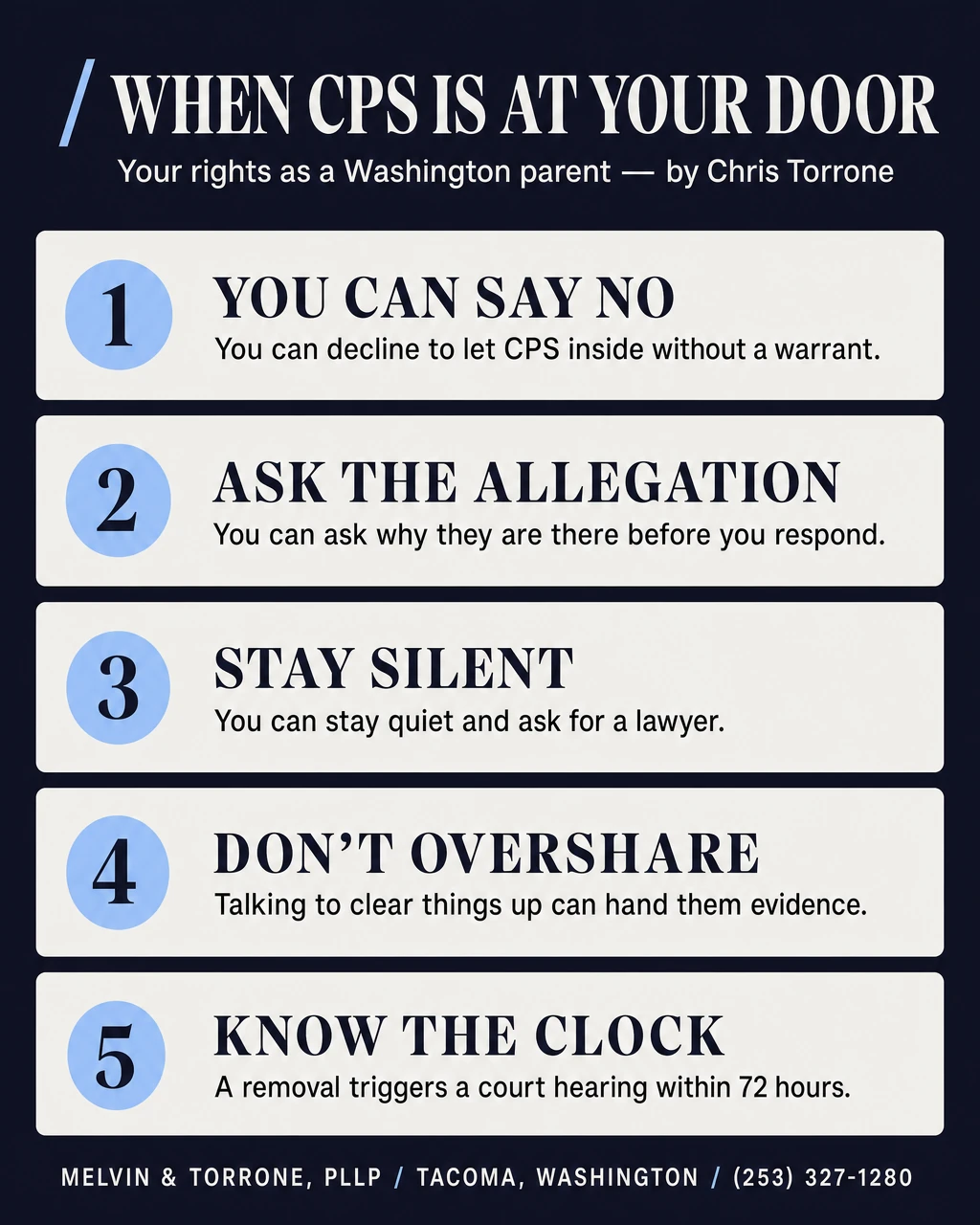
A CPS investigator generally cannot enter your home without your consent, a court order or warrant, or law enforcement acting on an emergency. Politely saying “I do not consent to you coming inside” is your right, and it is not obstruction. It does not make you look guilty, and it does not escalate the case by itself.
You Can Ask Why They Are There
You have the right to ask the caseworker to explain the general nature of the report. You do not have to guess what triggered the visit. Ask directly, listen, and write down what they tell you before you respond.
You Can Stay Quiet and Ask for a Lawyer
You are not required to answer a caseworker’s questions on the spot. You can say, “I would like to speak with an attorney before I answer any questions.” This is the right I most wish parents knew about, because CPS and law enforcement conduct separate assessments, and DCYF forwards information about a potential crime to law enforcement. What you say at the door can reach a criminal investigation, so a few careful words now protect you later.
What CPS Cannot Do at Your Door
A caseworker cannot force entry, cannot take your child on their own authority, and cannot pressure you into signing documents on the spot. They also cannot promise that full cooperation will make the case disappear. Removal is a high bar in Washington: under RCW 26.44.050, a law enforcement officer may take a child into protective custody without a court order only when there is probable cause that it is necessary to prevent imminent physical harm. A concern or an unproven allegation does not meet that standard.
| Situation | Your right as a parent | What CPS can do |
|---|---|---|
| Caseworker at your door | Decline entry without a warrant or court order | Ask to come in and ask questions from outside |
| The allegations | Ask for the general nature of the report | Share the general nature, not every detail |
| Your children at home | Keep your children inside without inviting the caseworker in | Ask to see the children to confirm they are safe |
| Caseworker’s questions | Decline to answer and ask to consult an attorney first | Note your decision in the case file |
| Children at school | For investigations, be notified at the earliest point that will not jeopardize the child (RCW 26.44.030) | Interview your child outside your presence |
| Signing documents | Decline to sign anything without legal advice | Present documents, including a voluntary placement agreement |
| Entry with law enforcement | Ask whether a warrant exists before stepping aside | Enter with law enforcement if imminent danger is established |
| A founded finding | Request a review within 30 days (RCW 26.44.125) | Record the finding in the department’s system |
The First Few Minutes Matter Most
What you do in the opening minutes shapes the rest of the case. Confirm who you are dealing with before anything else. Ask for the caseworker’s full name, agency identification, and the DCYF office they work from. You can call the statewide DCYF intake line at 1-866-363-4276 to verify before you say another word.
Keep your first words simple and steady. A few short phrases will carry you through the doorway conversation:
- “May I see your identification, please?”
- “What is the general nature of your visit?”
- “I would like to speak with an attorney before I answer questions.”
- “I do not consent to entry at this time.”
That is enough for the first encounter. A common situation I see is a parent who answers the door wanting to help and, within a few minutes, has volunteered information about an old conflict or a past struggle the caseworker did not arrive knowing. Cooperation feels safe in the moment. It can also hand the investigation material it did not have.
If a caseworker asks to see your children to confirm they are safe, you can bring a child to the door or to a window without inviting the caseworker inside. Keep it brief and calm, and stay with your child the whole time.
Costly Mistakes Washington Parents Make
Letting Them In to “Clear Things Up”
I hear this one constantly: “I had nothing to hide, so I let them in.” Once a caseworker is inside, they are trained to observe everything, from what is in the refrigerator to where the children sleep. What looks ordinary to you can read differently in a report. Letting them in rarely clears things up; it usually opens a longer chapter.
Oversharing Before Talking to a Lawyer
Volunteering details about a past substance use issue, an old domestic violence incident, or a mental health treatment program gives a caseworker context they did not arrive with. They are trained, prepared, and looking for patterns. You do not owe them your history in the first conversation.
Assuming a False Report Will Disappear
Another common situation I see is a parent who is certain a false report will fall apart on its own, so they wait. The case keeps moving while their side never gets documented. A false allegation still needs an active response, because a founded finding in Washington can follow you into background checks for jobs and volunteer roles that involve children.
How a Washington CPS Investigation Works
A lot happens on DCYF’s side while you wait. A CPS investigation must be completed within 90 days of the report under RCW 26.44.030, and a Family Assessment Response is generally completed within 45 days. When a child may be in immediate danger, the response moves much faster, and the department must notify law enforcement within 24 hours.
CPS Can Interview Your Child Outside Your Presence
Under RCW 26.44.030, CPS can interview your child at school, at home, or at daycare, outside your presence, and this surprises almost every parent I tell. For an investigation, the law requires that parents be notified of the interview at the earliest point that will not jeopardize the child’s safety. A common situation I see is a parent who learns, weeks into a case, that their child was already interviewed at school before they knew a case existed. Early legal involvement changes how much of that picture gets built without you.
Founded Versus Unfounded Findings
At the end of an investigation, DCYF reaches a finding, and the two outcomes carry very different weight. Under RCW 26.44.020, a finding is “founded” when, based on the available information, it is more likely than not that abuse or neglect occurred. It is “unfounded” when the information indicates it more likely than not did not occur, or when there is not enough evidence to decide. The department records a founded finding, and it can surface in background checks for years.
If you receive a founded finding, you have options. RCW 26.44.125 gives you 30 calendar days to ask the department to review it, and if the finding stands, a further 30 days to request an adjudicative hearing to contest it.
| Stage | What triggers it | Washington timeframe |
|---|---|---|
| Emergency response | Imminent danger to a child alleged | Law enforcement notified within 24 hours |
| Family Assessment Response | Lower-risk report screened in | Generally completed within 45 days |
| CPS investigation | Higher-risk report screened in | Completed in no more than 90 days |
| Founded or unfounded finding | Investigation concludes | At the close of the investigation |
| Founded-finding review | Founded finding issued | 30 days to request review (RCW 26.44.125) |
| Shelter care hearing | Child taken into protective custody | Within 72 hours, excluding weekends and holidays |
| Fact-finding hearing | Dependency petition filed | Within 75 days of filing |
| Permanency planning hearing | Child in out-of-home care | No later than 12 months after placement begins |
What Happens If CPS Wants to Remove Your Child
Removal is not something a caseworker can do on a feeling. A child can be taken into protective custody only when there is an imminent threat of physical harm, and DCYF’s stated goal is to keep families together whenever it is safe to do so.
The Shelter Care Hearing and the 72-Hour Rule
If a child is placed in protective custody, the clock starts immediately. By law, a child can be held no more than 72 hours, excluding weekends and legal holidays, before a court reviews the case. RCW 13.34.065 requires a shelter care hearing in that window, and its primary purpose is to decide whether the child can be returned home safely while the case moves forward. Going into that hearing without a lawyer is one of the hardest positions a parent can be in.
You do not have to face it alone. Under RCW 13.34.090, a parent in a dependency proceeding has the right to be represented by counsel, and to have counsel appointed at public expense if they cannot afford one.
Be Careful With a Voluntary Placement Agreement
A voluntary placement agreement sounds cooperative, which is exactly what makes it worth slowing down for. It places your child in out-of-home care, and signing it has real consequences. Washington’s 2023 law, HB 1295, gives parents the right to consult an attorney through the Office of Public Defense before agreeing to one, and OPD runs a voluntary placement agreement hotline built for exactly that conversation. Use it before you sign.
When a Case Becomes a Dependency Action
A dependency petition is the moment a CPS investigation becomes a court case, and it changes how you need to respond. DCYF files the petition when it believes a child has been abused or neglected, or has no parent able to provide adequate care. From there, a judge oversees major decisions about your family, including where your child lives and what services you complete.
The timeline is set by statute. A fact-finding hearing is held no later than 75 days after the petition is filed, unless the court finds exceptional reasons for a continuance. If a child remains in out-of-home care, a permanency planning hearing must occur no later than 12 months after the placement begins. At that hearing, the court sets a permanent plan, whether that is reunification, guardianship, or another arrangement.
I will be honest about the limits here. No attorney can promise an outcome in a dependency case, and anyone who does should worry you. What an experienced lawyer can do is make sure your side is documented, your deadlines are met, and your rights are protected at every hearing.
If a Caseworker Crosses a Line
Most parents do not know this office exists. The Office of the Family and Children’s Ombuds is an independent Washington agency that investigates complaints about DCYF, including caseworker conduct and due process concerns. If a caseworker is making threats or misrepresenting what is happening, a complaint to the Ombuds creates a record outside DCYF’s own chain of command.
Conclusion
A CPS knock does not have to become the worst day of your life. With the right information and a clear head, it becomes a problem you can work through. Know what you can decline, avoid oversharing, keep track of the timeline, and get advice before you make decisions under pressure. Parents who understand the process and their rights are in a far stronger position at every stage, from the first caseworker visit through dependency court.
Frequently Asked Questions
1. Can I refuse to let CPS into my home in Washington State?
Generally, yes. A caseworker cannot enter without your consent, a court order or warrant, or law enforcement responding to an emergency. Saying you do not consent to entry is your right under the Fourth Amendment, and it does not by itself escalate the investigation.
2. What happens if CPS shows up with law enforcement?
When officers accompany a caseworker, the situation carries more weight, and you can ask whether they have a warrant. Under RCW 26.44.050, law enforcement can take a child into protective custody without a court order only when there is probable cause of imminent physical harm. Contact a family law attorney right away, because police involvement often signals a higher-risk pathway.
3. Can CPS take my child without going to court first?
Only in a narrow emergency. A child can be placed in protective custody without a court order when there is an imminent threat of physical harm, and even then a court must review the matter through a shelter care hearing within 72 hours, excluding weekends and holidays. Outside that emergency, removal requires court involvement.
4. What is a safety plan, and do I have to follow it?
A safety plan is a written agreement between you and your caseworker that lists steps to address safety concerns while keeping your child at home. It is worth reviewing carefully, ideally with an attorney, because declining to engage with a plan can lead DCYF toward more formal court intervention.
5. Will a CPS investigation affect my SNAP or Apple Health benefits?
An investigation on its own does not automatically change public benefits like SNAP or Apple Health. If a dependency case later changes your household, your eligibility could be affected, so it is worth checking with your local Community Services Office to confirm.
6. How do I challenge a founded finding in Washington?
You have 30 calendar days from the founded-finding notice to ask DCYF to review the finding under RCW 26.44.125. If the finding stands after that review, you can request an adjudicative hearing to contest it, and an attorney experienced in administrative and dependency law can help you build that challenge.
7. Can a domestic violence situation trigger a CPS report even if I am the victim?
Yes, and it surprises many people. When domestic violence is present in a home, mandated reporters and responding officers may file a report with DCYF regardless of who the victim is. Bringing the full context forward, sometimes with help from a domestic violence advocate, matters during the investigation.
8. Do I qualify for a public defender in a dependency case?
If you cannot afford an attorney, you have the right to court-appointed counsel at public expense in a dependency proceeding under RCW 13.34.090. The court typically addresses appointment of counsel at the shelter care hearing.
Legal Disclaimer
This article is for general informational purposes only and is not legal advice. Reading it or contacting Melvin & Torrone, PLLP does not create an attorney-client relationship. Each case is unique, and past results do not guarantee future outcomes. For advice about your specific situation, speak with a licensed Washington attorney.
Sources
- RCW 26.44.030: Reports, duty, investigation, response
- RCW 26.44.020: Definitions (founded, unfounded, family assessment)
- RCW 26.44.050: Law enforcement protective custody
- RCW 26.44.125: Review of a founded finding
- RCW 13.34.065: Shelter care hearing
- RCW 13.34.090: Right to counsel in dependency
- RCW 13.34.070: Fact-finding hearing timeline
- RCW 13.34.145: Permanency planning hearing
- Washington DCYF: What happens once abuse and neglect is reported
- Washington HB 1295 (2023): Voluntary placement agreements
- Washington Office of Public Defense: Voluntary Placement Agreement hotline
- Office of the Family and Children’s Ombuds

Chris Torrone
Founding Partner, Melvin & Torrone PLLP
Chris Torrone is a dedicated advocate for clients facing family crises and criminal charges. With 20 years of experience practicing in Pierce County courts, Chris has built a reputation for meticulous case preparation and creative problem-solving in high-stakes litigation.