
How to Vacate a Criminal Record in Washington State

If an old conviction keeps surfacing every time you apply for a job, a lease, or a professional license, you already know what it costs you. The good news is that Washington gives many people a real path to clear it. Through a process called vacation, a court can withdraw the guilty finding, dismiss the charge, and let you lawfully say you were never convicted of that offense. The rules are specific and the waiting periods are real, but for a lot of people in Pierce County, this is achievable.
I have spent more than two decades defending criminal cases in Washington courts, and clearing a record is some of the most satisfying work I do, because the difference it makes in someone’s life is immediate. This guide walks through what vacation actually means here, who qualifies, the waiting period for each kind of offense, the convictions Washington will never clear, the documents you need, and how the New Hope Act has widened the door in recent years.
Torrone’s Takeaways
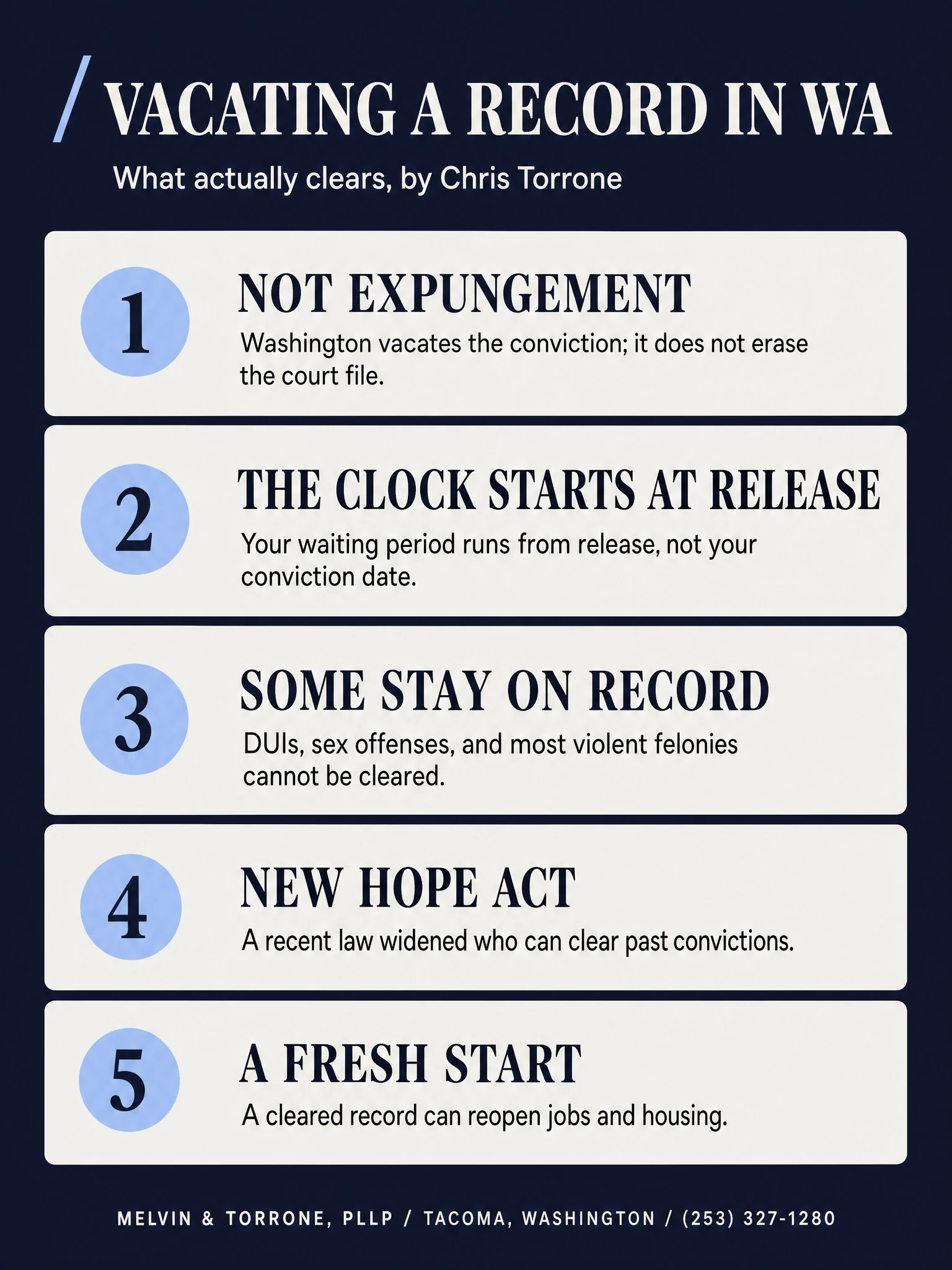
- In Washington, vacation is the relief you need if you were convicted. Expungement applies only to non-conviction data like arrests and dismissed charges.
- A vacated conviction comes off your public criminal history, and you can legally state on applications that you were never convicted of that offense.
- Standard misdemeanors clear after a three-year wait, domestic violence misdemeanors after five years, class C felonies after five years, and class B felonies after ten years.
- DUI and physical control convictions cannot be vacated in Washington, and neither can sex offenses or class A felonies. Most violent offenses are barred too, though the New Hope Act opened narrow exceptions.
- The waiting-period clock for a misdemeanor runs from your release, not from the day you make your final payment on court debt.
- A vacation order does not restore your firearm rights. That is a separate court petition with its own rules.
- The New Hope Act has expanded eligibility more than once, so a conviction someone told you was permanent years ago may qualify today.
Table of Contents
- Torrone’s Takeaways
- Vacation Versus Expungement in Washington
- Who Qualifies to Vacate a Conviction
- The Convictions Washington Will Never Vacate
- Gather Your Documents Before You File
- How to File Your Motion to Vacate
- How the New Hope Act Widened the Door
- Go Further by Sealing Your Court File
- What Changes After You Clear Your Record
- Why Local Pierce County Experience Matters
- Conclusion
- Frequently Asked Questions
- Legal Disclaimer
- Sources
Vacation Versus Expungement in Washington
People use “expungement” and “vacation” as if they mean the same thing. In Washington, they do not. Expungement applies to non-conviction data, meaning arrests or charges that never produced a guilty finding. If you were actually convicted, the relief you want is vacation, governed by RCW 9.96.060 for misdemeanors and RCW 9.94A.640 for felonies.
Be precise about what that means, because some states truly erase adult conviction records and Washington does not. Vacation withdraws the guilty finding and dismisses the charge, and the Washington State Patrol removes the conviction from your public criminal history. The underlying court file still exists in the court’s own indexes. So the better way to think about it is this: vacation lets you state, in most everyday situations like a job or housing application, that you were not convicted of that offense, and it removes the conviction from the public criminal history a routine background check pulls. It does not erase the court’s own file, and certain agencies and later criminal proceedings can still consider it.
What a Vacation Order Cannot Do
A vacation order is powerful, and it still has limits worth knowing before you file. The original court file remains accessible through Washington Courts public indexes, so the case did not vanish. It does not restore your right to possess a firearm, which is a separate petition. Certain parties can still see a vacated conviction, including criminal justice agencies for law enforcement purposes, prosecutors in some later proceedings, and the FBI in its own records. Private background-check companies sometimes keep older data scraped from court indexes even after the State Patrol updates your history, which is one reason some people also pursue sealing.
A common situation I see is someone who finished their sentence years ago, rebuilt their life completely, and still watches a decade-old conviction surface on background check after background check. The conviction is not who they are anymore, but the paperwork has not caught up. Vacation is how you make the record reflect the life you actually live now.
Who Qualifies to Vacate a Conviction
Eligibility depends on the type of conviction, whether you have completed every condition of your sentence, and how much time has passed. Here is how the main categories break down.
Misdemeanors and gross misdemeanors. Under RCW 9.96.060, most misdemeanor and gross misdemeanor convictions can be vacated once you have completed all terms of your sentence, have no criminal charges pending in any court, and have not picked up a new conviction in the three years before you apply. Thanks to the New Hope Act, you are no longer limited to vacating a single misdemeanor in a lifetime.
Class B and class C felonies. Under RCW 9.94A.640, a class C felony can be vacated after a five-year clean period and a class B felony after ten years, measured from the later of your release from community custody, your release from confinement, or your sentencing date. You cannot have a new conviction during that window, and you must have been discharged after completing every condition of your sentence.
Domestic violence misdemeanors. A DV misdemeanor carries a longer five-year wait under RCW 9.96.060, and it comes with extra conditions: you cannot have a prior DV conviction from a separate incident, and recent protection or no-contact order history can disqualify you. These cases are not off the table, but the analysis is more involved.
A common situation I see is someone who assumes a years-old domestic violence misdemeanor blocks them for life, when in fact they have already passed the five-year mark with a clean record and the only thing standing between them and relief is the motion itself. The assumption costs people years they did not need to wait.
Waiting Periods at a Glance
Timing decides these cases, and starting the clock on the wrong date is one of the most common mistakes I correct. The table below summarizes the standard waiting periods and the offenses Washington will not vacate.
| Conviction type | Eligible | Waiting period | Key condition |
|---|---|---|---|
| Standard misdemeanor or gross misdemeanor | Yes | 3 years after release | No new convictions, no pending charges |
| Domestic violence misdemeanor | Yes, with conditions | 5 years after sentence completion | No prior DV conviction from a separate incident |
| Reckless or negligent driving reduced from DUI | Yes, limited | 10 years from the arrest date | No subsequent alcohol or drug violation |
| DUI or physical control | No | Not eligible | Permanent bar under RCW 9.96.060 |
| Class C felony | Yes | 5 years after release | No new convictions in that period |
| Class B felony | Yes | 10 years after release | No new convictions in that period |
| Class A felony | No | Not eligible | Permanent bar |
| Sex offenses (RCW 9A.44) | No | Not eligible | Permanent bar |
| Most violent offenses | Usually no | Generally barred under RCW 9.94A.640, with narrow exceptions (Assault 2, Assault 3, Robbery 2 without an enhancement) | |
| Cannabis misdemeanor, 21 or older at the time | Yes | No waiting period | Vacated on application |
For a misdemeanor, the three-year clock runs from the later of your release from supervision or probation, your release from confinement, or your sentencing date, under RCW 9.96.060. That start date matters because of a change the New Hope Act made: the waiting-period clock now runs from your release, not from the day you finish paying court debt. You still generally need to satisfy the financial obligations of your sentence to be eligible, but unpaid debt no longer pushes back the date your clock begins.
The Convictions Washington Will Never Vacate
Some convictions are permanently outside the reach of the vacation statutes, and it is better to know that going in than to file and be denied.
DUI and physical control. This is the one that surprises people most. A conviction for driving under the influence or physical control cannot be vacated in Washington under any circumstances. RCW 9.96.060 bars it outright. There is one narrow path: if your DUI was reduced to reckless or negligent driving, that reduced conviction may be vacatable, but only after at least ten years have passed since the arrest and only if you have had no subsequent alcohol or drug violation in that window.
Sex offenses and most violent offenses. Convictions for sex offenses under RCW 9A.44 cannot be vacated, and most offenses classified as violent under RCW 9.94A.030 are barred as well. The violent-offense definition is broad and includes class A felonies and offenses like first and second degree manslaughter. There are narrow exceptions: under RCW 9.94A.640, second degree assault, third degree assault (when not against law enforcement), and second degree robbery can be vacated if the conviction carried no firearm, deadly weapon, or sexual-motivation enhancement and the applicable waiting period has passed (ten years for the class B offenses, second degree assault and second degree robbery, and five years for third degree assault, a class C felony).
Class A felonies. Class A felonies sit completely outside Washington’s vacation statutes regardless of how much time has passed or how completely someone has turned their life around.
A common situation I see is someone who read online that “almost any conviction” can be cleared, and arrives convinced that a decades-old serious felony qualifies. Part of doing this work honestly is delivering hard news with respect when an offense is permanently barred. The flip side is that the same review often turns up other convictions on a record that do qualify, which is exactly why a full read of your history matters before you assume the worst or the best.
Gather Your Documents Before You File
A vacation motion lives or dies on the records attached to it. Pull these together before you draft anything.
Your criminal history from the Washington State Patrol. Start with an official criminal history report directly from the Washington State Patrol, which shows exactly what convictions sit on your public record. Courts expect you to attach it, there is a small fee, and the request takes time, so build that into your schedule early.
Court records from the original case. You will need documents pulled from the case you want to clear, typically your judgment and sentence, your certificate of discharge, and the original charging documents. Contact the superior court or district court clerk in the county where you were convicted, since local rules and added requirements vary from one county to the next.
Proof that every sentence condition is complete. A court will not vacate a conviction while obligations from the original sentence remain open. You need documentation that fines, restitution, and other legal financial obligations are satisfied and that probation or community supervision is finished. The certificate of discharge under RCW 9.94A.637 is the document that proves a felony sentence is fully complete, and obtaining it also restores civil rights under RCW 9.96.050.
How to File Your Motion to Vacate
Washington publishes pattern forms for vacating convictions, and using the wrong set is a surprisingly common error. Misdemeanor cases and felony cases use different forms, all of which are available on the Washington State Courts forms page, and some counties layer on local requirements, so confirm with your specific court before you file.
Filing the petition and declaration is only the first step. You also have to serve a copy of the motion on the prosecuting attorney’s office in the county of conviction, generally on the same day you file with the court, and then schedule your hearing with the clerk. At the hearing, the judge reviews your petition, hears any response from the prosecutor, and exercises discretion. Meeting every statutory requirement under RCW 9.96.060 or RCW 9.94A.640 makes you eligible, but the decision is not automatic, which is the honest reason showing up prepared matters.
A common situation I see is someone who files on their own, uses the right forms, serves the prosecutor correctly, and then runs into an objection they did not anticipate, often about a payment timeline or a record detail, and the hearing gets continued. Doing it yourself is allowed, and the parts that trip people up are the parts a careful review catches before the judge ever raises them.
Once the judge signs your order, the court notifies the Washington State Patrol, the arresting agency, and the FBI so they can update their records, and the State Patrol removes the vacated conviction from your public criminal history. Keep certified copies of the signed order. If a background check ever surfaces the old conviction again, that document is your proof.
| Step | What you do | Where it happens |
|---|---|---|
| 1. Confirm eligibility | Match your conviction type and timeline to the statute | RCW 9.96.060 or RCW 9.94A.640 |
| 2. Order your criminal history | Request your official record | Washington State Patrol |
| 3. Gather court records | Pull judgment and sentence, certificate of discharge | County court clerk |
| 4. Complete the correct forms | Use the misdemeanor or felony packet | Washington State Courts |
| 5. File your petition | Submit the motion and declaration | County court clerk |
| 6. Serve the prosecutor | Deliver a copy the day you file | County prosecutor’s office |
| 7. Attend the hearing | Present your case to the judge | Your county courthouse |
| 8. Confirm the update | Verify the State Patrol has cleared the record | Washington State Patrol |
How the New Hope Act Widened the Door
The New Hope Act is the reason a lot of people who were once told “never” now qualify. Washington has expanded vacation eligibility more than once in recent years, and two changes matter most for the people I talk to.
First, the waiting-period clock for misdemeanors now starts when you are released, not when you make your final payment on court debt. For someone carrying court debt they could not realistically pay off quickly, that change alone moved the finish line years closer.
Second, certain felonies that were previously blocked are now eligible under RCW 9.94A.640, including some second degree offenses, as long as the conviction did not carry a deadly weapon enhancement, a firearm enhancement, or a sexual-motivation finding. If a lawyer told you years ago that your felony could never be cleared, that advice may simply be out of date, and it is worth a fresh look.
A common situation I see is someone living with an older felony for fifteen or twenty years who never qualified under the old rules, often because of court debt on a fixed income, and who now fits squarely within the expanded categories. The law changed underneath them while they assumed nothing had.
Go Further by Sealing Your Court File
Vacating and sealing are two different tools that work well together. Vacation removes the conviction from your public criminal history. Sealing, under Washington’s General Rule 15, restricts public access to the actual court file, so the documents themselves stop showing up in the court indexes that private data brokers tend to mine.
That gap is why some people pursue both. A vacation order can clear the conviction on official background checks while a private screening company keeps surfacing case data it pulled from a court index months earlier. Sealing the file closes that door. Not every case qualifies, and the court weighs the nature of the offense, the time that has passed, and whether sealing serves the interest of justice before granting it.
What Changes After You Clear Your Record
The practical payoff shows up fastest in three places.
Employment. Once the State Patrol updates your history, a vacated conviction generally will not show up on the routine background checks most employers run, and Washington’s Fair Chance Act already limits how and when employers can ask about criminal history. For someone who keeps clearing interviews and stalling at the background check, this is the step that finally unsticks the process.
Housing and professional licensing. Landlords routinely screen for criminal records, and clearing the conviction gives a rental application a fairer read. Professional licensing boards in fields like nursing, contracting, and real estate weigh conviction records heavily, and vacation can be the difference between a license approved and a license denied.
Firearm rights are separate. This catches people off guard, so I say it plainly: vacating a conviction does not restore your right to possess a firearm. Restoration is its own civil petition in superior court under RCW 9.41.041, with its own waiting periods and eligibility rules. If gun rights matter to you, plan both processes from the start rather than discovering the limit after your vacation order is already signed.
Immigration consequences are more complicated and depend heavily on individual circumstances. If you are not a U.S. citizen, talk with an immigration attorney alongside your criminal defense work before you file anything.
Why Local Pierce County Experience Matters
Vacation looks like paperwork until a prosecutor objects or a judge asks a question the forms did not prepare you for. Pierce County prosecutors and the judges in Pierce County Superior Court and the local municipal courts each have tendencies that shape how these motions actually go. Knowing the statute tells you whether you qualify. Knowing the courthouse helps you present your motion as strongly as possible the first time.
Conclusion
A criminal record does not have to follow you forever, and Washington gives you real tools to address it. Vacation is not automatic, and the waiting periods and eligibility rules are specific, but for many people in Pierce County a conviction they were told was permanent can in fact be cleared. Knowing where you stand, which statute applies, and what your timeline looks like is the first step toward a clean record and the doors it reopens.
Frequently Asked Questions
1. Can I vacate a misdemeanor if I still owe court fines in Washington?
In many cases the waiting-period clock has already started, because for misdemeanors it runs from your release rather than from your final payment on legal financial obligations. You generally still need to satisfy the financial terms of your sentence to be eligible, and in some cases you can ask the court to address remaining amounts, so it is worth confirming your exact status under RCW 9.96.060 before assuming you are blocked.
2. What is non-conviction data, and can I have it removed?
Non-conviction data means arrests, charges, and detentions that never resulted in a guilty finding, as defined under RCW 10.97.030. You can request deletion of that criminal history information from the Washington State Patrol through a separate process under RCW 10.97.060, which is distinct from vacating a conviction.
3. Can juvenile records be vacated or sealed in Washington?
Juvenile records follow different rules than adult convictions and are often easier to address. Both sealing and vacation may be available, but the relief does not happen automatically, so you generally have to petition the court to request it.
4. What is a Certificate of Restoration of Opportunity?
The Certificate of Restoration of Opportunity, available under RCW 9.97.020, is a separate tool for people who do not qualify for vacation. It signals to employers and licensing boards that a court has recognized your rehabilitation, which can reduce barriers even without a full vacation order.
5. Can a cannabis misdemeanor be vacated in Washington?
Yes. Under RCW 9.96.060, a person who was 21 or older at the time of a misdemeanor cannabis offense may apply to vacate that conviction, and the statute provides for it without the standard waiting period that applies to other misdemeanors.
6. Does a vacation order restore my right to own a firearm?
No. A vacation order does not restore firearm rights. That is a separate petition filed in superior court under RCW 9.41.041, with its own waiting period and eligibility requirements, and it can be pursued independently of vacating the underlying conviction.
7. Can I vacate more than one conviction in my lifetime?
For misdemeanors, the New Hope Act removed the old one-vacation-per-lifetime limit, so you may be able to clear multiple eligible misdemeanors. Each conviction is evaluated on its own type, timeline, and conditions under RCW 9.96.060, so eligibility is decided conviction by conviction.
Legal Disclaimer
This article is for general informational purposes only and is not legal advice. Reading it or contacting Melvin & Torrone, PLLP does not create an attorney-client relationship. Each case is unique, and past results do not guarantee future outcomes. Eligibility to vacate a conviction is fact-specific. For advice about your situation, speak with a licensed Washington attorney.
Sources
- RCW 9.96.060: Vacating records of conviction for misdemeanor and gross misdemeanor offenses
- RCW 9.94A.640: Vacation of offender’s record of conviction (felonies)
- RCW 9.94A.637: Discharge upon completion of sentence, certificate of discharge
- RCW 9.96.050: Restoration of civil rights, certificate of discharge
- RCW 9.94A.030: Sentencing Reform Act definitions (violent offense)
- RCW 46.61.502: Driving under the influence
- RCW 9A.44: Sex offenses
- RCW 9.41.041: Restoration of the right to possess a firearm
- RCW 9.97.020: Certificate of Restoration of Opportunity
- RCW 10.97.030 and 10.97.060: Criminal records privacy, non-conviction data
- RCW 49.94: Washington Fair Chance Act
- Washington State Patrol: Criminal History
- Washington Courts: Court forms
- Washington Courts: General Rule 15 (sealing court records)

Chris Torrone
Founding Partner, Melvin & Torrone PLLP
Chris Torrone is a dedicated advocate for clients facing family crises and criminal charges. With 20 years of experience practicing in Pierce County courts, Chris has built a reputation for meticulous case preparation and creative problem-solving in high-stakes litigation.