
False CPS Allegations in Washington: How to Fight Back
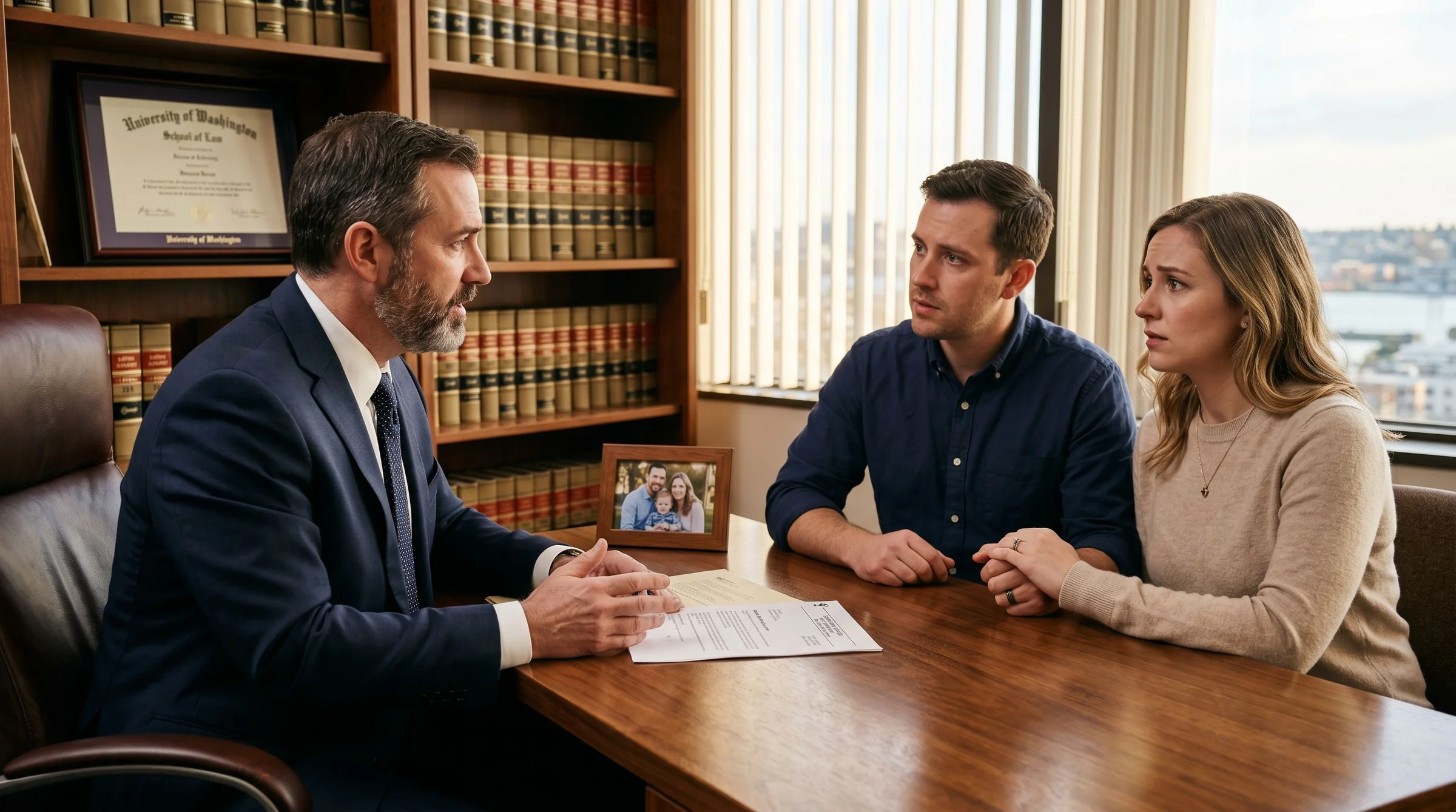
Someone filed false CPS allegations in Washington against you, and now a caseworker is at your door. That is one of the most gut-punching moments a parent can face, especially when you know the report came from a spiteful ex, a bitter relative, or a vindictive neighbor. After two decades of fighting these cases in Pierce County, I can tell you that a fake CPS report is not the end of your story. Washington law has real teeth when it comes to false reporting, and you have more rights than you probably realize right now. Let me walk you through exactly what to do.
Torrone’s Takeaways
- A fake CPS report is serious, but it is not the end. Washington law gives you real tools to fight back and protect your family.
- Know your rights the moment a caseworker knocks. You are not required to answer every question without an attorney present.
- Document everything immediately. Texts, emails, social media activity, and witness accounts build the paper trail that wins cases.
- The 30-day appeal window after a founded determination is not a suggestion. Miss it and you lose your right to challenge the finding.
- Retaliation against the reporter during an active investigation almost always hurts your own case more than theirs. Stay calm and let your attorney respond.
- Repeat false reports timed around court hearings are a recognized pattern in Washington family courts, and judges do take notice when it is properly presented.
- The earlier you get an experienced CPS attorney involved, the more options you have. Waiting costs you time, leverage, and sometimes your case.
Table of Contents
-
What Actually Happens After Someone Files False CPS Allegations in Washington
-
Your Legal Rights the Moment a CPS Investigator Shows Up at Your Door
-
How to Build a Paper Trail That Proves the Report Was Malicious
-
What Washington State Law Says About False CPS Allegations and Fake CPS Reports
-
How a Spiteful CPS Report Can Damage Your Custody Case and What to Do About It
-
Mistakes Parents Make During a False CPS Allegations Washington Investigation
-
How to Appeal a CPS Finding and Clear Your Name in Washington State
-
How Melvin & Torrone, PLLP Fights False CPS Allegations in Pierce County
What Actually Happens After Someone Files False CPS Allegations in Washington
How DCYF Decides to Open an Investigation
Not every report automatically triggers a full CPS investigation. Washington’s Department of Children, Youth and Families screens each intake first, checking whether the allegations meet the legal definition of abuse or neglect under RCW 26.44.020 and whether the reported risk level is moderate to high. In SFY 2024, DCYF received 41,709 screened-in intakes statewide, meaning thousands of reports never even made it past the front door.
The Timeline Parents Can Expect from First Contact to Findings
Once a CPS investigation opens, a DCYF caseworker must make initial face-to-face contact with your child within the timeframe set by agency policy, as short as 24 hours for emergent intakes. From there, child welfare employees have up to 60 days to complete the full investigation. That is 60 days of home visits, interviews, and record reviews, which is exactly why I tell every parent to get legal guidance from day one, not day 59.
A common pattern in Pierce County looks like this: a caseworker shows up unannounced within days of a custody dispute turning hostile, after the other parent filed a fake report the same week a primary-custody petition was filed. With no attorney present, a parent answers every question on the spot, unaware the clock is already running on a 60-day investigation. Recognizing how often false reports track the timing of a custody filing is the first step toward responding the right way.
What “Founded” vs. “Unfounded” Means
After completing its investigation, DCYF issues one of two findings. “Founded” means the caseworker concluded that child abuse and neglect most likely occurred. “Unfounded” means the evidence was not strong enough to support that conclusion. A founded finding does not just disappear. It shows up in background checks, can affect your custody of children, and follows you into future employment decisions involving child safety roles.
Table: Washington CPS Investigation Quick Reference Guide
| Stage | What Happens | Your Action |
|---|---|---|
| Report Filed | DCYF screens the intake against RCW 26.44.020 criteria | Stay calm, do not contact the reporter |
| Investigation Opens | Caseworker contacts you within 24-72 hours depending on risk level | Request attorney presence before answering questions |
| Home Visit | Caseworker inspects home, interviews family members | Keep home normal, be respectful but guarded |
| Child Interview | DCYF may interview your child at school without your permission | Inform your attorney immediately |
| Records Review | Caseworker reviews medical records, school records, prior CPS history | Begin gathering your own documentation |
| Investigation Closes | DCYF issues founded or unfounded determination within 60 days | If founded, you have 30 days to file an appeal |
| Appeal Window | Office of Administrative Hearings reviews the finding independently | File immediately with legal representation |
Common Reasons People File Fake CPS Reports Out of Spite
1. Custody Battles and Divorce Proceedings Gone Hostile
This is the big one. In my two decades of handling CPS and family law cases across Pierce County, the most common source of a fake CPS report is a custody dispute that has gotten ugly. A peer-reviewed study published in the journal Child Abuse and Neglect found that within cases involving a custody or access dispute, the rate of intentionally false allegations jumps to 12%, compared to just 4% of all cases overall. When one parent feels cornered, a call to Washington State Child Protective Services can feel like a fast and consequence-free weapon.
2. Angry Neighbors, Estranged Relatives, and Workplace Disputes
Custody battles get most of the attention, but false allegations also come from neighbors with a grudge, estranged family members trying to gain leverage, and even coworkers or former partners seeking retaliation. Washington law does not require a reporter to give their name, which makes anonymous false reporting feel low-risk to whoever is doing it. What most people filing a fake CPS report do not realize is that Washington law under RCW 26.44.060 treats intentional bad faith reporting as a criminal offense, not a harmless tip.
Some common sources of spiteful CPS reports I see in practice:
- A bitter ex-spouse during active divorce or custody proceedings
- A grandparent or in-law who disagrees with your parenting choices
- A neighbor following a property or noise dispute
- A former romantic partner after a difficult breakup
- A coworker or employer following a workplace conflict
False reports from estranged relatives follow a similar shape. An estranged family member with no real involvement in the children’s lives, sometimes someone who has not visited in over a year, files a neglect report with DCYF on the heels of a heated family conflict such as an inheritance or estate dispute, often with zero supporting evidence. Cases like these are a reminder that documenting every hostile interaction, even with family, matters more than people think.
How Repeat False Reporters Operate and What Their Pattern Looks Like
Repeat false reporters are a specific and particularly damaging category. They tend to file multiple reports over time, usually timed around court hearings, custody exchanges, or any moment when they sense you are gaining ground. Their reports often escalate in severity with each filing, moving from vague neglect claims toward more serious allegations of physical child abuse. Recognizing this pattern early, and documenting it carefully, is one of the most powerful things you can do before walking into a Washington family court.
Your Legal Rights the Moment a CPS Investigator Shows Up at Your Door
What You Are and Are Not Required to Say or Do
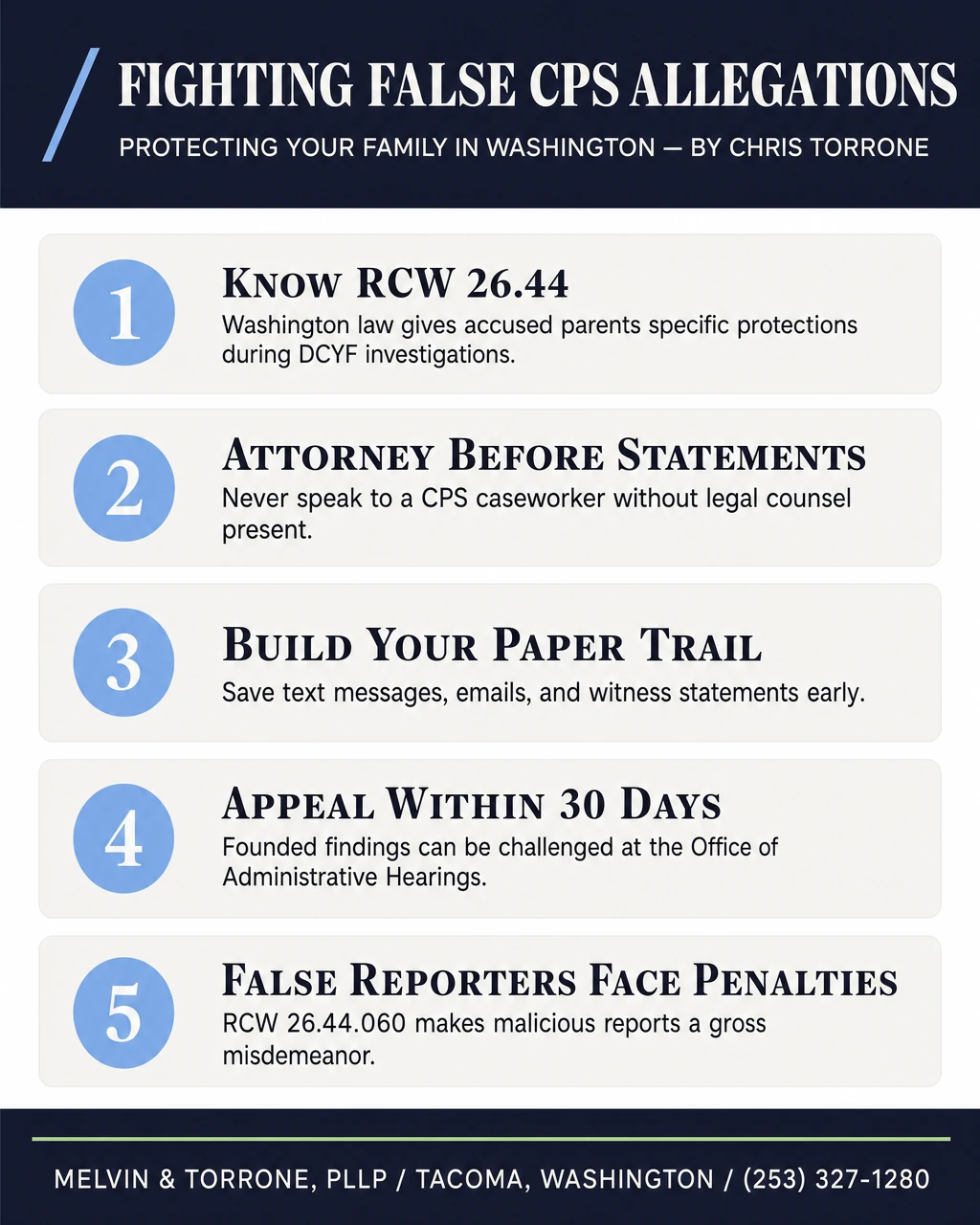
Take a breath. A DCYF caseworker knocking on your door does not mean you have lost already. You are not required to answer every question on the spot, invite the investigator inside without understanding why they are there, or sign anything before speaking with an attorney. Being cooperative does not mean being unguarded, and knowing the difference between the two can significantly change how your CPS investigation plays out.
Some things you are and are not required to do at first contact:
- You are NOT required to let a caseworker into your home without a court order or your consent
- You are NOT required to answer questions that could be used against you
- You ARE required to allow access if a court order is presented
- You ARE expected to be respectful and avoid giving investigators a reason to escalate
- Your children CAN be interviewed at school without your permission under Washington law
Your Right to an Attorney Before Speaking with DCYF
A common and costly scenario plays out like this: a DCYF caseworker has already conducted two home visits and interviewed both children at school before the parents realize they had the right to involve legal representation. By the time they reach an attorney, statements have already been made that complicate the defense. This is not rare. Parents across the South Sound make this same mistake every week.
This is the piece of information I want every parent in Washington state to hold onto. You have the right to tell a caseworker that you will cooperate fully, but that you would first like to speak with an attorney. That single sentence can protect you from making off-the-cuff statements that get misinterpreted or taken out of context inside a formal CPS investigation report. Invoking that right is not an admission of guilt. It is common sense.
Washington Law Under RCW 26.44 Protects Accused Parents
Washington’s Revised Code of Washington, specifically RCW 26.44, lays out the legal framework governing child abuse reporting, investigation procedures, and parents’ rights throughout the process. Under this law, you have the right to be notified of the investigation, to access CPS records related to your case, and to appeal any founded finding within 30 days of receiving your determination letter. These are real, enforceable protections, and I have used them effectively for families across Pierce County for over two decades.
How to Build a Paper Trail That Proves the Report Was Malicious
Documents and Records You Should Start Collecting Today
Documentation is your defense, and the time to start building it is right now, not after the investigation closes. Pull together any prior court orders, parenting plans, communications with the other party, medical records showing your children are healthy and well-cared-for, and any previous unfounded CPS findings. A well-organized record tells a story that a caseworker, a judge, and a Washington family court can all follow clearly.
Capture and Preserve Text Messages, Emails, and Social Media Activity
Consider how digital evidence can change a case. When a false report grows out of a family conflict, the person making threats often leaves a paper trail first, such as a text that reads, essentially, “you’ll regret this.” A parent’s instinct is sometimes to delete a message like that. Preserved and printed instead, a single screenshot can become one of the most compelling pieces of evidence in the entire case.
Digital evidence is gold in these situations, but only if you preserve it correctly. Take timestamped screenshots of threatening or suspicious text messages, emails, and social media activity before anything gets deleted. Do not just forward them to yourself; save them to a secure location, print physical copies, and note the date and context of each message so your attorney can present them clearly in dependency court or family court proceedings.
Getting Witness Statements That Hold Up in Washington Family Court
A witness statement is only as strong as the person giving it and the way it is recorded. Teachers, pediatricians, coaches, neighbors, and family friends who interact regularly with your children can all speak to your parenting and your child’s wellbeing. I always advise clients to approach potential witnesses early, ask them to write down what they know while details are fresh, and share those written accounts with legal representation before submitting anything formal to the court.
What Washington State Law Says About False CPS Allegations and Fake CPS Reports
The Criminal Penalty a Malicious Reporter Faces Under RCW 26.44.060
Washington law is not silent on this. Under RCW 26.44.060(4), a person who intentionally and in bad faith knowingly makes a false report of alleged child abuse and neglect is guilty of a gross misdemeanor, punishable under RCW 9A.20.021. That can mean up to 364 days in county jail and a fine of up to $5,000. The law specifically strips the reporter of their immunity protections the moment their report is proven to be made in bad faith rather than as a good faith report of genuine concern.
How to Report the False Reporter to Law Enforcement in Pierce County
A recognizable pattern emerges when parents face several anonymous fake reports over the span of a year or more, each one timed within days of a scheduled custody hearing. Once enough filings stack up, the documented pattern becomes difficult to ignore. Presenting that pattern to local law enforcement through an attorney is often what moves the reports from a civil inconvenience to a matter that can be examined as a criminal one.
Once your CPS investigation closes with an unfounded finding, you can take your documented evidence to local law enforcement and request that the false report be investigated as a criminal offense. In Pierce County, this means filing a report with the Tacoma Police Department or the Pierce County Sheriff’s Office and presenting your evidence of intentional false reporting. A cease and desist letter from your attorney, sent via certified mail, can also put the reporter on formal notice that their conduct has legal consequences.
Civil Claims You May Be Able to File for Defamation and Emotional Harm
Beyond the criminal side, Washington law may give you grounds to pursue civil action against the person who filed the false allegations. Depending on your situation, potential claims can include defamation, intentional infliction of emotional distress, and in some cases, interference with parental rights. To pursue any civil claim successfully, you will generally need to show the following:
- The report was made intentionally and knowingly without factual basis
- The false allegations caused you measurable harm, such as lost wages, legal costs, or damaged reputation
- The reporter acted with malice or bad faith rather than genuine concern for child safety
- You have documentation, witness statements, or prior unfounded findings that support your position
Civil litigation is not the right path in every case, and I always give clients an honest assessment before recommending it. But when the evidence is strong and the harm is real, it is a powerful option worth exploring.
Table: False CPS Reporting in Washington: Legal Consequences at a Glance
| Factor | Details Under Washington Law |
|---|---|
| Governing Law | RCW 26.44.060 and RCW 26.44.061 |
| Classification of Offense | Gross misdemeanor for intentional bad faith reporting |
| Maximum Jail Time | Up to 364 days in county jail |
| Maximum Fine | Up to $5,000 under RCW 9A.20.021 |
| Immunity Status | Reporter loses all immunity protections upon conviction |
| Who Can Be Held Liable | Any person, including mandated reporters acting in bad faith |
| Civil Action Available | Yes, defamation and intentional infliction of emotional distress |
| Where to File Criminal Report | Local law enforcement, Pierce County Sheriff, or Tacoma Police Department |
| Appeal Body for CPS Findings | Office of Administrative Hearings, Washington State |
| Oversight and Complaints | Office of the Family and Children’s Ombuds, DCYF Constituent Relations |
How a Spiteful CPS Report Can Damage Your Custody Case and What to Do About It
How Family Court Judges in Washington View CPS Findings During Custody Disputes
Washington family court judges take CPS findings seriously, even when those findings are later proven to be based on false allegations. A founded determination sitting in your file while a custody dispute is active can shift a judge’s perception of you before you ever speak a word in that courtroom. That is the real danger of a spiteful report. It plants a seed of doubt in a proceeding where perception matters enormously, and that is why I always tell clients that the time to fight back is during the CPS investigation, not after the custody hearing.
Requesting a Custody Modification After Repeated False Reports
If someone is using fake CPS reports as a repeated tactic in your custody dispute, Washington family courts can and do treat that pattern as relevant to custody modifications. A parent who repeatedly files false allegations is demonstrating something significant about their character and their willingness to prioritize conflict over the wellbeing of the child. Dr. Alan Blotcky, a clinical and forensic psychologist writing in Psychiatric Times, put it plainly: “False allegations of abuse in custody matters are an all-too-common phenomenon. They must be handled firmly and decisively by the targeted parent and his or her litigation team.”
When one parent files multiple reports with Washington State Child Protective Services over a period of years, each timed to coincide with scheduled modifications to a parenting plan, and every report comes back unfounded, that documented pattern itself becomes relevant evidence. Washington family courts can treat repeated false reporting as a reason to revisit an existing custody arrangement, and presenting the pattern clearly is what gives the court grounds to act on it.
How an Attorney Can Get the Fabricated Allegations Thrown Out Before They Stick
The earlier an experienced family lawyer gets involved in your case, the more options you have for neutralizing false allegations before they gain traction. An attorney who knows Washington CPS and dependency court can challenge the sufficiency of the investigation, present exculpatory evidence directly to the caseworker during the investigation period, and file motions that put the fabricated claims on record as part of a pattern of bad faith conduct. In my experience across Pierce County courts, a well-prepared legal response in the early stages of a false CPS allegation almost always produces a better outcome than scrambling to repair damage after the fact.
Mistakes Parents Make During a False CPS Allegations Washington Investigation
1. Talking Too Much to the Caseworker Without Legal Counsel Present
This is the mistake I see most often, and it is completely understandable. When a caseworker shows up at your door, your instinct is to prove your innocence by explaining everything immediately. But unguarded statements made during a CPS investigation can be recorded, misinterpreted, and used in dependency court or family court proceedings in ways you never anticipated. Saying too much without legal counsel present is one of the fastest ways to turn an unfounded report into a complicated legal problem.
Here are the specific things parents commonly say that create problems later:
- “I did discipline him, but it was not abuse” (opens the door to further questioning about discipline methods)
- “She has always been dramatic” (can be framed as dismissing a child’s wellbeing)
- “We have had CPS involved before but it was nothing” (prior history gets documented immediately)
- “I know who made this report” (signals potential for retaliation, which investigators note)
2. Retaliating Against the Reporter Before the Investigation Closes
Retaliation is one of the most damaging missteps a parent can make. A father who figures out that a neighbor filed a false neglect report after a property dispute may feel justified in confronting that neighbor and firing off angry text messages. But once those messages reach the DCYF caseworker, they can be treated as evidence of an unstable home environment. That kind of retaliation genuinely hurts a parent’s own case.
Retaliation feels justified when you know the report against you was pure spite. But any contact with the suspected reporter during an active investigation can seriously damage your credibility with caseworkers, law enforcement, and family court judges. Stay completely away from the reporter, document everything from a distance, and let your attorney handle any formal response through the appropriate legal channels.
3. Waiting Too Long to Get an Attorney Involved
I hear this one regularly: “I thought it would just go away on its own.” It rarely does. The CPS investigation timeline moves fast, caseworkers are forming impressions from the very first visit, and parents who wait until a founded finding arrives to seek legal representation are starting from a significant disadvantage. Getting a family lawyer involved from the first contact with DCYF gives you the best possible chance of keeping false CPS allegations from permanently affecting your family.
How to Appeal a CPS Finding and Clear Your Name in Washington State
The 30-Day Window to File Your Appeal After a Founded Determination
If DCYF issues a founded determination against you, Washington law gives you exactly 30 days from the date you receive your determination letter to file an appeal. That window does not pause, extend, or reset if you are confused about the process or waiting to see what happens next. I cannot stress this enough: missing that deadline means giving up your right to challenge the finding through the Office of Administrative Hearings, and that is a consequence that follows families in Pierce County and across Washington state for years.
What the Office of Administrative Hearings Looks for in a CPS Appeal
Founded findings built on false allegations can be overturned on appeal. A relative caregiver, for example, may be named in a founded finding after a grandchild’s other parent files false allegations during a contentious guardianship battle, even with no prior CPS involvement and years as the child’s primary caregiver. Filing the appeal within the 30-day window and presenting medical records, witness statements, and a documented timeline of the custody dispute is the kind of organized response that gives an administrative law judge reason to reverse a finding that should never have been made.
The Office of Administrative Hearings conducts an independent review of your case, separate from DCYF. Administrative law judges look at whether the founded finding was supported by a preponderance of evidence, whether the CPS investigation followed proper procedures under Washington law, and whether your parental rights were respected throughout the process. Coming into that hearing with organized documentation, credible witness statements, and clear legal representation gives you a genuinely strong foundation to fight a finding that should never have been made.
How a Founded Finding Can Follow You in Background Checks and Employment
A founded finding of child abuse and neglect in Washington state is not just a family law problem. It gets recorded in DCYF’s database and can surface in background checks for employment, professional licensing, volunteer work involving children, and foster care or adoption applications. Washington law under RCW 26.44 governs how these records are maintained and who can access them. Clearing a wrongful founded finding through a successful appeal is not just about your family. It is about protecting your livelihood, your reputation, and your future in the community you call home.
How Melvin & Torrone, PLLP Fights False CPS Allegations in Pierce County
Having a Local Tacoma Attorney Makes a Real Difference with DCYF
Local knowledge is not a small thing in CPS cases. I know the DCYF regional staff, the Pierce County dependency court procedures, and the local law enforcement practices that shape how these investigations unfold on the ground. That familiarity translates directly into faster, smarter responses for families across the South Sound.
What Chris Torrone’s Experience in CPS Cases Means for Your Family
This is more than two decades of fighting false allegations, dependency actions, and CPS investigations for real families in real crisis across Pierce County and Washington state. We bring these to your case:
- Courtroom-tested strategy honed over decades of CPS custody cases
- Deep experience across family law and criminal defense
- Decades of combined experience with Washington State Child Protective Services and dependency court
- Deep familiarity with RCW 26.44 and Washington law governing child abuse reporting
- Aggressive, compassionate representation from day one through final resolution
When false CPS allegations threaten your family, you deserve a team that has been in that fight before and knows exactly how to win it.
Schedule Your Free 30-Minute Consultation Today
You do not have to figure this out alone, and you should not have to. A single 30-minute phone call with our team can give you clarity on where you stand, what your rights are, and what your next move should be. Book your free consultation online, call Melvin & Torrone, PLLP today at (253) 327-1280 or visit our office at 950 Pacific Ave, Suite 720, Tacoma, WA 98402. We are here Monday through Friday, 8am to 5pm, ready to listen and ready to fight.
Frequently Asked Questions
1. Can someone file a false CPS report anonymously in Washington state?
Yes, Washington’s child abuse reporting laws allow anonymous reports, which is exactly what makes fake CPS reports so frustrating to deal with. However, anonymous reporters still face criminal liability under RCW 26.44.060 if their report is proven to have been made intentionally and in bad faith.
2. What is the penalty for filing a false CPS report in Washington?
Filing a false report intentionally is classified as a gross misdemeanor under Washington law, punishable by up to 364 days in county jail and fines up to $5,000. The Penalties Section of RCW 26.44.060 makes clear that bad faith reporters lose all legal immunity protections immediately.
3. When did Washington’s mandatory child abuse reporting laws take effect?
Washington’s foundational child abuse reporting framework has been in place since July 1, 1984, establishing the legal obligations that mandated reporters must follow today. These reporting laws have been updated several times since, with the Department of Children, Youth and Families now serving as the primary state agency overseeing child protective investigations.
4. Who counts as a mandated reporter in Washington state?
Mandated reporters include teachers, physicians licensed pursuant to chapters RCW, social workers, counselors, law enforcement officers, and other professionals who regularly work with children. These individuals are legally required to report reasonable suspicions of child abuse and neglect, and failure to report carries its own civil or criminal liability under Washington law.
5. What is the Family Assessment Response and how does it differ from a full investigation?
The Family Assessment Response, commonly called FAR, is an alternative pathway used by the Department of Children, Youth and Families for lower-risk reports that do not require a formal adversarial investigation. Rather than making a founded or unfounded determination, FAR focuses on connecting families with family support services and voluntary resources without the same legal consequences as a full CPS investigation.
6. What can I do if I believe the CPS investigation of my family was handled unfairly?
You have several options, including filing a complaint through DCYF Constituent Relations, contacting the Office of the Family and Children’s Ombuds, which independently investigates complaints about state agency conduct, or reaching out to Disability Rights Washington or the Office for Civil Rights if discrimination was a factor. Getting legal guidance from an experienced family lawyer before filing any complaint will help you present your concerns as effectively as possible.
7. Can false CPS allegations affect my child custody case even if the report is unfounded?
Yes, and this is one of the most serious consequences I see in Pierce County family courts. Even an unfounded finding can create a temporary cloud over your custody case, which is why responding to false allegations quickly and with proper legal representation is so important to protecting your parental rights.
8. Are CPS communications and case records kept confidential in Washington?
Washington law protects the confidential communication privilege around most CPS proceedings and records. However, abuse or neglect findings can be accessed in certain circumstances, including background checks, future CPS investigations, and child custody proceedings, which is why clearing a wrongful founded finding through a formal appeal matters so much for your long-term interests.
9. Can I get interpreter services during a CPS investigation in Washington?
Yes. Washington state requires that interpreter services be made available to families who need them during CPS investigations and dependency court proceedings. If you were denied interpretation support or felt that language barriers affected how your case was handled, that is a legitimate legal concern worth raising with your attorney and potentially with the Office for Civil Rights under federal and state laws.
10. What should I do if I keep receiving repeated false CPS reports from the same person?
Document every report, every finding, and every interaction related to each filing, then bring that full documented pattern to an experienced family lawyer as quickly as possible. Repeated false reporting is a recognized pattern in hostile custody disputes across the Pacific Northwest, and Washington courts can treat that pattern as evidence of bad faith conduct that warrants legal intervention and potentially a modification of existing custody arrangements.
Conclusion
False CPS allegations can shake your world, but they do not have to define your outcome. Washington law gives you real tools to fight back, and the families I have helped across Pierce County know that a strong defense started early makes all the difference. At Melvin & Torrone, PLLP, we have spent decades turning fear into confidence for parents exactly like you. Your family deserves a personalized plan and a fierce advocate in your corner.
Book Your Free Consultation Today.
Each case is unique. Past results do not guarantee future outcomes. This article provides legal information, not legal advice. Reading this article does not create an attorney-client relationship with Melvin & Torrone, PLLP.

Chris Torrone
Founding Partner, Melvin & Torrone PLLP
Chris Torrone is a dedicated advocate for clients facing family crises and criminal charges. With 20 years of experience practicing in Pierce County courts, Chris has built a reputation for meticulous case preparation and creative problem-solving in high-stakes litigation.