
DUI Defense in Washington: Your Complete Guide for 2026
Getting charged with a DUI in Washington State does not automatically mean a conviction, and the right DUI defense Washington strategy can make all the difference between walking free and facing life-altering consequences. I’ve spent over two decades fighting these charges in Pierce County courtrooms, and I can tell you that most people charged with drunk driving have more options than they think.
Washington’s laws are strict, prosecutors are aggressive, and the clock starts ticking the moment you’re arrested. But a charge is not a conviction. Let’s talk about what you’re actually facing and how to fight it.
Torrone’s Takeaways
- A DUI charge is not a conviction. Washington’s legal system has real gaps your attorney can exploit.
- The 7-day DOL deadline moves faster than you think. Miss it and your license is gone before your first court date.
- The 2026 lookback period change is not minor. A conviction from 13 years ago can now make your new charge a felony.
- High BAC numbers are not automatic losses. How that number was obtained matters as much as the number itself.
- Two cases run simultaneously after every DUI arrest. The DOL hearing and the criminal case require two separate defense strategies.
- Pleading guilty at arraignment before anyone has reviewed the evidence is one of the most expensive decisions you can make.
- Good intentions do not equal a legal defense in Washington State. Get an attorney in your corner before you say anything to anyone.
Table of Contents
-
How Washington’s 2026 DUI Law Changes Affect Your Case Right Now
-
The 7-Day DOL Hearing Deadline That Most People Miss After a DUI Arrest
-
DUI Defense Strategies That Can Get Charges Reduced or Dismissed
-
How DUI defense Washington Cases Actually Move Through Pierce County Courts
-
Mistakes That Can Destroy Your DUI defense Washington Case Before It Starts
-
How Melvin & Torrone, PLLP Fights DUI Charges in Pierce County
What Washington State Law Says About DUI Charges
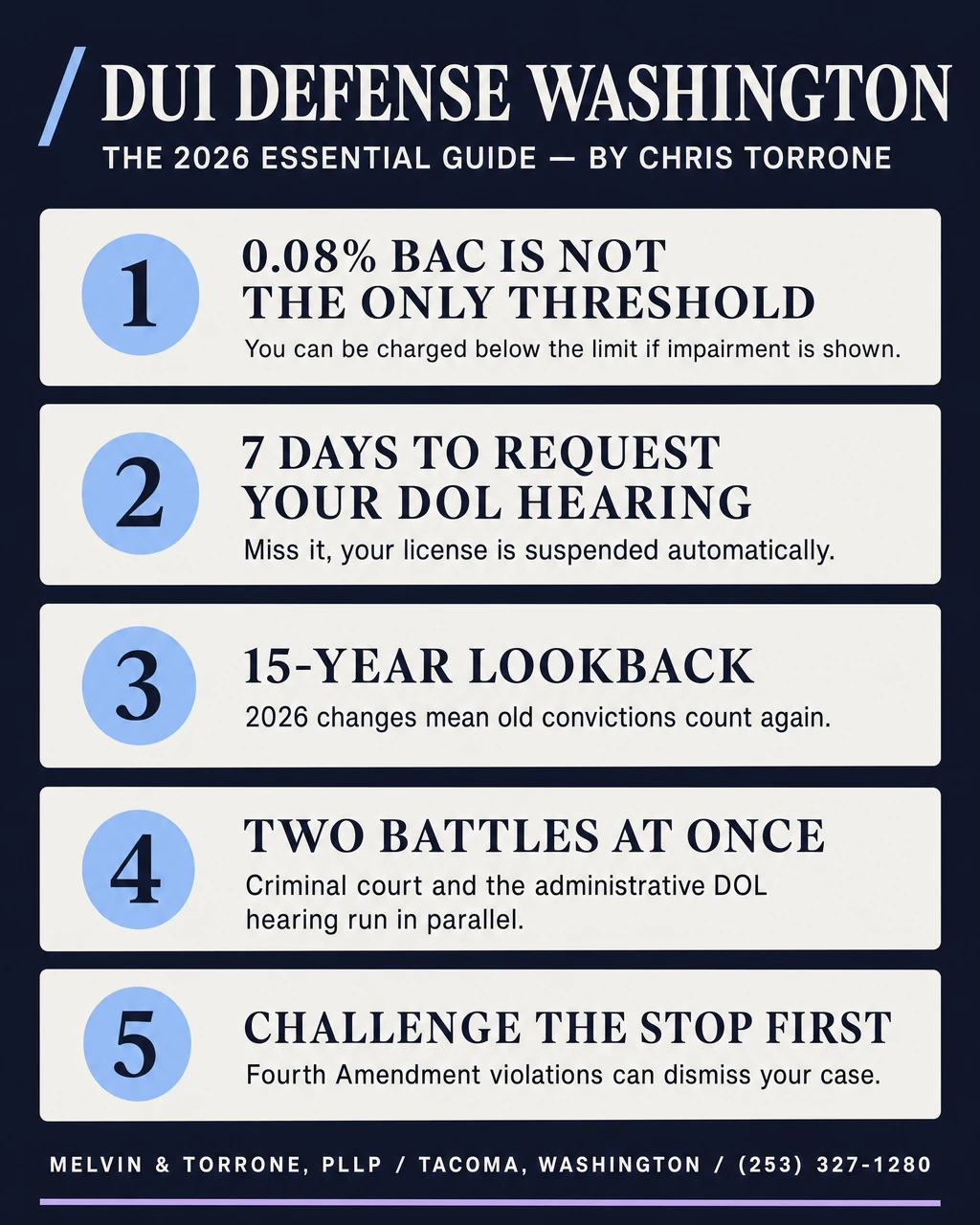
The 0.08% BAC Rule and What Gets You Charged Below the Limit
Most people think the 0.08% blood alcohol concentration limit is the only line that matters. It isn’t. Under RCW 46.61.502, Washington State law allows prosecutors to charge you with driving while under the influence even if your BAC was below 0.08%, as long as they can show your ability to drive was impaired by intoxicating liquor or any drug. I’ve seen people charged at 0.06% because an officer noted bloodshot eyes and poor field sobriety performance. The BAC number is evidence, not the whole case.
Drug DUI, Marijuana DUI, and Prescription Medication Charges
Washington treats drug DUI the same as alcohol DUI when it comes to criminal penalties. For a marijuana DUI, the presumed level of impairment is 5 nanograms of THC per milliliter of blood. For prescription medications, there is no set THC concentration threshold at all, which means prosecutors rely heavily on officer observations and blood samples from a private or state lab. Many people are genuinely shocked when they learn their legally prescribed medication landed them criminal charges. If you drive in Washington, this matters to you.
Physical Control Charges and How They Differ from Standard DUI
Here is one that catches people completely off guard. Physical control under RCW 46.61.504 means you can be charged with impaired driving even if your car was parked and you were sitting in the driver’s seat with the keys nearby. Washington courts have consistently held that a person does not need to be moving to be in physical control of a vehicle. The penalties mirror those of a standard DUI charge, so this is not a technicality you can dismiss.
Consider what looks like a responsible choice: a driver who feels the effects of drinking pulls into a parking lot, turns the car off, and sits in the driver’s seat to wait it out. An officer who finds them there with the keys in the ignition can charge them under the physical control statute, exposing them to the same license suspension and mandatory minimum penalties as a standard DUI. Cases like these often turn on whether the prosecution can prove the driver had the present ability to operate the vehicle, which is exactly where a focused defense can make the difference. The lesson: good intentions alone are not a legal defense in Washington State.
What “Gross Misdemeanor” vs. Felony DUI Means for Your Case
A first or second DUI in Washington is typically charged as a gross misdemeanor, which carries up to 364 days in jail and a $5,000 fine. That word “gross” is doing a lot of work because this is a criminal conviction, not a traffic ticket, and it creates a permanent criminal record under Washington law.
Under the 2026 updates from ESHB 1493, a DUI becomes a class B felony if you have three or more prior impaired driving convictions within the past 15 years, up from the previous 10-year lookback window. A class B felony carries up to ten years in prison and fines reaching $20,000. The difference between these two outcomes is significant, and it is exactly why the right legal representation from the start changes everything.
How Washington’s 2026 DUI Law Changes Affect Your Case Right Now
The 15-Year Lookback Period and Why Old Convictions Now Count Again
This is the change I want every Pierce County resident to read carefully. As of January 1, 2026, under Engrossed Substitute House Bill 1493, Washington extended its felony DUI lookback period from 10 years to 15 years. That means a conviction from 2012 that would have been “too old” to count last year can now push a new charge into felony territory. Prosecutors can use convictions that predate 2026 under this rule. If you have any prior DUI history, your exposure just changed significantly.
The New Drug Offender Sentencing Alternative for Felony DUI Cases
For the first time, Washington created a specific Drug Offender Sentencing Alternative for felony DUI defendants, commonly called DOSA-DUI. This is genuinely good news for people whose repeat offenses are rooted in substance use disorder rather than recklessness. Instead of a straight prison sentence, eligible defendants can receive a structured program combining reduced confinement, residential treatment, and supervised community custody. It is not a free pass, but it is a real path toward treatment over punishment, and it opens up negotiation possibilities that simply did not exist before 2026.
Consider two people facing felony DUI charges on similar facts. One has a prior conviction from 13 years ago that now counts under the new 15-year lookback rule. The other has no disqualifying priors and a documented substance use disorder, and is therefore a candidate to be assessed and petition for DOSA-DUI eligibility, which can produce a treatment-focused sentence rather than prison time. Same charge, very different paths, separated almost entirely by criminal history and legal strategy.
Second Deferred Prosecution and Who Qualifies Under the New Rules
Deferred prosecution under RCW 10.05 has always been a powerful tool, but previously you could only use it once in a lifetime. The 2026 changes allow a second deferred prosecution in limited circumstances. To qualify, you generally need to meet all of the following conditions:
- You are currently facing a misdemeanor DUI or physical control charge
- You successfully completed a prior deferred prosecution for a DUI-related offense
- That prior deferred prosecution concluded at least seven years before the new case
- You have no disqualifying convictions such as vehicular homicide or vehicular assault
If you complete the program, the charge is ultimately dismissed. But this requires genuine commitment, including intensive treatment, total abstinence, and years of court monitoring. I always tell clients this is not something to enter lightly.
New Saliva Testing Methods and Updated Ignition Interlock Requirements
Washington law enforcement now has access to portable oral fluid testing devices that check for the presence of specific drugs in a driver’s saliva. These tests are voluntary and the results are not admissible as evidence in court, but officers use them to decide whether to pursue a full chemical DUI test. On the ignition interlock device front, the 2026 rules tightened the employer exemption so it no longer applies to self-employed individuals unless the vehicle is used exclusively for work.
A 2026 JLARC audit also found that 59% of approximately 66,000 Washington drivers ordered to install an ignition interlock device never complied, which tells you enforcement gaps still exist but are now being actively addressed.
Penalties You Face for a DUI Conviction in Pierce County
First-Offense DUI Penalties Including Jail, Fines, and License Suspension
People are often surprised by how serious a first DUI charge actually is in Washington State. Under RCW 46.61.5055, a first-offense conviction with a BAC between 0.08% and 0.14% carries a mandatory minimum of one day in jail, fines starting around $990, and a 90-day driver’s license suspension. The court can also order electronic home monitoring, alcohol assessment, and probation on top of those minimums.
How a BAC of 0.15% or Higher Triggers Enhanced Mandatory Minimums
Cross the 0.15% blood alcohol concentration threshold and the math changes fast. Washington law requires a mandatory minimum of two days in jail for enhanced first-offense DUI, along with a one-year license revocation and mandatory ignition interlock device installation. Refusing the breath or blood test triggers the same enhanced penalties, which catches a lot of people off guard because they assumed refusing was the safer choice.
Consider a driver whose breath analysis registers above 0.15%, pushing the charge into enhanced penalty territory. Beyond the mandatory jail minimums and the ignition interlock requirement, the license suspension alone can threaten a job when the work requires daily driving to job sites across Pierce County. For many people, the financial and professional fallout hits harder than the legal penalties themselves, which is something we see far too often when people underestimate what a conviction actually costs in real life.
Second and Repeat Offense Penalties and the Escalating Consequences
Washington does not go easy on repeat offenders, and Pierce County prosecutors pursue these cases aggressively. A second DUI within seven years carries a mandatory minimum of 30 days in jail, significantly higher fines, a two-year ignition interlock requirement, and a longer license revocation. By a third offense, mandatory minimums jump again, and under the new 15-year lookback rule introduced in 2026, convictions you thought were buried in your past can now drive felony-level criminal charges.
Long-Term Consequences That Follow You After the Courthouse
The courtroom is only the beginning of what a DUI conviction costs you. In Washington State, a DUI conviction creates a permanent criminal record under RCW 9.96.060, meaning it cannot be vacated, expunged, or sealed. That record shows up on background checks run by employers, landlords, and licensing boards, and in 2024, impaired driving was linked to 348 traffic deaths in Washington, representing 48% of all fatalities, which is exactly why prosecutors and judges in this state treat these cases with very little leniency.
Table: Washington State DUI Penalty Quick-Reference Chart (2026)
| Offense Level | BAC | Minimum Jail | Maximum Jail | Minimum Fine | License Suspension | Ignition Interlock |
|---|---|---|---|---|---|---|
| First Offense | 0.08–0.14% | 1 day | 364 days | ~$990 | 90 days | Not mandatory |
| First Offense Enhanced | 0.15%+ or refusal | 2 days | 364 days | ~$1,195 | 1 year | Mandatory (1 year) |
| Second Offense | 0.08–0.14% | 30 days | 364 days | ~$1,245 | 2 years | Mandatory (2 years) |
| Second Offense Enhanced | 0.15%+ or refusal | 45 days | 364 days | ~$1,670 | 900 days | Mandatory (2 years) |
| Third Offense | 0.08–0.14% | 90 days | 364 days | ~$2,045 | 3 years | Mandatory (3 years) |
| Third Offense Enhanced | 0.15%+ or refusal | 120 days | 364 days | ~$2,545 | 4 years | Mandatory (3 years) |
| Felony DUI (Class B) | Any | Per sentencing grid | 10 years | Up to $20,000 | Varies | Mandatory |
The 7-Day DOL Hearing Deadline That Most People Miss After a DUI Arrest
What the Department of Licensing Hearing Is and Why It Runs Separately from Court
A DUI arrest in Washington triggers two completely separate cases at the same time. The Department of Licensing (DOL) hearing is a civil administrative process that runs independently from your criminal case in court, governed by implied consent laws under RCW 46.20.308. Winning your criminal case does not automatically save your license, and losing the DOL hearing does not mean you are convicted of a crime. These two tracks run on different rules, different timelines, and different standards.
How to Request a Hearing and What the $375 Fee Covers
The arresting officer should hand you a hearing request form at the time of your arrest. You submit that form along with a $375 fee to the Washington State Department of Licensing within seven calendar days of your arrest, including weekends and holidays. That fee is nonrefundable regardless of the outcome, and it buys you the right to challenge your license suspension before a DOL hearing examiner rather than accepting it automatically.
What Happens to Your License if You Miss the Deadline
Miss that seven-day window and your license suspension becomes automatic, full stop. The suspension begins 30 days after your arrest and can last anywhere from 90 days to two years depending on your prior record and the circumstances of your arrest. I have spoken with people who did not know this deadline existed until day ten, and by then their options were already significantly narrowed. This is one of the most consequential deadlines in Washington drunk driving law, and it moves fast.
A common and avoidable pattern: someone is arrested for DUI, spends a few days absorbing the shock, and tells themselves they will deal with the legal side later. By the time they contact an attorney after day seven, the DOL hearing window has already closed and the license is automatically suspended 30 days later. For anyone whose livelihood depends on driving, that can effectively shut down their operations for months. The criminal case may still have options, but the license is often gone before the fight even starts. That is why the seven-day deadline cannot wait.
How Pierce County District Court and Tacoma Municipal Court Handle Your Criminal Case at the Same Time
Your criminal DUI case lands in one of two courts depending on where you were arrested. Here is how the split works in Pierce County:
- Arrested by Tacoma Police within city limits, your case goes to Tacoma Municipal Court on South 11th Street
- Arrested outside city limits by a Pierce County Sheriff or Washington State Patrol trooper, your case goes to Pierce County District Court
- Both courts require you to appear at every scheduled hearing or a warrant will be issued for your arrest
- Missing a court date while your DOL hearing is also active can create compounding consequences across both proceedings
Pierce County prosecutors are known for pursuing DUI cases with real aggression, and the courts here do not wait for you to get organized. Getting legal representation in place immediately after an arrest is the only way to stay ahead of both processes at once.
Table: Your DUI Timeline After Arrest in Pierce County: What Happens and When
| Timeframe | What Happens | Action Required |
|---|---|---|
| At arrest | Officer issues DOL hearing request form and temporary license | Do not discard this form under any circumstances |
| Within 7 days | DOL hearing request deadline with $375 fee | Submit form and fee to Department of Licensing immediately |
| Day 30 after arrest | Automatic license suspension begins if hearing not requested | If deadline missed, explore ignition interlock driver license options |
| 4 to 6 weeks post-arrest | First criminal court date (arraignment) in Tacoma Municipal or Pierce County District Court | Appear at every hearing or a warrant will be issued |
| Within 60 days of arrest | DOL hearing takes place by phone with hearing examiner | Attorney presents your challenge to the administrative suspension |
| Ongoing | Omnibus hearing, pretrial motions, negotiation or trial | Defense attorney reviews police reports, breath and blood test records, and builds legal strategy |
| Case resolution | Conviction, reduction, dismissal, or deferred prosecution | Comply with all court-ordered conditions including victim impact panel if required |
DUI Defense Strategies That Can Get Charges Reduced or Dismissed
1. Challenging the Legality of the Traffic Stop Under the Fourth Amendment
Every solid DUI defense starts at the very beginning: why did the officer pull you over in the first place? Under the Fourth Amendment, law enforcement must have reasonable suspicion that you were violating the law before initiating a traffic stop. If that reasonable suspicion did not exist, any evidence gathered afterward, including breath test results, field sobriety performance, and your own statements, can be challenged for suppression. No lawful stop means the prosecution’s entire case gets significantly weaker, and in some situations, charges get dismissed entirely.
2. Attacking the Breath Test Results and the Officer’s Testing Procedures
Breath test results feel airtight until you start pulling at the threads. Washington uses specific alcohol breath testing machines that must be properly certified, maintained, and operated by a trained officer following exact protocols. The officer must observe you for a required period before administering the test, check for mouth jewelry or substances, and ensure the blood-alcohol measuring device ran a proper quality assurance cycle.
As Florida’s 5th District Court of Appeal once noted, no one should have their freedom jeopardized by a machine that cannot be properly examined and scrutinized. Blood lab cases carry their own vulnerabilities too, including chain of custody issues and blood analysis errors at private laboratories.
A breath result just over the limit is not the end of the analysis. Washington requires the officer to complete a 15-minute observation period before administering the breath test, and a careful review of the police reports and breath test records sometimes shows that step was skipped. A procedural failure like that can become the centerpiece of a defense and support a reduction to negligent driving, which avoids mandatory jail time and, for licensed professionals, can protect a professional license. One missed step by the officer can change the trajectory of a case.
3. Field Sobriety Test Errors and How They Can Weaken the Prosecution’s Case
Field sobriety tests are not as objective as they look on a dashcam recording. The standardized tests used in Washington, developed through DWI Detection and Standardized Field Sobriety Testing protocols, require precise administration by the officer to produce reliable results. Factors like uneven pavement, poor lighting, medical conditions, footwear, and even nervousness can all affect performance without any alcohol involved at all. I have reviewed cases where the officer’s own instructions were incomplete, which is enough to challenge the weight of that evidence in court.
Violations of Your Right to Counsel During the Investigation
Your Sixth Amendment right to consult with an attorney before submitting to chemical testing is a real and enforceable legal right in Washington. If law enforcement denied you a reasonable opportunity to contact a DUI attorney after your arrest and before your blood or breath test, that denial can form the basis of a legitimate legal challenge. This defense requires careful documentation from the police reports and arrest records, but when it holds up, it can lead to suppression of the test results themselves. I always review this aspect of every case because the violation is more common than people expect.
How DUI defense Washington Cases Actually Move Through Pierce County Courts
Arraignment, Omnibus Hearing, and What to Expect at Each Stage
The criminal process moves faster than most people expect after a DUI arrest in Pierce County. Your arraignment is your first court appearance, where formal charges are read and you enter an initial plea. After that comes the omnibus hearing, where your attorney raises pretrial motions, including any challenges to the traffic stop, the breath or blood tests, or constitutional violations. This is the stage where strong legal defenses get built, tested, and presented before a case ever gets close to trial.
How Pierce County Prosecutors Handle DUI Negotiations and Plea Agreements
Pierce County prosecutors take impaired driving cases seriously, and they come prepared. The Prosecutor’s Office assigns a dedicated deputy prosecuting attorney to handle DUI negotiations in each courtroom, and they are not in the habit of giving ground without a fight. What moves them is solid defense work: documented procedural errors, questionable breath analysis results, weak field sobriety evidence, or constitutional violations in how the stop or arrest was conducted. The stronger your defense preparation, the more leverage you have at the negotiation table.
What moves a Pierce County prosecutor is documented weakness in the State’s case. When a BAC registers just above the legal limit and a thorough review of the police reports reveals inconsistencies in the officer’s documentation of the stop, those inconsistencies can support a negotiated reduction. Avoiding a DUI conviction on a criminal record matters enormously for people in the licensed trades, where it can determine whether they keep their contractor licensing and stay on job sites that require background checks.
Possible Reductions to Reckless Driving or Negligent Driving Charges
A DUI reduction to reckless driving or negligent driving in the first degree is one of the most meaningful outcomes a defense attorney can pursue in Washington State. These reduced charges do not carry mandatory jail time, do not trigger the ignition interlock device requirement, and do not create the same long-term criminal record consequences as a DUI conviction. Prosecutors will not offer these reductions freely, but when the evidence has real weaknesses, they become a genuine possibility worth pursuing through focused and strategic case management.
What Going to Trial Looks Like in Tacoma Municipal or Pierce County District Court
Most DUI cases resolve before trial, but some do not, and when they do not, you need to know what you are walking into. DUI trials in Washington are heard before a jury of six people in district and municipal courts, and every juror must agree on guilt for a conviction to occur. The prosecution carries the burden of proving driving while under the influence beyond a reasonable doubt, which means your attorney’s job is to raise genuine, reasonable questions about the stop, the chemical DUI test procedures, the blood or breath test results, and the credibility of the arresting officer’s observations throughout the arrest process.
Mistakes That Can Destroy Your DUI defense Washington Case Before It Starts
1. Talking to Police Without an Attorney Present After the Arrest
I want to be straightforward with you about this one: anything you say after a DUI arrest can and will be used against you in court. Officers are trained to ask conversational questions that feel routine but are designed to build evidence, including where you were, what you drank, and how much. Politely invoking your right to remain silent and requesting legal representation is not an admission of guilt. It is the smartest move you can make in those first critical minutes after an arrest.
2. Waiting Too Long to Hire a Lawyer and Missing Critical Deadlines
Time is genuinely not on your side after a DUI arrest in Washington State. The seven-day DOL hearing deadline alone can permanently cost you your driver’s license before your criminal case has even had its first hearing. Beyond that, police reports need to be reviewed, blood samples need to be preserved for independent testing, and witnesses fade fast. Every day you wait without legal representation is a day the prosecution uses to build its case while yours sits undefended.
3. Assuming a High BAC Means There Is No Defense Worth Pursuing
A high blood alcohol concentration reading feels like a closed door, but in practice it is often anything but. The 2026 JLARC audit revealed that 59% of Washington drivers ordered to install an ignition interlock device never complied, which reflects a broader reality: the legal system around DUI enforcement is far from perfect, and imperfect systems produce challengeable evidence. How the blood or breath test was administered, whether the alcohol breath testing machines were properly calibrated, and whether the blood lab followed correct chain of custody procedures all matter enormously, regardless of the number on the report.
Even a high reading well above 0.15% does not automatically make a case unwinnable. When an attorney digs into the breath or blood testing device records, they sometimes find the machine missed a required quality assurance certification window. Test results obtained from a non-compliant device can be challenged, and what looks like an open-and-shut case for the prosecution can turn into a negotiated reduction. The number on a breath test is the starting point of a defense, not the ending point.
4. Pleading Guilty at Arraignment Without Knowing All Your Options
Walking into arraignment and pleading guilty might feel like the fastest way to put everything behind you, but it is one of the most consequential decisions you can make under pressure. Here is what a guilty plea at arraignment typically locks in before any real investigation has happened:
- Mandatory minimum jail time or electronic home monitoring
- Automatic driver’s license suspension separate from your DOL hearing outcome
- A permanent DUI conviction on your criminal record that cannot be vacated under RCW 9.96.060
- Ignition interlock device requirements for at least one year
- Potential SR-22 auto insurance requirements that follow you for years
No attorney has reviewed the police reports. No one has checked whether the stop was lawful or whether the breath analysis followed proper protocol. Pleading guilty before that work is done means accepting consequences that a proper defense might have reduced or avoided entirely.
What to Look for in a DUI Lawyer in Washington
Local Pierce County Court Experience Changes the Outcome of Your Case
Knowing Washington drunk driving law is one thing. Knowing how it gets applied inside Pierce County District Court and Tacoma Municipal Court is something else entirely. Pierce County rotates its judges more frequently than most Washington district courts, and the Prosecutor’s Office assigns specific deputy attorneys to negotiate DUI cases in each courtroom. An attorney who knows those individuals, understands their tendencies, and has stood before those judges regularly brings a practical advantage that no amount of general legal knowledge can replicate.
Questions to Ask During Your Free Consultation Before You Hire Anyone
A free consultation is not just a formality. It is your opportunity to evaluate whether the attorney sitting across from you actually knows this specific legal system. Here are questions worth asking before you commit:
- How many DUI cases have you handled in Pierce County specifically?
- Have you handled cases in both Tacoma Municipal Court and Pierce County District Court?
- What is your track record with charge reductions to reckless or negligent driving?
- How do you approach DOL hearings, and do you handle both the civil and criminal tracks?
- What does your case management process look like from arrest through resolution?
The answers will tell you quickly whether you are talking to someone with genuine local experience or someone who handles DUI as an occasional side matter alongside other case types.
A frequent and expensive mistake on a first DUI is hiring a general criminal defense attorney based on a low flat fee, only to learn weeks later that they have never handled a DOL hearing and are unfamiliar with the specific negotiation patterns of the assigned deputy prosecutor in that courtroom. Switching to counsel who properly contests the DOL hearing can still lead to a reduced criminal charge, but the first hire costs time, money, and unnecessary stress during an already difficult period. Local DUI experience is not a luxury; it shapes the outcome.
The Difference Between a General Criminal Defense Lawyer and a Dedicated DUI Attorney
Not every criminal defense attorney is built the same when it comes to DUI cases. DUI defense in Washington is a technically demanding area that involves breath analysis science, blood testing protocols, blood lab chain of custody rules, field sobriety testing standards from DWI Detection and Standardized Field Sobriety Testing training, and the administrative review process at the DOL running alongside the criminal case. A dedicated DUI attorney builds their practice around understanding every layer of that system. A general practitioner may know enough to get by, but in a Pierce County courtroom with an aggressive prosecutor, getting by is rarely enough to protect your future.
How Melvin & Torrone, PLLP Fights DUI Charges in Pierce County
Deep Criminal Defense Experience Built in Tacoma Courtrooms
Our criminal defense experience is not a marketing number. It reflects over two decades of courtroom fights in the same Pierce County courts where your case will be heard. We know these prosecutors, these judges, and these proceedings because this is our community too.
People facing DUI charges in Pierce County need a fighter who also takes the time to explain what is happening and why. Clients consistently tell us they finally felt heard, respected, and genuinely defended. A common phrase we hear is “It Felt Like Someone Was Finally in My Corner.” That is exactly what we show up to do every single day.
What Happens in Your Free 30-Minute Consultation
Book a free consultation now for:
- A real conversation about your specific arrest, not a generic legal overview
- An honest assessment of your DOL hearing deadline and whether it has passed
- A plain-language explanation of the criminal charges you are facing
- A clear outline of the defense strategies that apply to your situation
- Zero pressure to hire us on the spot
You can also call us at (253) 327-1280. We are available Monday through Friday, 8am to 5pm, at 950 Pacific Ave, Suite 720, Tacoma. You will leave that call with more clarity than you walked in with, guaranteed.
Frequently Asked Questions
1. Can an out-of-state DUI conviction count against me in Washington?
Yes, Washington law treats comparable out-of-state offense convictions as prior offenses when calculating penalties and determining whether your charge escalates to a felony under the Revised Code of Washington.
2. Does Washington State have a separate legal limit for marijuana DUI?
Washington sets the THC concentration limit at 5 nanograms per milliliter of blood for a marijuana DUI. Below that threshold, prosecutors can still charge you if they have evidence that intoxicating liquor or drugs impaired your driving ability.
3. Can I be charged with DUI on a boat in Washington?
Yes. Boating Under the Influence carries the same BAC threshold of 0.08% as driving a vehicle, and Washington BAC laws apply on all Puget Sound waterways. A BUI conviction can also be used as a prior offense in future DUI sentencing.
4. What is Senate Bill 5880 and does it affect my case?
Senate Bill 5880 was part of Washington’s ongoing legislative effort to address impaired driving, pursued under Governor Bob Ferguson’s administration. Depending on when your arrest occurred, recent legislative changes may affect your sentencing options, which is why current legal consultation matters.
5. Do DUI cases in Washington ever go to jury trials?
Yes, defendants have the right to jury trials in felony DUI cases in Washington State. Six jurors must unanimously agree on guilt, and that requirement creates real opportunities for a skilled defense attorney to raise reasonable doubt.
6. What is a victim impact panel and will I have to attend one?
A victim impact panel is a program where DUI offenders hear directly from people affected by impaired driving crashes. Washington courts frequently order attendance as a condition of sentencing or probation, particularly for first-offense DUI convictions across Pierce County and King County.
7. How does DUI defense in Washington differ in various counties?
The underlying Washington State DUI statutes apply statewide, but local prosecution style, court procedures, and negotiation patterns vary significantly. Pierce County operates differently from King County or Snohomish County, which is why local legal experience matters as much as general knowledge of Seattle DUI laws.
8. What does “preponderance of the evidence” mean in my DUI case?
Preponderance of the evidence is the standard used in your DOL civil hearing, meaning the hearing examiner decides based on what is more likely than not. This is a lower bar than the criminal standard, which is why fighting both proceedings simultaneously requires different legal strategies.
9. What should I look for when comparing DUI attorneys?
Look for attorneys with documented legal experience in the specific court where your case will be heard and familiarity with DWI Detection and Standardized Field Sobriety Testing protocols. The quality of legal services varies significantly, and a free legal consultation is always the right first step before making any decision.
Conclusion
A DUI charge in Washington State is serious, but it is not the end of the road. The right defense strategy, built on real Pierce County courtroom experience, changes outcomes. At Melvin and Torrone, PLLP, we have spent decades fighting for people in exactly your situation, and we understand what is at stake for you and your family. Every case deserves a personalized plan, not a generic response. We are ready to build yours.
Book your free 30-minute consultation today.
Each case is unique. Past results do not guarantee future outcomes. This article provides legal information, not legal advice. Reading this article does not create an attorney-client relationship with Melvin & Torrone, PLLP.

Chris Torrone
Founding Partner, Melvin & Torrone PLLP
Chris Torrone is a dedicated advocate for clients facing family crises and criminal charges. With 20 years of experience practicing in Pierce County courts, Chris has built a reputation for meticulous case preparation and creative problem-solving in high-stakes litigation.