
CPS During Divorce in Washington: How to Protect Your Custody Rights
Yes, your ex can file a CPS report during your divorce to weaponize Child Protective Services against you in a CPS during divorce Washington custody battle, and it happens more than most people realize. It is one of the nastiest moves in a high-conflict divorce playbook. After 20-plus years fighting these cases in Pierce County family courts, I have seen good parents blindsided by false allegations designed to do one thing: steal your children and your credibility at the same time. But the good news is that a weaponized CPS report almost always backfires when you have the right legal representation fighting back.
Torrone’s Takeaways
- A CPS report filed right before a custody hearing is rarely a coincidence. Timing tells the story.
- You have the right to an attorney before speaking to any DCYF caseworker. Use it every single time.
- An unfounded finding does not end the fight. Get ahead of it before opposing counsel tries to use it anyway.
- Document everything from day one. Your log becomes your evidence.
- Repeated unfounded CPS reports hurt the parent filing them, not the parent receiving them.
- Your CPS defense and your divorce strategy must work together. Two separate attorneys who do not coordinate will cost you.
- A false report is not just a legal problem. It is a story about who your ex really is, and Pierce County judges read that story clearly.
Table of Contents
-
Washington Divorces and CPS Investigations Collide More Often Than You Think
-
How to Tell If Your Ex Filed a False CPS Report to Win Custody
-
Know Your Legal Rights the Moment CPS Contacts You During Your Divorce
-
What to Do in the First 48 Hours After a CPS Report During Your Divorce
-
How a CPS Investigation During Divorce Washington Cases Actually Affects Your Custody Ruling
-
How to Build a Defense That Protects Both Your CPS Case and Your Custody Case at the Same Time
-
How to Hold Your Ex Legally Accountable for a False CPS Report in Washington
-
What Fathers Specifically Need to Know About CPS During a Washington Custody Battle
-
How Melvin & Torrone PLLP Fights for Parents Facing CPS During Divorce in Pierce County
Washington Divorces and CPS Investigations Collide More Often Than You Think
How High-Conflict Divorces Create a CPS Reporting Pattern in Pierce County
In my 20-plus years handling family law cases across Pierce County, I have watched a clear pattern emerge. The moment a divorce turns hostile, CPS reports tend to follow. Washington State’s DCYF received 41,709 screened-in CPS intakes in State Fiscal Year 2024 alone, and a measurable share of those originate from households already inside active family court proceedings. High-conflict divorces are a breeding ground for this overlap, and Tacoma family courts see it regularly.
Difference Between a Legitimate Report and a Tactical One
Not every CPS report filed during a divorce is a weaponized one, and I want to be clear about that. Legitimate child safety concerns deserve to be reported and investigated, full stop. The tactical report, though, looks different. It arrives right after a custody hearing goes badly, or right before a scheduled parenting plan review. It targets specific allegations that are nearly impossible to disprove quickly, like emotional abuse or neglect, and it comes from a parent with everything to gain from derailing your residential schedule.
A textbook tactical report looks like this: an ex files a CPS report the same week a parenting plan modification hearing is scheduled, alleging child neglect even though the children are enrolled in school, attending regular medical appointments, and thriving in the accused parent’s care. In situations like that, the timing tends to tell the whole story.
What Washington’s DCYF Is Actually Required to Do Once a Report Comes In
Once a report meets the legal threshold under RCW 26.44.020, DCYF is legally required to investigate it, regardless of the source or their suspicion of motive. The caseworker assigned to your case is not there to take sides. They are there to determine child safety, and Washington’s dependency laws require them to complete that investigation within 60 calendar days of the report being filed.
Timing of a Report During a CPS Custody Battle Matters to a Judge
Pierce County Superior Court judges handling child custody and visitation matters are not naive. They read timelines. A CPS report filed three days before a scheduled family law court hearing registers very differently than one filed by a teacher who noticed bruising at school. Judges in Washington family courts are trained to evaluate the full context of a CPS custody battle alongside the divorce proceedings, and the suspicious timing of a report can actually work against the parent who filed it when the facts come to light.
How to Tell If Your Ex Filed a False CPS Report to Win Custody
Common False Allegations Used in Washington Custody Cases
After handling hundreds of custody disputes across Pierce County and the South Sound, I can tell you the same false allegations surface again and again. The most frequent ones involve child neglect, emotional abuse, substance abuse, and domestic violence. These are not random choices. They are selected precisely because Washington family courts treat them seriously, they trigger immediate DCYF involvement, and they are genuinely difficult to disprove on short notice.
Behavioral Red Flags That Signal a Weaponized CPS Report
The report itself is rarely the only signal. Pay attention to the pattern surrounding it. A few red flags I have seen repeatedly in Pierce County custody disputes include:
- The report is filed immediately after a court date, mediation session, or custody decision that did not favor your ex
- The allegations in the CPS report mirror the exact arguments your ex has been making in family law court
- Your children have never had prior involvement with child protective services or the child welfare system
- The report is filed anonymously, but the details are specific enough that only your ex could have known them
- A new report appears every time a significant legal deadline approaches
If two or more of these apply to your situation, the report almost certainly did not come from a place of genuine concern for child safety.
What Washington Courts Look for When Evaluating the Source of a Report
Washington family courts do not look at a CPS report in isolation. Judges evaluate the credibility of the source, the history of the filing parent, and whether a pattern of false allegations exists across the case. A peer-reviewed study published in Child Abuse and Neglect found that within custody disputes, the rate of intentionally false allegations rises to 12%, compared to just 4% across all CPS cases. Pierce County judges are well aware of this dynamic, and experienced legal counsel knows how to present that context effectively to the court.
Consider a parent on the receiving end of a third CPS report in eight months, each one closed as unfounded by DCYF. That parent is exhausted, the children are being interviewed over and over, and the parenting plan is disrupted every time a new report lands. To the court, a pattern like that is obvious, even when the filing parent seems not to see it.
How Repeated or Pattern CPS Reports Work Against the Filing Parent
Washington courts pay close attention to patterns of conduct, and a parent who files multiple unfounded CPS reports during a custody battle is building a case against themselves. Repeated reports with unfounded findings signal to the court that one parent is prioritizing conflict over the child’s wellbeing. That behavior directly undermines their claim to be the more fit parent, and it can result in the court modifying the parenting plan in your favor.
Table: False CPS Report Red Flags vs. Legitimate Report Indicators
| Factor | Red Flag (Tactical Report) | Legitimate Report |
|---|---|---|
| Timing | Filed days before a custody hearing or parenting plan review | Filed independently of any court date |
| Prior CPS history | No previous reports until divorce began | History of documented safety concerns |
| Source | Anonymous but suspiciously specific details | Named mandatory reporter such as teacher or doctor |
| Allegation type | Vague emotional abuse or neglect, hard to disprove quickly | Specific, observable incident with physical evidence |
| Pattern | Multiple reports, all returned unfounded | Single report followed by DCYF closure or services |
| Child’s status | Children are thriving in school, healthy, and stable | Observable signs of harm, neglect, or distress |
| Correlation | Report mirrors exact arguments made in family law court | Report contains information only a concerned third party would know |
Know Your Legal Rights the Moment CPS Contacts You During Your Divorce
Your Right to an Attorney Before Speaking With a DCYF Caseworker
The single most important thing I tell every parent who calls me after a CPS contact is this: you have the right to legal counsel before you say a single word to a DCYF caseworker. Washington State law guarantees this right at every stage of the process. Exercising it is not obstruction and it is not an admission of guilt. It is the smartest move you can make when your parental rights and your divorce case are both on the line.
What You Are and Are Not Required to Let CPS Do at Your Home
A DCYF caseworker showing up at your door does not have automatic authority to enter your home. Without a court order or a documented emergency, you are not legally required to let them in. You are required to be respectful, and I always advise clients to stay calm and cooperative in tone. However, calmly asking a caseworker to return when your family law attorney is available is a completely lawful and often wise response.
This is one of the most common and avoidable missteps. A DCYF caseworker shows up unannounced, often during the evening or in the middle of parenting time, and the parent, not knowing their rights, lets them in without calling anyone first. That visit becomes part of the investigation record before the parent ever speaks to a lawyer, which makes the road afterward harder than it needed to be.
Your Rights If DCYF Interviews Your Children Without Your Permission
This surprises many parents, and I understand why it feels wrong. Under Washington State law, DCYF caseworkers are legally permitted to interview your children at school or elsewhere without your prior consent. Your child does have the right to request a trusted adult be present during that interview. Knowing this ahead of time, and making sure your children understand that right in an age-appropriate way, can meaningfully affect what gets documented in the investigation.
The 72-Hour Rule and What Happens If Your Child Is Removed
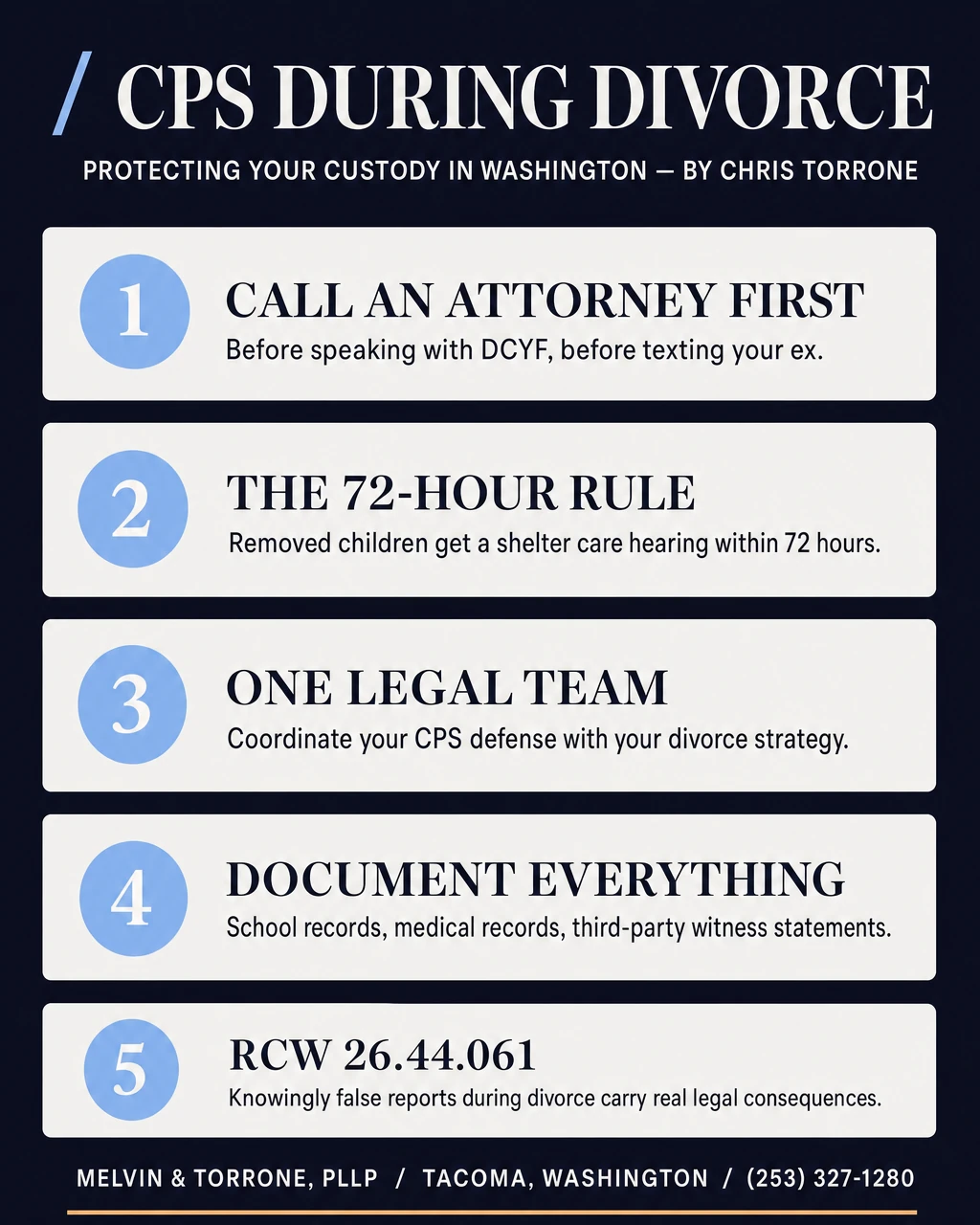
If a law enforcement officer places your child in protective custody and transfers them to DCYF, Washington State law allows your child to be held for no more than 72 hours, excluding weekends and legal holidays, before a court must review the situation. That review happens fast, and you need legal representation in place before it does. A dependency petition can follow quickly, and the decisions made in those first hearings carry serious weight for your parenting plan, your custody and visitation rights, and the entire direction of your divorce case.
Table: Your Legal Rights During a Washington State CPS Investigation
| Situation | Your Right | What This Means Practically |
|---|---|---|
| Caseworker arrives at your door | Right to refuse entry without a court order or documented emergency | Politely ask them to return when your attorney is available |
| DCYF requests an interview with you | Right to have an attorney present | Do not answer substantive questions before consulting legal counsel |
| Caseworker interviews your child at school | Right to be notified, child has right to request a trusted adult | Inform your child of this right in an age-appropriate way beforehand |
| DCYF issues a founded finding | Right to appeal within 30 days via written request | File immediately and engage an attorney to guide the administrative appeals process |
| Child is placed in protective custody | Right to court review within 72 hours excluding weekends and holidays | Have legal representation in place before that hearing occurs |
| DCYF requests you sign a safety plan | Right to review the document with an attorney before signing | Never sign any CPS document without understanding its legal implications |
| Case is closed | Right to request your full case records through DCYF Public Disclosure | Use those records to protect yourself in ongoing family law court proceedings |
What to Do in the First 48 Hours After a CPS Report During Your Divorce
Why Calling a Family Law Attorney Comes Before Anything Else
I know the instinct is to call your ex and demand an explanation, or to post something on Facebook, or to call DCYF back immediately and defend yourself. Resist all of that. The first call you make in those 48 hours needs to be to a family law attorney who also understands CPS and dependency cases. The decisions you make in those first two days shape everything that follows, including your parenting plan, your custody disputes, and how the family law court ultimately views you as a parent.
How to Document the Situation Without Making Your Custody Case Worse
Documentation is your best friend right now, but only if you do it correctly. Start a written log immediately. Record every interaction with DCYF, every caseworker name, every date and time, and every question you were asked. The log should capture this from day one:
- The date and time of the initial CPS contact
- The full name and contact information of the assigned caseworker
- Every question asked and your response, written down as soon as possible after the interaction
- Any documents or forms handed to you, including their titles
- The names of any witnesses present during home visits or interviews
- Any communications from your ex that seem connected to the timing of the report
This log becomes multimedia evidence your attorney can use across both the CPS case and your family law court proceedings.
What Not to Say to Your Ex, on Social Media, or to the Caseworker
A single furious reaction can cost a parent months of progress in a custody case. It happens when a parent, enraged after receiving a CPS report, fires off a series of text messages to the ex calling the report “a disgusting lie” and threatening to expose them in court. Messages like those get submitted as evidence and frame the sender as aggressive and uncooperative. The caseworker never sees a calm, stable parent. They see conflict.
Anything you say to your ex right now is potential evidence. Anything you post publicly is potential evidence. Even venting to a mutual friend can find its way back into the record. The legal process here rewards composure, and I have seen parents win and lose custody cases on the strength of their own words alone.
How to Cooperate Strategically Without Waiving Your Parental Rights
Strategic cooperation means engaging with the CPS investigation in a way that demonstrates you are a safe, present, and capable parent, without giving up rights you are legally entitled to keep. You can answer general questions about your children’s wellbeing, your home environment, and your daily routines. You do not have to answer questions that venture into your divorce proceedings, your legal strategy, or anything your attorney has advised you to keep confidential. Cooperation and self-protection are not opposites in Washington’s child welfare system.
How a CPS Investigation During Divorce Washington Cases Actually Affects Your Custody Ruling
When a Judge Pauses Custody Proceedings to Wait for CPS Findings
One thing that catches parents completely off guard is how a CPS investigation can put the brakes on your entire divorce timeline. Pierce County Superior Court judges routinely pause custody proceedings when an active DCYF investigation is underway, because they need those findings before making residential schedule decisions. That pause can last weeks or the full 60-day investigation window, and every day your parenting plan stays unresolved is a day your access to your children remains uncertain.
How a “Founded” vs. “Unfounded” Finding Plays Out in Pierce County Family Court
A founded finding from DCYF, meaning the agency determined abuse or neglect more likely than not occurred, carries serious weight in your custody ruling. It can result in supervised contact, a protective parenting plan, mandatory services, or significantly reduced residential time. An unfounded finding is better news, but I want to be honest with you: it does not automatically erase the report from the court’s awareness. Washington’s 2025 DCYF Annual Progress and Services Report confirmed that 92.5% of reviewed cases demonstrated strengths, but founded findings still follow parents into family courts and affect parental fitness evaluations directly.
Compare two parents in nearly identical situations, one with a founded finding and one with an unfounded finding. Even the parent with the unfounded finding still needs aggressive legal work to prevent that closed case from being weaponized during the custody hearing. The label alone does not protect you.
Even a Closed CPS Case Can Follow You Into the Custody Hearing
A lot of parents breathe a sigh of relief when DCYF closes a case as unfounded and assume the problem is over. It is not. Under Washington State law, DCYF records of founded findings remain in agency records and can be used as background information in future proceedings and as evidence in court cases involving your children. Even an unfounded investigation can be referenced by opposing counsel in family law court to cast doubt on your parental fitness, which is exactly why how you handled the investigation matters just as much as the outcome.
Guardian ad Litem Changes the Equation in Washington Custody Disputes
A Guardian ad Litem, or GAL, is a court-appointed individual whose sole job is to investigate and represent your child’s best interests, independent of both parents. In Washington custody disputes that involve CPS activity, a GAL can be a powerful force in either direction. If the GAL’s independent investigation aligns with your position as a fit and stable parent, their report to the superior court carries significant credibility. If it does not, that report can reshape the entire custody and visitation outcome in ways that are very difficult to reverse.
How to Build a Defense That Protects Both Your CPS Case and Your Custody Case at the Same Time
Gathering Third-Party Evidence That Shows You as a Safe and Stable Parent
The strongest defense I have seen in combined CPS and custody cases is never built on what the accused parent says about themselves. It is built on what everyone else says about them. Teachers, pediatricians, coaches, neighbors, daycare providers, and family friends all carry credibility that a parent’s own testimony simply cannot match. Start identifying these people early, because your attorney will need time to gather their statements and prepare them to speak to your parental fitness in a way that holds up in both dependency court and family law court.
Using School Records, Medical Records, and Witness Statements Effectively
Take a neglect allegation claiming the children are missing school and not receiving medical care. The most effective answer is documentary: pull years of school attendance records, vaccination histories, and dental appointment logs. When every record contradicts the allegation, the CPS case tends to close, and the family law court takes notice of exactly who was telling the truth.
School and medical records are among the most objective forms of evidence available in a custody dispute. They do not have opinions, they do not have motives, and they cannot be cross-examined. Regular attendance records show an engaged parent. Up-to-date medical and dental records show a parent who prioritizes child safety. Witness statements from professionals who interact with your children regularly add a human voice to that paper trail and significantly strengthen your position in superior court.
Requesting a Court-Appointed Guardian ad Litem to Counter a One-Sided CPS Report
Requesting a Guardian ad Litem is a strategic move that many parents overlook when they are fighting a one-sided or retaliatory CPS report. A GAL conducts their own independent investigation, speaks directly with your children, reviews records from both households, and reports their findings to the family law court without allegiance to either parent. When a CPS report paints an unfair picture of you, a thorough GAL investigation gives the court an independent, credible counterweight that can shift the entire direction of your custody ruling.
How Washington Attorneys Coordinate CPS Defense With Divorce Strategy
This is where having the right legal representation makes an enormous difference. A family law attorney who only understands divorce but not dependency cases, or a criminal defense attorney who does not know family courts, will leave dangerous gaps in your defense. The most effective approach coordinates your responses to DCYF with your positions in the divorce proceedings so that nothing you say or do in one arena contradicts your strategy in the other. Coordinated legal defense across both cases typically involves:
- Reviewing all CPS communications before you respond to anything in writing
- Aligning your parenting plan positions with the narrative your attorney is building for the dependency court
- Timing requests for GAL appointment to maximize impact across both proceedings
- Preparing consistent, factual accounts of your parenting that hold up across DCYF interviews, family court hearings, and any administrative law proceedings
- Identifying and addressing any vulnerabilities in your record before opposing counsel finds them first
I have worked cases in Pierce County where the divorce strategy and the CPS defense strategy were built side by side from day one, and the difference in outcomes compared to cases where parents tried to handle each separately was significant.
How to Hold Your Ex Legally Accountable for a False CPS Report in Washington
What Washington State Law Says About Knowingly False Abuse Reports Under RCW 26.44.061
Washington State does not treat false CPS reports as a harmless inconvenience. Under RCW 26.44.061, when a report is determined to be knowingly false, the investigation record must document that finding and the reporting party receives a formal written warning about the legal consequences of filing false reports. This statute exists precisely because false allegations drain DCYF resources, traumatize families, and corrupt the child welfare system that vulnerable children genuinely depend on.
When a False Report Can Be Used to Modify Custody in Your Favor
A documented pattern of false CPS reports is powerful ammunition in a custody modification request filed in Washington family law court. Pierce County judges evaluate each parent’s willingness to support the child’s relationship with the other parent as a direct factor in parental fitness determinations. A parent who repeatedly weaponizes child protective services is demonstrating, on the record, that they are willing to harm their own child’s stability to win a legal battle.
Consider a parent who files four CPS reports against the other parent over roughly a year and a half, with all four closed as unfounded by DCYF. When the targeted parent brings every closure letter into the custody modification hearing, courts can modify the parenting plan to expand that parent’s residential time, citing the pattern of false allegations as evidence of the filing parent’s unwillingness to support a healthy co-parenting relationship.
The Civil and Criminal Consequences a Vindictive Ex May Face
Beyond the custody implications, a parent who knowingly files false abuse allegations can face real legal consequences outside of family court. On the civil side, a defamation claim or a malicious prosecution action may be viable depending on the facts and the documented harm caused. On the criminal side, filing a knowingly false report to a law enforcement or child welfare agency can support criminal charges in Washington, though prosecution in these cases requires clear evidence of intent.
Courts in Pierce County Treat Parental Alienation Tactics Seriously
Pierce County family courts operate under Washington State law’s best interests standard, and that standard explicitly considers each parent’s willingness to maintain the child’s relationship with the other parent. Using false CPS reports as a parental alienation tactic is one of the most direct ways a parent can signal to the court that they prioritize winning over their child’s wellbeing. I have watched judges respond to documented alienation tactics by restructuring custody arrangements entirely, because the court’s job is to protect the child from both external threats and harmful parenting decisions.
What Fathers Specifically Need to Know About CPS During a Washington Custody Battle
Fathers Are Disproportionately Targeted by CPS Reports in Divorce Cases
The research on this is uncomfortable but important to know. A peer-reviewed study published in Child Abuse and Neglect found that noncustodial parents, who are most often fathers, are among the most frequent sources of deliberately false reports, but they are also disproportionately the targets of them. In high-conflict Washington divorces, fathers are frequently the named subject of CPS reports filed strategically during custody disputes, and I have seen this play out in Pierce County more times than I can count.
How Washington Courts Evaluate Fathers’ Parental Fitness During a CPS Investigation
Consider a service member whose ex files a CPS report the week he returns from a training deployment, after he had been an active, hands-on father before leaving. Courts evaluate fitness not by the allegation but by the documented history of involvement, and a strong record of day-to-day parenting tends to speak loudly in the father’s favor.
Washington courts assess parental fitness by looking at the total picture of a father’s involvement, not just the allegations against him. School pickup records, medical appointment attendance, communication logs, and witness statements from teachers and coaches all carry real weight. A father who has consistently shown up for his children has a story to tell, and the superior court is required to hear it.
Steps Fathers Can Take Right Now to Protect Their Parental Rights in Pierce County
If you are a father in the middle of a Washington custody battle and a CPS report has been filed against you, start building your record today. Document every parenting interaction, every school event you attend, every medical appointment, and every communication with your co-parent. Get legal counsel from a family law attorney who specifically understands CPS defense, because in Pierce County, protecting your parental rights means running two parallel strategies at once, and doing both well requires someone who knows both systems inside and out.
How Melvin & Torrone PLLP Fights for Parents Facing CPS During Divorce in Pierce County
You Need One Legal Team Handling Both Your CPS Case and Your Divorce
When CPS and divorce collide, having two separate attorneys who do not talk to each other is a recipe for contradictions that hurt your case in both courtrooms. At Melvin & Torrone PLLP, we handle both sides of this fight under one roof, which means your CPS defense and your family law strategy are built together from day one. That coordination is not a luxury. In Pierce County, it is the difference between protecting your children and losing ground you cannot get back.
How Chris Torrone Defends CPS Custody Cases
This is not a marketing line. It is the result of over two decades of focused, aggressive advocacy for parents across Tacoma, Pierce County, and the South Sound. Our deep experience in CPS custody cases means that when families come to us facing the child welfare system, we know how to fight to protect them. It means we know these cases, we know these courts, and we know what it takes to win.
What to Expect When You Schedule Your Free Consultation
Your free 30-minute consultation is not a sales pitch. It is a real conversation about your situation, your children, and your options. We cover these in that first call:
- A clear explanation of where your CPS case currently stands and what the likely next steps are
- An honest assessment of how the investigation may affect your divorce and parenting plan
- The specific rights you have right now that you may not know you have
- The immediate actions you should take before your next DCYF contact or court hearing
- A straightforward answer to whether Melvin & Torrone PLLP is the right fit for your case
You will leave that call knowing more than you did when you picked up the phone. Fill out our scheduling form or call us at (253) 327-1280, Monday through Friday, 8am to 5pm, to set up your consultation today. You do not have to fight this alone.
Frequently Asked Questions
1. Can a CPS report filed during my divorce affect my child support order?
Yes, it can. If a CPS investigation results in a founded finding that changes your residential time or parenting plan, Washington family courts may revisit child support calculations accordingly.
2. What happens if CPS gets involved while I am going through a custody battle in King County?
King County family courts follow the same Washington State dependency laws as Pierce County. A concurrent jurisdiction situation may arise where both dependency court and family law court are actively handling matters involving your children simultaneously.
3. Can my ex use a closed CPS case against me in our custody and visitation dispute?
Unfortunately, yes. Even an unfounded finding can be referenced in family law court proceedings. Having strong legal counsel who can contextualize that closed case is essential to protecting your child custody and visitation rights.
4. What is the Silver Bullet Method and how does it relate to false CPS reports in divorce cases?
The Silver Bullet Method refers to the tactic of using a single damaging allegation, often a false CPS report, to devastate a parent’s position in custody battles. Recognizing this tactic early gives your attorney time to build a counter-strategy before it damages your case.
5. Can a false CPS report during divorce affect my professional license in Washington State?
Yes, a founded finding of child abuse or neglect can appear in background checks and impact your professional license in fields involving children or vulnerable populations. Challenging a founded finding through the administrative appeals process at the Office of Administrative Hearings is an important option to explore immediately.
6. Are there special situations for military families dealing with CPS during a Washington divorce?
Military family law cases involving CPS carry unique challenges, including deployment schedules affecting residential time and parenting plan compliance. Washington courts handling these special situations must consider federal protections for active-duty service members alongside standard dependency laws and residential schedules.
7. Can I file a Writ of Habeas Corpus if my child is wrongfully removed during my divorce proceedings?
A Writ of Habeas Corpus is a legal tool that can challenge the unlawful detention or removal of a child in certain circumstances. Your family law attorney or criminal defense attorney can advise whether this remedy applies to your specific situation under Washington State law.
8. What should Native families know about CPS involvement during a Washington divorce?
Native families have additional federal protections under the Indian Child Welfare Act, which imposes stricter legal norms on how dependency petitions involving Native children must be handled. These cultural and legal issues require an attorney with specific knowledge of both Washington dependency laws and federal tribal jurisdiction standards.
9. What happens to my parental rights if CPS files a dependency petition during my divorce?
A dependency petition opens a separate legal proceeding in dependency court that runs alongside your divorce case. If the dependency case progresses and parental rights become threatened, the stakes extend far beyond the divorce itself, potentially reaching termination proceedings governed by RCW 13.04.030.
10. Can domestic violence survivors use CPS investigation records as evidence in their divorce proceedings?
Yes, and this cuts both ways. Domestic violence survivors who have legitimate safety concerns documented through CPS can use those records to support requests for a protective parenting plan or restricted decision making authority for the other parent. An experienced divorce lawyer can help you present that evidence effectively in Washington family courts.
Conclusion
A CPS report landing in the middle of your divorce is one of the most stressful things a parent can face. But it does not have to define the outcome. At Melvin & Torrone PLLP, we have spent decades fighting exactly these battles for families across Pierce County and the South Sound, and we know how to protect your parental rights on both fronts at once. You deserve a team that understands the full picture.
Book your free consultation today and let us build your defense together.
Each case is unique. Past results do not guarantee future outcomes. This article provides legal information, not legal advice. Reading this article does not create an attorney-client relationship with Melvin & Torrone, PLLP.

Chris Torrone
Founding Partner, Melvin & Torrone PLLP
Chris Torrone is a dedicated advocate for clients facing family crises and criminal charges. With 20 years of experience practicing in Pierce County courts, Chris has built a reputation for meticulous case preparation and creative problem-solving in high-stakes litigation.