
Drug-Exposed Newborns and CPS in Washington: What Happens If You Test Positive at Birth
A positive drug test at birth in Washington does not automatically mean CPS takes your baby. That is the first thing families need to hear in that hospital room. State law has changed, and substance use by itself is not enough to remove a newborn from a parent’s care. I have spent decades representing parents in Pierce County, and I have watched fear take over a recovery room faster than any diagnosis. The system can feel like it has already decided against you. Usually it has not. What you do, and what you avoid doing, in the first hours matters more than most parents realize.
This is a practical guide to what a positive test actually triggers in Washington, what your rights are from that first moment, and where the real decision points are.
Torrone’s Takeaways
-
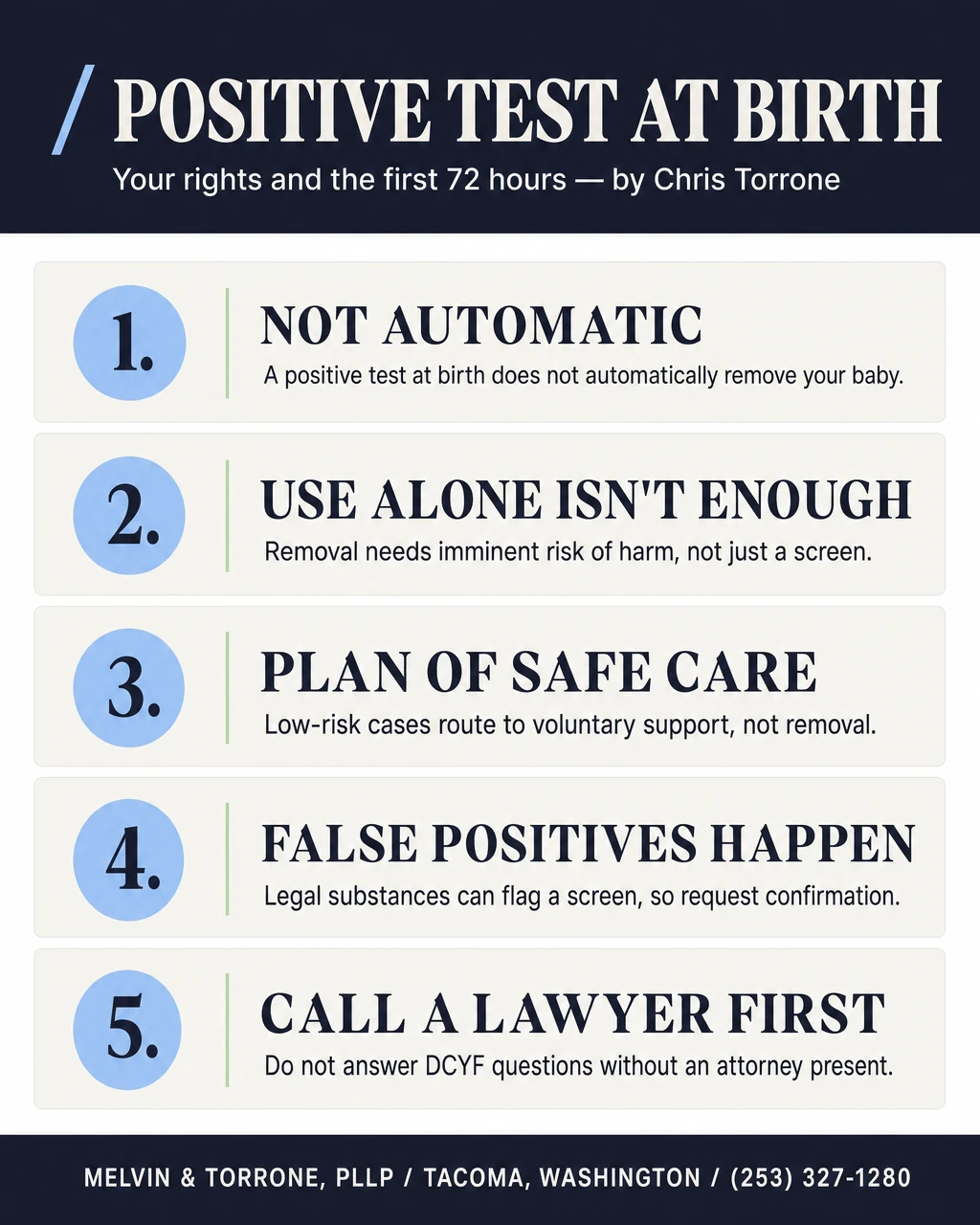
A positive drug test at birth in Washington is not an automatic removal order. Your rights apply the moment the question comes up.
-
Under RCW 13.34.065, substance use and prenatal drug or alcohol exposure cannot, by themselves, justify keeping your baby from you. The state has to show an actual, imminent safety risk.
-
Under Washington’s Plan of Safe Care, a baby exposed only to cannabis or to a doctor-prescribed treatment medication, with no other safety concerns, no longer triggers an automatic report to DCYF.
-
If your baby is removed, the shelter care hearing happens within 72 hours, excluding weekends and holidays. That hearing is your first real chance to argue for your child’s return.
-
False positives are real. Poppy seeds, prescribed medications, and even the pain medicine in your own epidural can flag a hospital screen. You can ask for a confirmatory test.
-
You can be polite and still decline to answer a caseworker’s questions until you have a lawyer. Everything you say is written down.
-
The sooner you involve an experienced Pierce County CPS attorney, the more options stay open to you.
Table of Contents
- Torrone’s Takeaways
- What a Positive Drug Test at Birth Triggers in Washington
- The First 72 Hours After a Positive Test
- How Washington’s Plan of Safe Care Works
- When a Case Becomes a Dependency Action
- Your Rights From the Moment of That Positive Test
- False Positives Are More Common Than Parents Realize
- Mistakes That Hurt a Parent’s Case
- How Melvin & Torrone, PLLP Helps Families Facing a Positive Test at Birth
- Frequently Asked Questions
- Conclusion
- Sources
What a Positive Drug Test at Birth Triggers in Washington
A positive screen at delivery starts an assessment, not an automatic removal. Whether anything more happens depends on the substance, your circumstances, and how the situation is handled in the first day or two.
How Washington Hospitals Decide Who Gets Tested
Not every parent who delivers in a Washington hospital gets drug tested, which surprises many people. Some hospitals screen every patient who comes through labor and delivery. Others test based on factors like limited prenatal care, certain pregnancy complications, or a disclosed history of substance use. The decision often comes down to that hospital’s own policy and the judgment of the clinician in the room, which is one reason testing is applied unevenly from facility to facility.
The Hospital’s Reporting Duty, and What Plan of Safe Care Changed
Washington’s mandatory reporting law, RCW 26.44.030, requires medical staff and other professionals to report suspected child abuse or neglect. For years, a flagged newborn often meant a report to DCYF before discharge. That has narrowed.
While the Keeping Families Together Act took effect, Washington also rolled out Plan of Safe Care (POSC), which is designed to keep substance-exposed newborns out of the child welfare system when there is no real safety concern. When a baby is born exposed to cannabis, or to synthetic opioids a doctor prescribed to treat substance use disorder (such as methadone or buprenorphine), and there are no other safety concerns, medical professionals no longer need to report the case to DCYF Intake. Instead, they refer the family to supports and services through a Plan of Safe Care.
That framework sits on top of a federal requirement. Under the federal Child Abuse Prevention and Treatment Act, as amended in 2016 and codified at 42 U.S.C. 5106a, states must have a process for health care providers to flag infants affected by substance exposure and must develop a plan of safe care addressing the needs of the infant and the caregiver. A POSC is Washington’s version of that plan. It is closer to a roadmap than a punishment, though what you agree to in it still carries weight.
A common situation I see is a parent who took a prescribed medication, sometimes a sleep aid or something for severe nausea, in the days before delivery. A routine urine screen flags positive, a social work consult goes in, and the information reaches DCYF before anyone looks at the medication list. The exposure had a simple, lawful explanation, but the paperwork was already moving.
Table: Washington drug testing at birth, what tends to prompt a report versus what does not
| Situation | Likely path | Automatic DCYF report? |
|---|---|---|
| Positive screen for illicit opioids, no prenatal care, unsafe home | Formal CPS investigation | Yes |
| Parent on doctor-prescribed methadone, stable housing, in treatment | Plan of Safe Care referral | Not automatically |
| Positive screen traced to epidural pain medicine, no other risk factors | Safety assessment, possibly voluntary services | Varies by hospital |
| Cannabis exposure only, no other safety concerns | Voluntary supports through Plan of Safe Care | Not automatically |
| Newborn with active withdrawal symptoms needing intensive care | Clinical concern can prompt a report | More likely |
| Positive screen from a prescribed medication, cleared by confirmatory testing | Case may close or never open | Less likely if challenged early |
| Positive screen plus limited prenatal care plus unstable housing | Higher likelihood of a dependency petition | Yes |
| Positive screen, parent cooperative with a Plan of Safe Care, no prior history | Voluntary services, often no court | Not automatically |
The First 72 Hours After a Positive Test
The first two or three days set the tone for everything that follows. Here is what tends to happen, and where parents lose ground without realizing it.
What Happens in the Hospital Room
The room changes fast when a positive result comes back. A social worker appears, questions start, and the mood shifts. Many hospitals use a 5-panel or 10-panel urine screen, and a preliminary result often gets treated as settled fact before anyone slows down to confirm it. You are recovering from childbirth, running on no sleep, and suddenly someone is asking about your substance use history. Knowing that moment is coming, and knowing what you do and do not have to say, makes a real difference.
The Safety Assessment Before You Go Home
Before discharge, a DCYF caseworker will often do a safety assessment of you, your baby, and your home situation. They look at your support network, your housing, any prior history with the agency, and whether you are engaged in treatment or prenatal care. Washington has been moving deliberately to reduce removals where it is safe to do so. The Keeping Families Together Act, which took effect on July 1, 2023, produced a 14% drop in children entering out-of-home care in its first year of implementation.
One pattern I see again and again is a parent who, trying to seem cooperative, starts over-explaining to the caseworker within minutes of delivery. They are exhausted and frightened and want to prove they are a good parent. Details they were never required to volunteer end up in the record, and the assessment stretches longer than it needed to. Being polite is smart. Volunteering your history without a lawyer is a different thing.
When DCYF Opens an Investigation Versus Offers Voluntary Services
DCYF does not open a full investigation on every family flagged at birth. The caseworker weighs safety concerns against protective factors, and the situation usually lands in one of two places: a voluntary services referral or a formal investigation. A voluntary referral means accepting support without an open legal case. A formal investigation means the agency is building a record, and that changes how you should respond.
How Washington’s Plan of Safe Care Works
A Plan of Safe Care connects families affected by prenatal substance exposure to support without automatically pulling them into court. It is a written plan, developed with your input, that lays out how your baby’s needs will be met and what services you will engage with.
What a Plan of Safe Care Asks of You
A POSC typically asks a family to commit to things like:
-
Engaging with substance use treatment or counseling
-
Keeping up regular medical checkups for the baby
-
Maintaining stable housing
-
Taking part in parenting support programs
-
Staying in consistent contact with the assigned caseworker
Voluntary Services Versus a Court Order
Voluntary services sit outside the court system, which is a real advantage. A court order, by contrast, creates enforceable obligations with deadlines, compliance requirements, and consequences if you fall short. The distance between those two outcomes is wide, and which one you land in often depends on how the early days are handled.
A common situation I see involves a family offered voluntary services under a Plan of Safe Care who assume voluntary means optional. A few missed check-ins later, what could have stayed a supportive, out-of-court arrangement turns into a formal referral. Voluntary does not mean consequence-free.
How Cooperation Affects Your Case
Consistent engagement with a Plan of Safe Care is one of the clearest signals you can send that you are a safe and capable parent, and caseworkers document that engagement. Washington’s removal numbers have fallen alongside these reforms. Between state fiscal year 2018 and the end of fiscal year 2023, the state saw a 35.6% decrease in the number of children in out-of-home care, a trend DCYF notes is broadly consistent with national patterns. A documented record of cooperation works in your favor if your case ever reaches a dependency hearing.
When a Case Becomes a Dependency Action
If voluntary services are not enough to satisfy DCYF that the baby is safe, the case can move into court as a dependency action under chapter 13.34 RCW.
What Triggers a Dependency Petition
A dependency petition is DCYF’s formal request asking a court to take legal jurisdiction over your child. It does not get filed just because a screen came back positive. State data on substance-exposed infants shows that about 34% of infants identified as substance-exposed or affected are placed in out-of-home care within 30 days of the intake. A petition typically follows when the agency believes voluntary services will not keep the baby safe.
The Shelter Care Hearing and the 72-Hour Rule
If your baby is removed, RCW 13.34.065 requires a shelter care hearing within 72 hours, excluding Saturdays, Sundays, and holidays. The primary purpose of that hearing is to decide whether the child can be safely returned home while the dependency case is pending. It is your first real opportunity to put your situation in front of a judge and argue for your child’s return, and it moves quickly.
A common situation I see is a parent who walks into that hearing alone, with no documentation of their treatment, their housing, or their support network. The judge is looking for a safe parent, not a perfect one. But the parent has given the court almost nothing to weigh in their favor. That hearing is the hardest place to be unprepared.
What the Court Weighs Before Deciding
At shelter care, the court releases the child unless it finds reasonable cause to believe removal is necessary to prevent imminent physical harm due to abuse or neglect, with evidence of a causal relationship between the conditions in the home and that harm. The statute is explicit that poverty, inadequate housing, substance abuse, prenatal drug or alcohol exposure, mental illness, disability, and nonconforming social behavior do not, by themselves, constitute imminent physical harm. One important caveat lives in the same statute: the court is directed to give great weight to the lethality of high-potency synthetic opioids, such as fentanyl, and to public health guidance about them. So the protection is real, but it is not absolute where a high-potency synthetic opioid is involved.
Your Rights From the Moment of That Positive Test
You have more rights at the bedside than most parents know, and they apply right away.
You Do Not Have to Answer DCYF Questions Without a Lawyer
You can decline to speak with a DCYF caseworker until you have legal counsel present. A caseworker is not law enforcement, but anything you say is documented and can be used in a dependency proceeding. Being courteous is smart. Answering questions about your history without a lawyer in the room is where avoidable harm happens.
Substance Use Alone Cannot Be the Sole Basis for Removal
This is one of the strongest protections Washington parents have, and few people know it exists. Under RCW 13.34.065, the state cannot use substance use or prenatal exposure, standing alone, as the basis for keeping your child out of your care. It must show an imminent threat of physical harm with a real connection to conditions in the home. Washington law also protects parents from removal decisions based solely on factors like:
-
Income level or poverty
-
Disability status
-
Inadequate or crowded housing
-
Nonconforming social behavior
Your Right to Challenge the Test Result
A positive screen is not the final word. The immunoassay urine screens most hospitals use are fast and cheap, but they are prone to false positives, which is why a preliminary positive is supposed to be confirmed by a more precise method. You have the right to ask which test was used, to obtain your full medical records from the birth, and to request confirmatory testing through a more specific method such as mass spectrometry. Challenging a flawed result is a legitimate strategy, and sometimes a winning one.
False Positives Are More Common Than Parents Realize
The screen used on most labor and delivery floors is a preliminary tool, not a definitive one. Plenty of lawful substances can set it off.
Legal Substances That Can Trigger a Positive Screen
A joint investigation by The Marshall Project and CBS News documented how routine, legal substances get misread by these screens. Common culprits include:
-
Poppy seeds in foods like bagels and muffins, which can read as opiates
-
Legal CBD and hemp products that cross-react on THC panels
-
Some blood pressure medicines, which can read as methamphetamine
-
A prescription ADHD medication such as Vyvanse, which can read as methamphetamine
-
Fentanyl or morphine given through your own epidural during labor
How to Request a Confirmatory Test
If a screen flags positive and you know why, or you have no idea why, ask for a confirmatory test right away. Mass spectrometry testing is far more specific than the standard immunoassay screen and can distinguish a prescribed or dietary source from an illicit one. If the hospital will not run one, you can pay for an independent test at a private lab and use those results. Document everything you took in the days before delivery, including prescriptions and over-the-counter products.
If DCYF Acts Before You Can Challenge It
DCYF does not always wait for a confirmatory test before acting. The same Marshall Project and CBS News investigation found that more than 70,000 reports were made to police or prosecutors across 21 states over a six-year period (federal fiscal years 2018 through 2023) based on these screens. If the agency has already moved on a positive result, your priority is documentation: your medication list, your birth records, and any independent test results you can get.
Mistakes That Hurt a Parent’s Case
Most of the damage I see is self-inflicted and well-intentioned. These are the three patterns worth guarding against.
1. Talking to DCYF Without a Lawyer
This one is almost always driven by good intentions. Parents think being open will show the caseworker they have nothing to hide. What tends to happen is that unguarded statements get recorded, taken out of context, and resurface later in a dependency petition. A caseworker’s job is to assess risk, not to advocate for you.
2. Refusing Every Service Without Understanding the Consequences
Refusing every service DCYF offers can feel like standing your ground, but courts read it differently. Pierce County judges pay attention to whether a parent engaged with available support, and a pattern of flat refusal can signal that you are not prioritizing your child. There is a real difference between declining a service strategically, with legal guidance, and refusing everything out of fear or anger. A few things to think through before refusing:
-
Refusing DCYF-ordered drug testing can accelerate proceedings
-
Declining parenting classes can be framed as resistance to addressing concerns
-
Skipping scheduled home visits creates documentation gaps that hurt reunification timelines
-
Turning away a substance use evaluation can read as non-compliance to the court
3. Waiting Too Long to Get a Lawyer Involved
Timing matters enormously. Waiting until a dependency petition is already filed puts you behind from day one. The shelter care hearing happens within 72 hours of removal, and every day without counsel is a day the case narrative is written without your input.
Table: Parent actions and how DCYF and courts tend to view them
| Parent action | How it is generally viewed | Effect on the case |
|---|---|---|
| Speaking freely to a caseworker without a lawyer | Statements documented and usable later | Negative |
| Requesting a confirmatory test right away | Shows awareness of rights and a proactive response | Positive |
| Engaging with Plan of Safe Care services | Demonstrates cooperation and parental fitness | Strongly positive |
| Refusing all services without legal guidance | Read as non-cooperative | Negative |
| Missing scheduled home visits | Creates compliance gaps in the record | Negative |
| Obtaining an independent confirmatory test | Provides a basis to dispute findings | Strongly positive |
| Appearing at shelter care without representation | Leaves the judge little favorable information | Strongly negative |
| Involving an experienced CPS attorney early | Helps shape the record and protect your rights | Strongly positive |
| Maintaining stable housing and a support network | A protective factor judges weigh | Positive |
| Engaging with treatment proactively | Signals commitment to your child’s welfare | Strongly positive |
How Melvin & Torrone, PLLP Helps Families Facing a Positive Test at Birth
Washington’s child welfare system has moving parts that a general practice attorney does not deal with every day. Plan of Safe Care, HB 1227, chapter 13.34 RCW, and the 72-hour shelter care timeline create a fast-moving environment where the early decisions shape the whole case. Families in Pierce County and across the South Sound need someone who works inside this system regularly.
I founded my Tacoma practice in 2011 to represent parents facing a child welfare system that can feel impossible to face alone, and that focus carried into Melvin & Torrone, PLLP. My colleague Jordan Foster brings deep criminal defense experience, which matters when a positive test at birth carries potential law enforcement exposure alongside the child welfare side. What we bring to a drug-exposed newborn case includes:
-
An early case review to assess whether the test result is challengeable
-
Representation at the 72-hour shelter care hearing
-
Guidance on engaging with or declining voluntary services
-
Communication with DCYF on your behalf from the start
-
Dependency defense if the case escalates to court
You tell us what happened, we listen without judgment, and we give you an honest read on where things stand and what your options are. We are located at 950 Pacific Ave, Suite 720, in Tacoma, and we serve families throughout Pierce County and the South Sound. Schedule a free case review or call us at (253) 327-1280.
Frequently Asked Questions
1. Does a positive drug test at birth automatically mean my baby goes into foster care?
No. Washington law requires DCYF to show an imminent risk of physical harm before removing a child, and prenatal substance exposure on its own is generally not enough. Many families are connected to voluntary supports through a Plan of Safe Care instead of facing removal.
2. My newborn’s screen came back positive for cannabis. What happens next?
A positive cannabis flag does not automatically trigger a full child protective services case. Under Plan of Safe Care, cannabis exposure with no other safety concerns no longer requires an automatic report to DCYF Intake, and many families are referred to voluntary services instead.
3. I had limited prenatal care during my pregnancy. Does that make a CPS investigation more likely?
Limited prenatal care is one factor some hospitals weigh when deciding whether to order a drug screen at delivery, and it can raise scrutiny. By itself, it does not establish abuse or neglect under Washington law, and it is not grounds for removal on its own.
4. Why was I tested when another parent on my floor was not?
Testing is not applied uniformly. Each hospital sets its own criteria, and the decision can come down to facility policy and a clinician’s judgment, so two parents in similar situations can be treated differently. You have the right to ask which test was used and why you were screened, and to request your full medical records from the birth.
5. Does federal law require Washington hospitals to report every positive drug test to child protective services?
Federal law under the Child Abuse Prevention and Treatment Act sets a baseline for notifying child protective services about substance-affected infants and for developing a plan of safe care. Washington’s Plan of Safe Care implements that framework so that low-risk cases, such as cannabis exposure or doctor-prescribed treatment medication with no other concerns, route to voluntary services rather than an automatic report.
6. My baby had withdrawal symptoms after birth. Does that change things?
Clinical signs like neonatal withdrawal can prompt a closer look and, depending on the circumstances, a report. They do not by themselves establish abuse or neglect. Courts and caseworkers review the full clinical and family picture, including your engagement with treatment and your support network.
7. Can I challenge how the hospital decided to flag me?
Yes. You can request your full hospital records, ask which testing method was used, and pursue confirmatory testing through a more precise method such as mass spectrometry. If a preliminary screen was wrong, that documentation is often the fastest way to clear it up.
Conclusion
A positive drug test at birth in Washington does not have to define what happens to your family. The system moves fast and the stakes are enormous, but the law gives parents more protection here than most people realize. A positive test is not an automatic removal, a Plan of Safe Care may keep a report from ever reaching DCYF, and you can decline to answer questions until you have counsel. Knowing that from the first day puts you in a far stronger position.
Sources
- RCW 13.34.065, Shelter care hearing, 72-hour timeline, and removal standard
- Chapter 13.34 RCW, Juvenile Court Act (dependency)
- RCW 26.44.030, Mandatory reporting of suspected child abuse or neglect
- DCYF, HB 1227 (Keeping Families Together Act) and Plan of Safe Care
- DCYF HB 1227 Data Update, October 2024
- DCYF, Infants Identified for Substance Exposure or Affected at Birth (2022)
- Washington Health Care Authority, Neonatal Abstinence Syndrome legislative report (2024)
- 42 U.S.C. 5106a (CAPTA), notification and plan of safe care requirements
- The Marshall Project and CBS News, drug testing during pregnancy and false positives
Each case is unique. Past results do not guarantee future outcomes. This article provides legal information, not legal advice. Reading this article does not create an attorney-client relationship with Melvin & Torrone, PLLP.

Chris Torrone
Founding Partner, Melvin & Torrone PLLP
Chris Torrone is a dedicated advocate for clients facing family crises and criminal charges. With 20 years of experience practicing in Pierce County courts, Chris has built a reputation for meticulous case preparation and creative problem-solving in high-stakes litigation.