
What Percentage of Marriages Survive Infidelity? (and what to do about it)

By Chris Torrone, Founding Attorney, Melvin & Torrone, PLLP
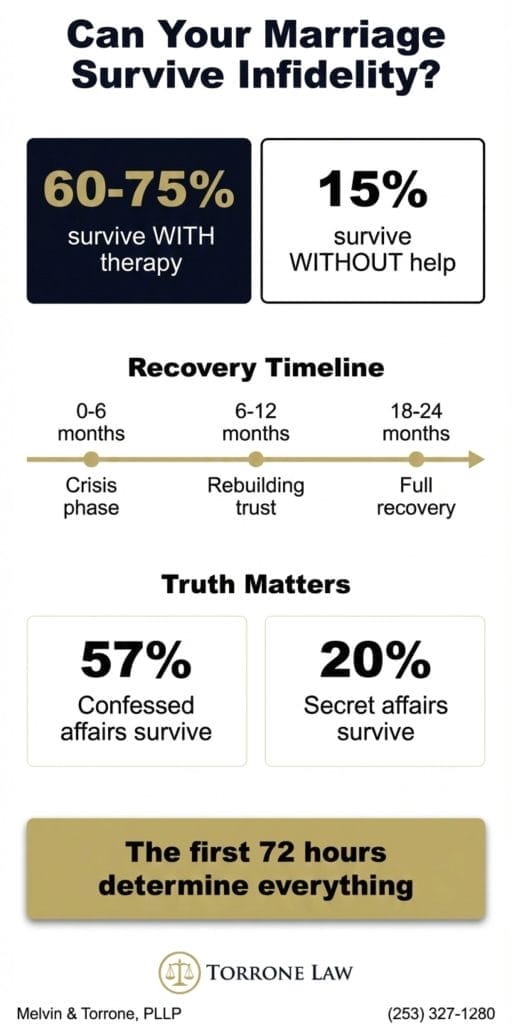
Between 60-75% of marriages survive infidelity when couples get professional help, but only 15% make it without therapy. I’ve spent two decades helping Tacoma families rebuild after extramarital affairs shattered their marriage vows, and the difference between those who stay together and those who don’t comes down to three things: timing, truth, and treatment. Both sexual infidelity and emotional infidelity destroy romantic relationships, but your next move matters more than the betrayal itself.
Torrone’s Takeaways
-
Therapy doubles your survival odds from 25% to 60-75%, so get professional help immediately after discovering infidelity
-
Truth matters more than you think because confessed affairs have triple the survival rate of secret ones discovered later
-
The first 72 hours determine everything, so pause before making permanent decisions during temporary insanity
-
Washington’s no-fault divorce laws mean infidelity won’t affect your 50-50 property split or custody decisions in Pierce County courts
-
Real trust restoration takes 18-24 months minimum when both partners commit to the difficult work
-
If you can’t imagine trusting them again in two years, that’s your gut telling you the answer
-
Free consultation gives you clarity about your options whether you’re rebuilding or walking away with dignity
Table of Contents
- The Numbers Behind Marriage Survival After Cheating
- Secret Affairs Kill Marriages 80% Faster Than Confessed Ones
- Warning Signs Your Marriage Won’t Survive This Betrayal
- The First 72 Hours Determine Everything About Your Future
- How Washington’s No-Fault Divorce Laws Change Your Decision Timeline
- Rebuilding Trust Takes 18-24 Months When Both Partners Actually Commit
- Five Questions That Tell You Whether to Stay or File for Divorce
- Why Tacoma Families Choose Melvin & Torrone When Infidelity Hits Home
- Frequently Asked Questions
- Conclusion
The Numbers Behind Marriage Survival After Cheating
Why Only 25% Stay Together Without Professional Help
When betrayed partners try going it alone, only 15.6% of marriages survive. That’s because most couples make the same mistake in the first week after discovering marital infidelity. They either shut down completely or explode in anger without any framework for processing the trauma. About 54.5% of couples break up immediately after discovering an extramarital affair, and it usually happens because neither person knows how to handle the conversation that comes next.
How Therapy Doubles Your Odds from 25% to 60-75%
A 38-year-old teacher from Puyallup discovered her husband’s emotional infidelity through social media messages in 2023. She felt destroyed. But after six months of relationship counseling using emotionally focused therapy, they rebuilt their romantic relationship stronger than before. That’s the pattern I see with couples who commit to professional help. Between 60-75% of marriages survive when both partners show up to therapy and do the actual work. The difference isn’t the severity of the affair partner relationship but whether you’re willing to examine what broke in the first place.
Washington State Marriages Face Higher Stakes with 2.8 Divorce Rate Per 1,000
Washington’s divorce rate sits at 2.8 per 1,000 people, slightly higher than surrounding states. That means couples here already face steeper odds before sexual infidelity even enters the picture. Pierce County courts see hundreds of divorce filings every month where affairs triggered the final breakdown. The question isn’t whether your marriage can statistically survive. The question is whether you both want to fight for marital satisfaction or walk away with your dignity intact.
Table: Marriage Survival Rates After Infidelity (Sources: Health Testing Centers Survey (2019), American Psychological Association (2014))
| Scenario | Survival Rate | Timeline |
|---|---|---|
| No professional help | 15.6% | 5 years post-discovery |
| With couples therapy | 60-75% | 5 years post-treatment |
| Secret affair discovered later | 20% | 5 years post-treatment |
| Confessed before discovery | 57% | 5 years post-treatment |
| Unfaithful husband | 61% stay married | Long-term |
| Unfaithful wife | 44% stay married | Long-term |
| Immediate breakup rate | 54.5% | Within weeks of discovery |

Secret Affairs Kill Marriages 80% Faster Than Confessed Ones
The 20% vs 57% Survival Gap When Truth Comes Out
The numbers tell a brutal story about secrets. When affairs stay hidden and surface later, only 20% of marriages survive five years post-treatment. But when the unfaithful partner confesses before discovery, 57% of couples stay married after therapy. That’s nearly triple the survival rate. I’ve seen this pattern repeatedly with betrayed partners who learned the truth through confession versus those who discovered it themselves. The relationship trauma cuts deeper when you had to become a detective instead of hearing honest accountability.
Why Husbands Survive Their Own Affairs More Often Than Wives Do
Gender creates a surprising survival gap in romantic relationships affected by infidelity. Research shows 61% of unfaithful husbands remain married compared to only 44% of unfaithful wives. The reasons are complex but consistent:
-
Women often struggle more with sexual jealousy when their husbands stray
-
Men experience deeper emotional jealousy but sometimes compartmentalize sexual infidelity
-
Society still judges female infidelity more harshly, creating additional shame
-
Women who cheat often report pre-existing emotional distance before the affair partner entered
The Five-Year Mark Where 53% of Couples Hit Breaking Point
A Tacoma couple in their early fifties came to me in 2019 after rebuilding from his emotional infidelity. They’d done everything right for three years. Individual therapy, couples counseling, rebuilt sexual intimacy. Then year four hit and old attachment injuries resurfaced during a stressful job loss. By year five, they filed for divorce. That matches what research shows about infidelity couples having double the divorce rate of non-infidelity couples five years post-treatment. The affair doesn’t kill the marriage immediately. It plants seeds of distrust that bloom years later under pressure.
Warning Signs Your Marriage Won’t Survive This Betrayal
When Emotional Withdrawal Means Someone Already Checked Out
Temporary distance after discovering infidelity is normal. But when your partner shows zero interest in rebuilding emotional intimacy after three months, that’s different. I can usually tell within the first consultation whether someone wants to save their monogamous relationship or just wants permission to leave. The signs are consistent:
-
They avoid discussing the affair partner or dismiss your questions
-
Physical touch feels forced or nonexistent beyond basic courtesy
-
They prioritize social media and chat rooms over face-to-face conversations with you
-
Future planning stops completely
The Difference Between Remorse and Regret That Predicts Divorce
A 29-year-old construction worker from Lakewood came to me after his wife discovered his romantic infidelity through text messages. He kept saying “I’m sorry you’re hurt” instead of “I was wrong.” That’s regret, not remorse. Regret means feeling bad about consequences.
Remorse means taking full ownership of the boundary violation and the attachment injuries you caused. Betrayed partners can sense the difference immediately. When someone shows genuine remorse, they answer every painful question without defensiveness. They rebuild trust through consistent actions over months, not just words during one emotional conversation.
Why Recurring Trust Issues After Year One Signal Long-Term Failure
If you’re still checking their phone daily 18 months after the affair ended, something broke that therapy couldn’t fix. Normal healing involves gradual trust restoration where triggers become less frequent and less intense. But when emotional dysregulation continues past year one, and every business trip causes panic attacks, the relationship trauma runs too deep.
I’ve watched couples spend three years in relationship counseling only to divorce because the betrayed partner couldn’t stop reliving the discovery moment. Sometimes the attachment trauma creates permanent damage and a broken link that no amount of couple healing can repair.
Table: Genuine Remorse vs Damage Control
| Category | Genuine Remorse | Damage Control |
|---|---|---|
| Communication | Answers every question without defensiveness | ”Why do you keep bringing this up?” |
| Accountability | ”I was completely wrong and hurt you" | "I’m sorry you feel that way” |
| Contact with affair partner | Immediately cuts off all contact permanently | ”We’re just friends now” |
| Therapy attitude | Attends willingly, does homework assignments | Goes reluctantly or refuses entirely |
| Transparency | Offers phone access without being asked | Password protects everything, defensive when questioned |
| Timeline expectations | ”I know this takes years to rebuild" | "When are you going to get over this?” |
| Blame pattern | Takes full responsibility for choices | ”You pushed me away, what did you expect?” |
The First 72 Hours Determine Everything About Your Future
What to Do Immediately After Discovery Without Making Things Worse
Your brain is screaming at you to do something right now. But the first 72 hours after discovering sexual infidelity require strategy, not emotion. Take three deep breaths before any confrontation. Document what you found without destroying evidence. Tell one trusted person what happened so you’re not alone with this infidelity-based trauma. Don’t post on social media sites or blast your partner publicly. Don’t make permanent decisions during temporary insanity. I’ve seen people ruin their court cases and destroy reconciliation chances because they acted on rage instead of wisdom during the first three days.
Why Confrontation Style Predicts Your Recovery Success Rate
The way you handle the first conversation about the affair partner matters more than what was said in those secret chat rooms. Screaming and throwing things might feel justified, but it triggers defensive walls that take months to break down. Asking clear questions with pauses for answers creates space for truth. I’ve noticed couples who start with “I need to understand what happened” instead of “You destroyed everything” have better odds of rebuilding emotional closeness. Your pain is valid, but how you express that pain either opens doors to healing or slams them shut permanently.
Critical Mistakes That Push Reconciliation Into Divorce Territory
A Gig Harbor mom in her mid-thirties discovered her husband’s hookup app history during the COVID-19 lockdown period in 2020. She immediately told his parents, posted vague accusations online, and demanded he leave within 24 hours. All three actions killed any chance of reconciliation before therapy could even start.
The mistakes I see repeatedly are demanding immediate decisions about the marriage, involving extended family before processing your own feelings, and using social network platforms as weapons. These moves feel powerful in the moment but create irreversible damage to any future relationship contract you might rebuild together.

How Washington’s No-Fault Divorce Laws Change Your Decision Timeline
The 90-Day Waiting Period You Need to Know About
Washington State requires a mandatory 90-day waiting period from the date you file for marital dissolution until the divorce can be finalized. That means even if you discover sexual infidelity today and file tomorrow, you’re looking at three months minimum before anything is final. This waiting period exists specifically to give couples time to reconsider and attempt reconciliation.
I’ve seen angry spouses file immediately after discovering an affair partner, then use those 90 days for intensive therapy and ultimately withdraw the petition. The cooling-off period protects people from making permanent decisions during peak emotional dysregulation.
Community Property Rules That Split Everything 50-50 Regardless of Fault
A 44-year-old Boeing engineer from Federal Way came to my office in 2022 convinced his wife’s romantic infidelity meant he’d keep the house and retirement accounts. I had to deliver hard news. Washington splits marital property 50-50 regardless of who violated marriage vows. Community property rules don’t care about affair partners or broken trust. The cars, savings, retirement funds, and debts accumulated during marriage get divided equally unless you have a prenuptial agreement. Infidelity might destroy your emotional intimacy, but it won’t change your financial split in court cases.
Why Infidelity Won’t Affect Your Settlement in Pierce County Courts
Pierce County judges handle divorce as a purely legal transaction, not a moral judgment. Your spouse’s extramarital affair won’t impact custody decisions unless it involved domestic violence or child endangerment. It won’t affect spousal maintenance unless financial deception occurred alongside the betrayal.
Washington adopted no-fault divorce laws decades ago specifically to remove blame from the legal process. I explain this to every client who wants their day in court to expose their partner’s betrayal. The judge won’t care about the affair partner or chat room messages. They care about dividing assets fairly and protecting children’s best interests.
Table: Washington State Divorce Process Timeline
| Stage | Timeline | What Happens | Cost Range |
|---|---|---|---|
| Filing Petition | Day 1 | Paperwork filed with Pierce County court | $280-350 filing fee |
| Serving Spouse | Days 1-30 | Legal service of divorce papers | $50-100 service fee |
| Response Period | 20-60 days | Spouse has time to respond to petition | Varies if contested |
| Temporary Orders | 30-90 days | Child custody, support, living arrangements set | $500-2,000 attorney time |
| Discovery Phase | 90-180 days | Financial disclosure, asset documentation | $1,500-5,000 attorney time |
| Mandatory Waiting Period | 90 days minimum | State-required cooling off period from filing date | N/A |
| Settlement Negotiation | 120-270 days | Working toward agreement on all issues | $2,000-8,000 attorney time |
| Final Hearing | 180-365 days | Judge signs final divorce decree | $3,000-15,000+ total |
Rebuilding Trust Takes 18-24 Months When Both Partners Actually Commit
The Monthly Milestones That Show Real Progress vs False Hope
A University Place couple in their early forties started relationship counseling after his emotional infidelity in spring 2023. By month three, she stopped checking his phone obsessively. By month six, they had their first genuine date night without discussing the affair. By month twelve, sexual intimacy returned without feeling forced. By month eighteen, triggers became rare instead of daily. That’s the realistic timeline I see when both partners commit to couple healing. Research confirms 18-24 months minimum before attachment injuries truly heal and emotional closeness feels natural again, not performed.
When Individual Therapy Matters More Than Couples Counseling
Sometimes your own attachment trauma needs attention before you can work on the marriage together. Betrayed partners dealing with suicidal ideation or severe emotional dysregulation benefit more from individual therapy first. The unfaithful partner needs solo sessions to understand why they sought an affair partner instead of addressing problems at home. Emotionally focused therapy shows a 70-75% long-term success rate, but it only works after each person processes their individual attachment styles and wounds. I always recommend starting with separate therapists before jumping into joint sessions.
How 65% of Couples Report Stronger Intimacy After Full Recovery
This sounds impossible when you’re six months into recovery and still crying randomly. But couples who survive infidelity and complete the full healing process often report posttraumatic growth that transforms their romantic relationships. The statistics back this up:
-
Five-year follow-up studies show survivors report marital satisfaction levels identical to non-infidelity couples
-
Many describe deeper emotional intimacy than before the betrayal
-
Sexual intimacy often improves because couples finally communicate openly about needs
-
The shared trauma creates bonding that superficial marriages never develop
The affair forced conversations about sexual ruts, emotional distance, and unmet needs that should have happened years earlier.
Table: Trust Rebuilding Timeline Month by Month
| Month Range | What Success Looks Like | Red Flags to Watch |
|---|---|---|
| Months 1-3 | Frequent tears, constant questions, phone checking daily | Continued contact with affair partner, defensiveness, blame-shifting |
| Months 4-6 | Slightly longer periods between triggers, first genuine conversations | Still lying about details, refusing therapy, emotional withdrawal |
| Months 7-12 | Date nights without discussing affair, rebuilding physical intimacy | Daily phone checking continues, no reduction in anxiety |
| Months 13-18 | Triggers become weekly instead of daily, future planning resumes | Resentment growing stronger, sexual intimacy still forced |
| Months 19-24 | Affair becomes part of your story not your identity, genuine trust moments | Trust issues as intense as month one, constant fear |

Five Questions That Tell You Whether to Stay or File for Divorce
1. Can You Imagine Trusting Them Again in Two Years?
Close your eyes and picture yourself 24 months from now. Can you see a version of your marriage where you don’t check their phone, where intimacy feels genuine, where the affair partner becomes a distant memory instead of a daily intrusion? I ask every client this question during our first meeting about marital infidelity. If you can’t visualize any future without resentment poisoning every interaction, that’s your answer. Trust restoration requires believing recovery is possible. Some betrayals create attachment injuries too deep for imagination to bridge.
2. Are They Showing Genuine Remorse or Just Damage Control?
Genuine remorse looks like answering every painful question without defensiveness, cutting off all contact with the affair partner immediately, and attending therapy without being forced. Damage control looks like minimizing what happened, blaming you for driving them to infidelity, or showing anger that you can’t just move on.
A Spanaway dad in his late fifties came to me in 2024 after discovering his wife’s romantic infidelity through social media. She refused to stop talking to the other person, claiming they were “just friends now.” That’s not remorse. That’s someone who hasn’t accepted responsibility for the boundary violation.
3. Does Staying Together Damage Your Children More Than Divorce?
Kids don’t need perfect parents, but they need emotionally healthy ones. If your home fills with constant tension, passive-aggressive attacks, or complete emotional withdrawal after the affair, your children absorb that toxicity daily. Research on children in high-conflict marriages shows worse outcomes than children of divorce. I watch parents stay together “for the kids” then model dysfunction that shapes their children’s future romantic relationships. Sometimes the healthiest gift you give your family is two separate, peaceful homes instead of one battlefield.
4. Do You Both Want the Same Future or Just Avoiding the Pain of Leaving?
This question separates real reconciliation from relationship limbo. Successful couples who rebuild after sexual infidelity share a vision for their second marriage together. They both want to restore emotional intimacy, rebuild sexual desire, and create something better than before. But many couples stay because leaving feels harder than existing in quiet misery. Neither partner fights for the marriage, they just avoid the discomfort of marital dissolution. That’s not a marriage worth saving. That’s two people postponing the inevitable.
5. What’s the Real Cost of Trying Versus Walking Away Today?
Calculate the actual investment required for recovery. Relationship counseling costs $150-250 per session weekly for 18-24 months. Individual therapy adds another $500-1000 monthly. Time investment means two years of difficult conversations, triggers, and emotional labor. Now calculate divorce costs in Pierce County including attorney fees, splitting assets, establishing separate households, and potential spousal maintenance.
Compare both paths honestly. Some marriages are worth the investment in couple healing. Others cost more to save than to end with dignity. I can’t tell you which applies to your situation, but the numbers often reveal what your heart already knows.
Why Tacoma Families Choose Melvin & Torrone When Infidelity Hits Home
Our 90% Divorce Success Rate Protects Your Rights During the Worst Time
When marital infidelity destroys your marriage vows, you need a fierce advocate who understands Pierce County courts. We’ve closed over 1,345 cases with a 90% success rate in divorce matters. I founded this practice in 2011 specifically to fight for families navigating the worst moments of their lives.
Free 30-Minute Consultation Answers Your Immediate Questions
You’re dealing with relationship trauma and need answers today, not next week. Our free consultation gives you clarity about Washington’s community property rules, the 90-day waiting period, and your realistic options. We explain complicated legal processes with language that makes sense, so you can make informed decisions about your future.
Decades of Pierce County Experience That Ends Confusion and Starts Clarity
We know every judge, every courtroom, and every procedure in Tacoma family law cases. You’re known by your name here, not a case number. Whether you’re considering divorce after discovering sexual infidelity or need help protecting your rights during marital dissolution, contact us at (253) 327-1280 or open our consultation page to schedule your consultation today.
Frequently Asked Questions
1. Does emotional infidelity count as real cheating or is it just friendship?
Emotional infidelity absolutely counts as cheating when your partner shares intimate thoughts, feelings, and emotional closeness with someone else that should belong to you. I see this type of extradyadic relationship destroy marriages just as effectively as sexual affairs because the emotional betrayal cuts deeper than physical acts.
2. Can someone cheat again after being caught once?
Research shows people who cheat once are three times more likely to cheat in future romantic relationships. Past behavior predicts future actions unless they do serious individual therapy addressing their attachment theory issues and relationship patterns. Serial cheaters rarely change without professional intervention targeting the root causes.
3. How do cyber-behaviors and virtual apps change what counts as cheating today?
Online affairs through virtual apps, sexting, and secret social media relationships cause the same attachment injuries as physical affairs. The United States has seen a massive increase in cyber-behaviors that cross boundaries. If you’re hiding the interaction from your spouse, you already know it’s wrong.
4. Should we try a polyamorous arrangement to save our marriage after infidelity?
Opening your marriage after betrayal almost never works because the foundation already broke. A polyamorous arrangement requires massive trust, communication, and relational intelligence that infidelity destroyed. I’ve never seen this approach succeed when used as a band-aid for existing marital deceptions rather than a mutual choice made from strength.
5. Will my psychological health ever recover from discovering their affair?
Most betrayed partners experience symptoms matching adjustment disorder for 6-12 months after discovery. Your psychological health gradually improves with therapy and time. Some people report full recovery within two years while others carry triggers indefinitely. Individual therapy helps process the relationship trauma faster than suffering alone.
6. What role does attachment theory play in why people cheat?
People with anxious or avoidant attachment styles developed in childhood often seek validation outside their marriage when feeling emotionally distant. Attachment theory explains why some individuals struggle with sexual fidelity more than others. Understanding your attachment patterns through therapy helps prevent repeating destructive relationship choices.
7. Does infidelity affect child custody decisions in Washington State?
Washington judges only consider infidelity in custody cases when it directly endangered the children or involved domestic violence. Your affair partner doesn’t matter to Pierce County courts unless parental investment theory gets compromised through neglect or putting kids in unsafe situations. Cheating makes you a bad spouse, not automatically a bad parent.
8. How do therapists decide between recommending reconciliation or divorce?
Therapists’ treatment decisions focus on safety, genuine remorse, and both partners’ willingness to do the work. We look at patterns of marital deceptions, emotional availability, and whether attachment injuries can realistically heal. Good therapists never force reconciliation when the relationship shows signs of permanent damage.
9. Can erotic rituals or changing our sex life prevent future affairs?
Rebuilding sexual intimacy through new erotic rituals helps some couples reconnect after betrayal. But affairs usually stem from emotional disconnection, not just sexual boredom. Social exchange theory suggests people cheat when they perceive greater rewards elsewhere. You need to address both emotional and physical intimacy for long-term sexual fidelity.
10. What if I suspect a paternal discrepancy after discovering the affair?
Paternal discrepancy concerns arise when timing suggests your child might not be biologically yours. Washington law presumes the husband is the legal father regardless of biology. DNA testing requires careful legal guidance because results affect custody, support, and your rights. Contact us immediately if you’re facing this situation alongside divorce proceedings.
Conclusion
Infidelity destroys marriages, but you don’t have to face marital dissolution alone. We’ve helped hundreds of Tacoma families protect their rights during the worst moments of their lives. Whether you’re considering reconciliation or need aggressive representation in divorce proceedings, our team brings decades of Pierce County experience to your corner. We explain Washington’s community property rules and 90-day waiting period with clarity that eliminates confusion.
Your next move matters more than the betrayal itself. Call us at (253) 327-1280 or click here to book your free 30-minute consultation and create a personalized plan for your future today.

Chris Torrone
Founding Partner, Melvin & Torrone PLLP
Chris Torrone is a dedicated advocate for clients facing family crises and criminal charges. With 20 years of experience practicing in Pierce County courts, Chris has built a reputation for meticulous case preparation and creative problem-solving in high-stakes litigation.
Need Legal Help?
Schedule Your Free Consultation
If you're facing a legal issue discussed in this article, our Tacoma attorneys are here to help.
Get Your Free Consultation