
What are the Hardest Years of Marriage?

By Chris Torrone, Founding Attorney, Melvin & Torrone, PLLP
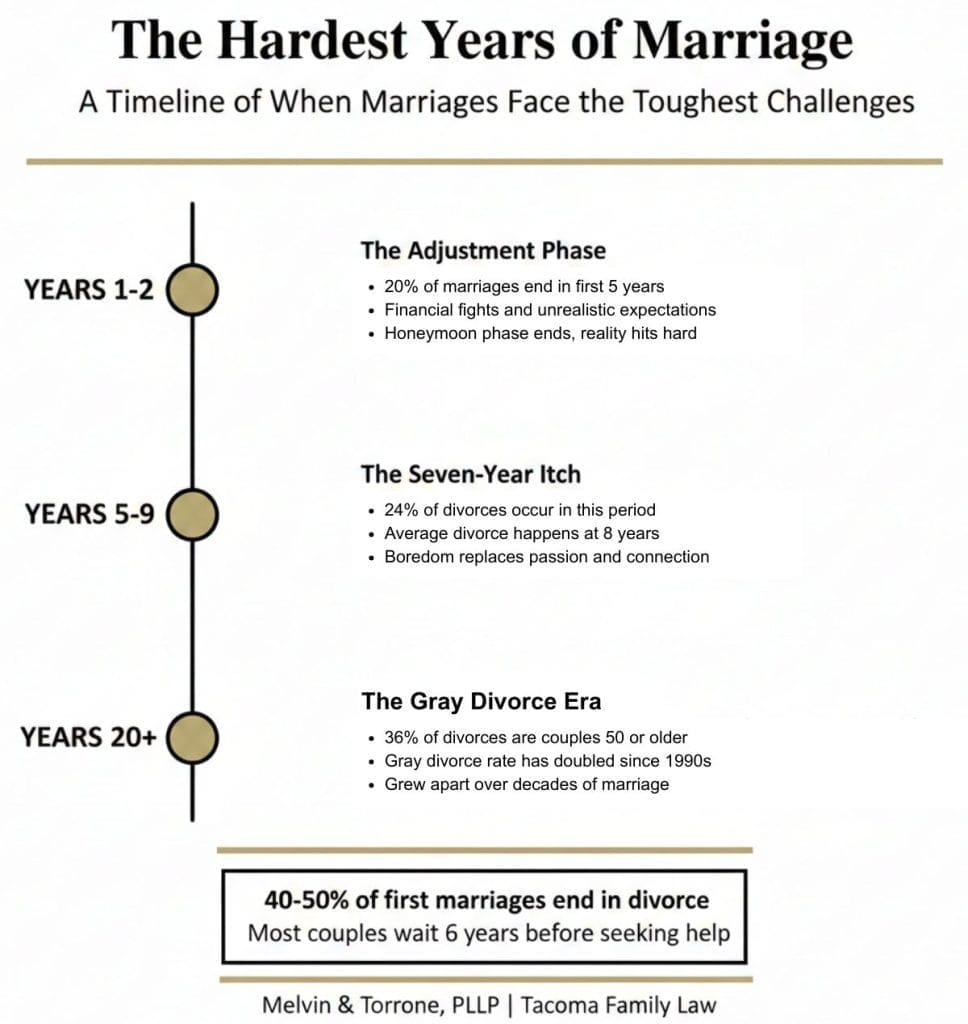
The hardest years of marriage typically hit during years 1-2, 7, and 15-20, when life transitions expose the cracks most couples try to ignore. As a family lawyer who has spent over two decades helping Tacoma families through their toughest moments, I’ve seen the pattern repeat itself. The honeymoon phase ends fast, the seven-year itch shows up right on schedule, and empty nesters suddenly realize they’ve been living like roommates for years.
Your marriage isn’t failing because you’re broken. It’s struggling because you’re human, facing predictable pressure points that challenge even the strongest couples.
Torrone’s Takeaways
-
Years one through two, seven, and fifteen through twenty hit hardest when life transitions expose the cracks you’ve been ignoring
-
Financial fights and communication breakdown destroy more marriages than infidelity, and those problems start early in year one
-
The seven-year itch is statistically real, with twenty-four percent of divorces happening between years five and nine
-
Empty nesters discover they built their marriage around kids and have nothing left when the children leave home
-
Gray divorce rates have doubled since the 1990s as couples over fifty refuse to stay in unsatisfying marriages
-
Most couples endure around three years of misery before seeking help, waiting until the damage runs too deep to repair
-
Schedule counseling immediately when you’re living like roommates, not after resentment calcifies into something permanent
Table of Contents
- The First Two Years Feel Like a Crash Course in Compromise
- Years Three and Four Bring the Baby Question and Career Pressures
- The Seven Year Itch Is Real According to Washington Divorce Data
- Years Ten Through Fifteen Create a False Sense of Security
- Midlife Marriages Face Different Challenges After Twenty Years
- Washington State Marriage and Divorce Statistics
- What Family Lawyers See When Couples Finally Call for Help
- Fighting for Your Marriage is Better With Legal Guidance
- Frequently Asked Questions
- Conclusion
The First Two Years Feel Like a Crash Course in Compromise
The Reality Shock That Nobody Warned You About
The honeymoon phase ends faster than anyone admits. You’re suddenly sharing a bathroom with someone who leaves toothpaste everywhere, arguing about whose turn it is to do laundry, and realizing your partner’s “quirks” are actually permanent personality traits. Twenty percent of marriages end within the first five years, and most of those couples never made it past the adjustment phase that hits hardest in year one.
Money Fights Start Early and Hit Hard
Financial stress doesn’t wait politely until you’re settled. According to research, 40% of couples point to money issues as the reason they split, and those fights typically start before the first anniversary. Joint accounts become battlegrounds when one person is a saver and the other thinks budgets are suggestions. A Gig Harbor couple in their late twenties came to me after eighteen months of marriage, drowning in wedding debt and blaming each other for every Amazon purchase.
What to Do When the Honeymoon Phase Ends
Stop pretending everything is fine when it’s not. Couples who argue about finances at least once a week are thirty percent more likely to divorce, but the ones who survive learn to talk about money before resentment builds. Schedule monthly money meetings where you both review spending without judgment. Date nights matter too, even cheap ones, because emotional connection prevents the roommate dynamic that kills so many young marriages before they hit year three.
Table: Action Steps for Each Hard Year of Marriage
| Marriage Stage | Warning Signs to Watch For | What You Should Do Right Now | When to Call a Lawyer |
|---|---|---|---|
| Years 1-2 | Constant money fights, buyer’s remorse, feeling trapped | Schedule monthly budget meetings, attend premarital counseling even after the wedding, learn conflict resolution skills | If domestic violence occurs or financial abuse starts |
| Years 3-4 | Baby question causing daily fights, career resentment building, different life visions | Have honest kids-or-no-kids conversation, discuss career sacrifices before pregnancy, see a couples therapist | If fundamental disagreements can’t be resolved and resentment is permanent |
| Years 5-9 | No sex life, living like roommates, emotional affairs starting | Weekly date nights non-negotiable, learn each other’s love language again, marriage counseling immediately | If extramarital affair happens or separation seems inevitable |
| Years 10-15 | Empty nest panic, realizing you have nothing in common, silence at dinner | Rediscover individual identities, try new activities together, rebuild emotional intimacy intentionally | If you’re staying together only for the kids who are now grown |
| Years 20+ | Wanting completely different retirements, decades of unspoken resentment, gray divorce thoughts | Soul searching conversations about your next chapter, couples therapy focused on reinvention, financial planning together | When you’ve decided divorce is healthier than staying in an unhappy marriage |

Years Three and Four Bring the Baby Question and Career Pressures
The Kids or No Kids Conversation Can Make or Break You
This is when the “someday” conversation becomes “right now,” and suddenly you’re facing a decision that defines your entire future. One partner feels their biological clock ticking while the other still wants to travel and save money. I’ve watched Pierce County couples who genuinely loved each other realize they wanted completely different lives, and no amount of compromise fixes that fundamental split when someone desperately wants children and their spouse absolutely doesn’t.
When Career Ambitions Clash With Family Plans
Work demands peak during these years right when the baby pressure hits hardest. Someone gets a promotion that requires sixty-hour weeks, or a dream job offer arrives in another state, and suddenly you’re negotiating who sacrifices their career for the relationship. A Tacoma tech worker in her early thirties sat in my office explaining how her husband expected her to quit her six-figure job when their first baby arrived, even though they’d never discussed that expectation during their courtship years.
Practical Steps to Survive This Transition Period
Talk about the infant and toddler years honestly before you’re pregnant and emotions run too high. Discuss financial planning for childcare, career adjustments, and what your actual family routines will look like when sleep deprivation hits. If one partner wants kids and the other doesn’t, meeting with a marriage counselor now saves you from a devastating divorce later. These conversations feel uncomfortable, but marital dissatisfaction grows fastest when couples avoid the hard topics during this pressure point.
The Seven Year Itch Is Real According to Washington Divorce Data
What Divorce Statistics Actually Show About Year Seven
The average marriage that ends in divorce lasts eight years, which means the seven-year itch hits right before couples call it quits. Twenty-four percent of divorces happen between years five and nine, making this the second deadliest period after the first five years. The data backs up what I see in my Tacoma office every week: couples who made it through the early chaos hit a wall around year seven when familiarity breeds contempt.
Boredom and Routine Replace the Spark You Once Had
Your sex life becomes predictable or nonexistent. Date nights disappeared somewhere between the second kid and the mortgage refinance. A Federal Way couple in their mid-thirties recently told me they couldn’t remember the last time they had a conversation that wasn’t about logistics, bills, or whose turn it was to handle the kids’ middle school drama. They’d become efficient roommates running a household together, but the emotional intimacy that kept them connected had quietly died years earlier.
How to Reignite Connection Before It’s Too Late
Stop waiting for passion to magically return and start building it intentionally. Schedule weekly date nights like they’re doctor appointments you can’t miss, even if it’s just coffee after the kids go to bed. Learn each other’s love language again because people change over seven years and what made your spouse feel loved at twenty-five might not work at thirty-two. Couples therapy isn’t a last resort for failing marriages; it’s preventive maintenance that keeps good marriages from becoming divorce statistics.

Years Ten Through Fifteen Create a False Sense of Security
Why This “Second Honeymoon” Period Doesn’t Last Forever
You’ve survived the hardest years and things actually feel stable for once. The kids are more independent, careers are established, and you’re not arguing about money every week like you used to. This comfortable plateau tricks couples into thinking they’ve made it, but complacency is dangerous because you stop doing the work that got you through the rough patches, and relationship dynamics shift without anyone noticing until it’s too late.
Empty Nest Syndrome Exposes the Cracks You Ignored
Empty nesters suddenly realize they built their entire marriage around raising kids and have nothing left in common. You spent fifteen years as a parenting team, and now you’re staring at a stranger across the dinner table with no idea what to talk about. A Puyallup couple in their late forties came to see me after their youngest left for college, admitting they’d been functioning as co-parents for so long that they forgot how to be husband and wife, and the silence in their house felt unbearable.
Action Steps for Couples Who Feel Like Roommates
Start having conversations that aren’t about the kids, the house, or work logistics. Rediscover who you both are as individuals now because people change dramatically between thirty and forty-five. Try new activities together instead of falling into the same tired routines that reinforce the roommate dynamic. A mental health professional or relationship therapist can help you rebuild emotional connection before resentment calcifies into something unfixable that leads to divorce after twenty years together.
Midlife Marriages Face Different Challenges After Twenty Years
Gray Divorce Rates Are Climbing in Washington State
Thirty-six percent of adults getting divorced in recent years are fifty or older, and that number keeps climbing. The gray divorce rate has doubled since the 1990s, and for couples over sixty-five, it’s tripled. Susan Brown, the sociology professor at Bowling Green State University who coined the term “gray divorce,” notes that celebrity splits in this age group normalize the idea that you don’t have to stay in an unsatisfying marriage just because you’ve invested decades together.
When Personal Growth Means Growing Apart From Your Spouse
The person you married at twenty-five is fundamentally different at fifty, and sometimes that evolution takes you in opposite directions. One spouse discovers new passions, political beliefs, or life goals during their midlife crisis while the other stays exactly who they’ve always been. A Lakewood business owner in his early fifties recently filed for divorce after realizing he and his wife had spent twenty-three years raising kids and building wealth but never bothered to check if they still shared the same values, dreams, or vision for retirement.
What Long-Term Couples Can Do to Stay Connected
Schedule regular soul searching conversations about where you both are in life and where you want to go next. The median marital duration at first divorce for those fifty and older is twenty-nine years, which means couples often wait until they’re miserable before addressing problems. Long-term connection requires:
-
Treating your spouse like someone you’re still getting to know, not someone you figured out decades ago
-
Making emotional intimacy a priority even when physical intimacy changes with age
-
Building a shared vision for retirement instead of assuming you want the same things
Couples counseling helps you rebuild connection before resentment becomes permanent.

Washington State Marriage and Divorce Statistics
How Pierce County Divorce Rates Compare to National Averages
Washington State’s divorce rate sits at approximately 3.5 per 1,000 people, slightly higher than the national average of 3.2. The state reported over 24,000 divorces in 2022, though we saw a 5.3 percent decrease from 2021 to 2022. Pierce County tracks closely with these state trends, and I see the patterns reflected in my Tacoma caseload every single week.
Financial Stress and Communication Breakdown Lead the List
Seventy-five percent of people cite lack of commitment as their divorce reason, but communication problems contribute to sixty-five to seventy percent of failed marriages. Money fights accelerate the breakdown because couples who argue about finances weekly are thirty percent more likely to divorce. The communication breakdown usually starts small with unspoken resentments, then escalates into full-scale conflict resolution failures that destroy even the strongest emotional connection between partners.
Survey Data Shows Most Couples Wait Too Long to Seek Help
Most couples endure around three years of marital dissatisfaction before seeking counseling, and by then the damage runs deep. Forty to fifty percent of first marriages end in divorce, and half of those involve no minor children. I consistently see clients who knew their marriage was struggling for years but convinced themselves things would magically improve without intervention, professional guidance, or honest conversations about their relationship contract.
Table: Washington State Divorce Timeline by Marriage Length
| Years Married | Percentage of Divorces | Reasons Couples File | What Typically Happens |
|---|---|---|---|
| 0-5 years | 20% | Financial stress, unrealistic expectations, lack of compromise | Couples realize they married too quickly or can’t handle early adjustment phase pressures |
| 5-9 years | 24% | Seven-year itch, boredom, extramarital affairs, feeling like roommates | Romance dies, routine replaces passion, communication breakdown becomes severe |
| 10-14 years | 18% | Growing apart, empty nest syndrome beginning, career conflicts | Kids become more independent, couples realize they have nothing in common anymore |
| 15-20 years | 16% | Empty nest, midlife crisis, personal growth in opposite directions | Children leave home, spouses discover they’ve been co-parents instead of partners |
| 20+ years | 22% | Gray divorce, decades of resentment, wanting different retirement futures | Long-term dissatisfaction finally reaches breaking point, couples refuse to stay unhappy |
What Family Lawyers See When Couples Finally Call for Help
The Reasons Washington Clients File for Divorce by Marriage Length
Couples in years one through five cite financial hardship and unrealistic expectations as their top reasons for filing. The seven-year mark brings complaints about boredom, extramarital affairs, and feeling like roommates instead of partners. Clients divorcing after fifteen or twenty years tell me they grew apart slowly, stopped communicating meaningfully, and realized they were staying together out of habit rather than love, with about half of Washington’s divorces involving no minor children at all.
Warning Signs That Your Marriage Needs Professional Intervention
You’re living separate lives under the same roof, barely speaking except about logistics and bills. Your sex life disappeared months or years ago and neither of you seems to care enough to fix it. A University Place mom in her forties recently admitted she and her husband hadn’t had a real conversation in over a year, communicating only through text messages about their kids’ schedules even when they were both home. Those patterns signal your marriage needs help now, not after resentment becomes permanent.
How Attorney Chris Torrone Helps Couples Make Informed Decisions
I’ve spent over twenty years helping Tacoma families understand their options during marital crisis. Some couples discover through our consultation that they’re ready to file for divorce and need guidance on custody, support, and property division. Others realize they want to fight for their marriage and need a referral to a skilled marriage counselor who can help them rebuild. My job is to explain the legal process clearly, answer every question you have, and help you make the decision that protects your family’s future.
Fighting for Your Marriage is Better With Legal Guidance
How Melvin & Torrone Supports Tacoma Families Through Marital Crisis
We understand that calling a family lawyer feels like admitting defeat, but sometimes the smartest way to protect your family is getting clear answers about your legal rights and options. Our team has helped hundreds of Pierce County families through divorce, child custody disputes, and separation agreements with compassion and fierce advocacy. You’ll be known by your name, not a case number, because we build relationships with clients during their most vulnerable moments.
Free Consultation to Discuss Your Options and Protect Your Rights
Schedule a thirty-minute consultation where we’ll listen to your situation, answer your questions honestly, and explain what divorce or legal separation looks like in Washington State. We’ll discuss child custody arrangements, spousal support calculations, property division, and protection orders if domestic violence is part of your story. There’s no pressure to hire us immediately. Our goal is helping you make informed decisions about your family’s future with complete clarity about the legal process ahead.
Decades of Experience Helping Pierce County Couples Navigate Divorce
Chris Torrone has spent over twenty years fighting for Tacoma families, with a ninety percent success rate in divorce cases and ninety-six percent in CPS custody matters. We handle everything from contested divorces and child support modifications to prenuptial agreements and adoption cases. Our Tacoma office at 950 Pacific Ave has served the South Sound community since 2011. Call us at 253-327-1280 to schedule your free consultation and get the legal guidance you deserve.
Frequently Asked Questions
1. What is the hardest year of marriage statistically?
Years one through two are statistically the toughest, with twenty percent of marriages ending within the first five years. The seven-year itch hits next, when twenty-four percent of divorces occur between years five and nine as routine replaces romance.
2. Does the seven-year itch really exist?
Yes, the data backs it up completely. The average marriage ending in divorce lasts eight years, meaning couples hit a crisis point around year seven when boredom and communication breakdown destroy the emotional connection they once had.
3. Why do so many marriages fail after twenty years?
Gray divorce rates have doubled since the 1990s because couples realize they grew apart slowly over decades. Empty nesters discover they built their entire relationship around raising kids and have nothing left in common once the children leave home.
4. What causes most divorces in the first year of marriage?
Financial stress and unrealistic expectations destroy young marriages faster than anything else. Forty percent of couples cite money issues as their reason for splitting, and those fights typically start before the first anniversary when reality replaces the honeymoon phase.
5. When should struggling couples seek marriage counseling?
Immediately, not after six years of misery like most couples do. The moment you’re living like roommates instead of partners, your sex life has disappeared, or you’re only communicating about logistics, you need professional intervention before resentment becomes permanent.
6. How long do most couples stay married before divorcing?
The average marriage that ends in divorce lasts eight years, though sixteen percent divorce within five years and another twenty-four percent between five and nine years. Gray divorce after twenty or thirty years is climbing rapidly among couples over fifty.
7. Can a marriage survive the hardest years?
Absolutely, but only if you address problems early instead of hoping they’ll magically disappear. Successful couples prioritize emotional intimacy, schedule regular date nights, learn each other’s love language, and seek couples therapy before marital dissatisfaction calcifies into something unfixable.
Conclusion
The hardest years of marriage don’t have to end in divorce if you recognize the warning signs early and take action. Some marriages are worth fighting for with counseling and commitment. Others have run their course, and that’s okay too. We’ve spent decades helping Pierce County families make informed decisions during their most difficult moments.
Schedule your free consultation** with Melvin & Torrone to discuss your options, protect your rights, and create a personalized plan for your family’s future.**

Chris Torrone
Founding Partner, Melvin & Torrone PLLP
Chris Torrone is a dedicated advocate for clients facing family crises and criminal charges. With 20 years of experience practicing in Pierce County courts, Chris has built a reputation for meticulous case preparation and creative problem-solving in high-stakes litigation.
Need Legal Help?
Schedule Your Free Consultation
If you're facing a legal issue discussed in this article, our Tacoma attorneys are here to help.
Get Your Free Consultation