
Easy Guide to Getting a Job with a Domestic Violence Charge in WA

By Chris Torrone, Founding Attorney, Melvin & Torrone, PLLP
Yes, getting a job with a domestic violence charge in Washington State is possible, but it requires strategy, timing, and often legal help to clear your record. I’ve spent over 20 years helping people in Pierce County rebuild their lives after criminal charges, and I can tell you this honestly: your employment prospects improve dramatically when you understand Washington’s Fair Chance Act, know which industries will hire you, and take steps to vacate your conviction or seal your records. A domestic violence charge doesn’t have to define your career forever.
Torrone’s Takeaways
-
Washington’s Fair Chance Act protects you from background check questions until after a conditional job offer
-
Vacating your conviction under RCW 9.96.060 erases it from most employment background checks
-
Construction, trades, and self-employment offer the best job prospects with a domestic violence record
-
Avoid government jobs, healthcare roles, and positions requiring security clearances or professional licenses
-
Prepare a three-part disclosure script that acknowledges the charge, shows growth, and highlights your skills
-
Deferred prosecution keeps your record clean if you complete the two-year treatment program successfully
-
Fighting your charge now protects your career for decades, so get aggressive legal help immediately
Table of Contents
- What Washington Law Says About Hiring Someone with a Domestic Violence Charge
- How to Get Your Domestic Violence Record Cleared or Sealed in Washington
- Industries That Will Actually Hire You with a Domestic Violence Charge in Pierce County
- Jobs You Should Avoid If You Have a Domestic Violence Conviction
- Exactly What to Say When an Employer Asks About Your Domestic Violence Charge
- How to Build a Resume and Application That Works Around Employment Gaps
- Washington State Resources That Help People with Criminal Records Find Work
- Melvin & Torrone Can Help Getting a Job with a Domestic Violence Charge
- Frequently Asked Questions
- Conclusion
What Washington Law Says About Hiring Someone with a Domestic Violence Charge
How RCW 49.94 (Washington’s Fair Chance Act) Protects You During Job Applications
Washington’s Fair Chance Act (RCW 49.94) stops employers from asking about your criminal history on initial applications. They can’t run background checks until after making you a conditional job offer. This gives you a real shot to impress them with your skills first, not your past mistakes.
The Critical Difference Between a Pending Charge and a Conviction on Background Checks
Here’s what most people don’t realize: a pending domestic violence charge and a conviction show up differently on background checks. A pending charge means you’re still fighting it in court, so employers see “arrested but not convicted.” A conviction means the case is closed and you were found guilty. I’ve seen clients lose job offers because they didn’t explain this difference clearly.
One client, a 34-year-old warehouse supervisor from Puyallup, thought his pending case wouldn’t show up on a background screening. It did. The employer asked about it during the conditional offer stage, and because he hadn’t prepared an explanation, they rescinded the offer. We helped him vacate a similar charge later, and he landed a better position with a Tacoma logistics company. The lesson? Pending charges still appear on criminal records, but you have more flexibility in how you explain them since you haven’t been convicted yet.
When Employers Can Ask About Your Criminal History in Washington State
Employers in Washington can only ask about your criminal history after they’ve made you a conditional job offer. They review your background check results, then decide if the conviction relates to the job duties. If they want to deny you based on your record, they must give you a chance to explain or provide evidence of rehabilitation programs you’ve completed. This process protects you from automatic disqualification.
Table: Washington State Background Check Timeline for Domestic Violence Charges
| Stage of Job Application | Can Employer Ask About Criminal History? | Can Employer Run Background Check? | Your Rights Under RCW 49.94 |
|---|---|---|---|
| Initial Application | No | No | Leave criminal history questions blank or mark “N/A” |
| Phone Screening | No | No | Do not volunteer information about your charge |
| First Interview | No | No | Focus on skills and qualifications only |
| Second Interview | No | No | Answer job-related questions only |
| Conditional Job Offer | Yes | Yes | Employer must make offer before asking about record |
| After Background Check | Yes | Already completed | You get chance to explain before they rescind offer |
| Final Hiring Decision | Yes | Already completed | Employer must consider if conviction relates to job duties |

How to Get Your Domestic Violence Record Cleared or Sealed in Washington
When You Can Vacate a DV Conviction Under RCW 9.96.060
You can vacate a domestic violence conviction in Washington if you’ve completed all sentencing requirements, waited the required time period (usually three to five years), and haven’t committed new crimes. Vacating erases the conviction from most background checks, giving you a clean slate for employment opportunities.
How Deferred Prosecution Changes What Shows Up on Background Checks
Deferred prosecution is a game-changer for employment prospects. Instead of getting convicted, you complete a two-year treatment program, and if you finish successfully, the charge gets dismissed. This means background checks show “charge dismissed” rather than “convicted of domestic violence.” I worked with a 28-year-old electrician from Lakewood in 2019 who faced losing his contractor’s license after a domestic violence arrest. We got him into deferred prosecution.
He completed mandatory treatment programs, stayed out of trouble, and two years later, the charge was dismissed. When he applied for jobs with small businesses in the construction industry, his background screening showed no conviction. He’s now running his own electrical company in Tacoma. The catch? You only get one deferred prosecution in your lifetime, so you need to make it count and stay committed to the program.
Free Expungement Clinics and Legal Aid Resources in Pierce County
Pierce County offers free expungement clinics through the Tacoma Pro Bono program and Northwest Justice Project. These legal advocacy organizations help with record sealing, vacating convictions, and restoring firearm rights. You can also contact the Pierce County Volunteer Legal Services for an initial case evaluation. They’ll review your criminal history and explain which convictions qualify for vacating under Washington State law.
Table: Vacating Your Domestic Violence Conviction in Washington - Eligibility & Timeline
| Type of Conviction | Waiting Period After Sentence Completion | Eligibility Requirements | What Gets Erased |
|---|---|---|---|
| Misdemeanor DV (Simple Assault) | 3 years | No new convictions, all fines paid, completed probation | Conviction removed from most background checks |
| Misdemeanor DV (Harassment) | 3 years | No new convictions, compliance with protection orders | Shows as “vacated” on court records |
| Felony DV (Assault 2nd Degree) | 5 years | No new felonies, completed treatment programs, paid restitution | Restores most civil rights except firearm possession |
| Felony DV (Assault 3rd Degree) | 5 years | Certificate of discharge, no pending charges | Removed from employment background screenings |
| Deferred Prosecution (Completed) | Immediate upon dismissal | Successfully completed 2-year treatment, no violations | Charge dismissed, shows “no conviction” |
| Deferred Prosecution (Failed) | Not eligible | Must be convicted first, then wait standard period | Cannot vacate if you violated deferred prosecution terms |
Industries That Will Actually Hire You with a Domestic Violence Charge in Pierce County
Construction, Trades, and Manual Labor Jobs That Don’t Automatically Disqualify DV Charges
The construction industry in Pierce County actively hires people with criminal records, including domestic violence charges. Roofing, framing, concrete work, landscaping, and warehouse jobs focus more on your skills and work ethic than your criminal history. Many small businesses in the trades run informal background checks or none at all.
Self-Employment and Freelance Work Where You Control the Narrative
Starting your own business eliminates the background check problem entirely. I’ve seen clients launch successful landscaping companies, handyman services, truck driving operations, and freelance consulting businesses after domestic violence convictions.
A 42-year-old former restaurant manager from Spanaway lost his job in 2021 after a misdemeanor domestic violence conviction. He had 15 years of food service experience but couldn’t get hired anywhere because of his record. He started a mobile food prep business, catering small events and meal prepping for busy families. Within 18 months, he was earning more than his old manager salary and employed two people. Self-employment gives you control over your employment history narrative and lets you build professional integrity on your own terms.
Second Chance Employers in Tacoma and the South Sound Area
Several organizations in Pierce County specialize in hiring people with criminal records. Pioneer Human Services offers job placement and support groups for individuals rebuilding after convictions. Goodwill provides training and certifications to improve job prospects. Dave’s Killer Bread Foundation partners with local employers committed to second chances. These employers understand rehabilitation and focus on your current character, not past mistakes.
Jobs You Should Avoid If You Have a Domestic Violence Conviction
Government Jobs and DSHS Background Check Levels That Restrict DV Convictions
Washington State runs three levels of DSHS background checks, and domestic violence convictions can disqualify you from positions involving vulnerable populations. Jobs in nursing homes, childcare facilities, and group homes typically require Level 2 or Level 3 clearance, which automatically flags felony domestic violence convictions and most misdemeanor convictions involving assault or harassment.
Security Clearances for Federal Jobs, Military, and Defense Contractors
Federal courts and defense contractors won’t hire you if you have an unresolved domestic violence conviction. Security clearances examine your entire criminal history, including restraining orders and protection orders. Military positions and law enforcement officers face even stricter firearm restrictions because federal law prohibits domestic violence offenders from possessing firearms, which makes you ineligible for armed positions regardless of your skills.
Professional Careers That Require Licensing (Nurses, Teachers, Lawyers, Contractors)
Professional licenses get complicated fast with a domestic violence conviction. Here’s what I’ve seen over two decades in Pierce County:
-
Medical licenses face disciplinary proceedings and possible license suspension
-
Teaching credentials trigger review by the Office of Superintendent of Public Instruction
-
Bar admission gets denied or delayed, and existing lawyers face ethics investigations
-
Contractor licenses may be revoked if the conviction involves dishonesty or violence
A 31-year-old nursing student from Fife completed her program in 2020, passed her boards, then applied for her RN license. The Washington State Department of Health flagged her 2018 misdemeanor domestic violence conviction. She had to appear before a review panel, submit character references, and prove she’d completed anger management and rehabilitation programs. The process delayed her license by eight months and cost her a job offer at a Tacoma hospital. She eventually got licensed but learned a hard lesson about disclosure timing and professional integrity.

Exactly What to Say When an Employer Asks About Your Domestic Violence Charge
The Three-Part Script for Disclosing Your Record Without Sabotaging Your Chances
I’ve coached dozens of clients through this conversation, and the formula works every time. First, acknowledge what happened briefly without excuses. Second, explain what you learned and how you changed through counseling, support groups, or rehabilitation programs. Third, redirect to your skills and why you’re the right fit for this job.
Five Practice Interview Questions and Strong Answers That Show Growth
Here are the questions employers actually ask and responses that work:
-
“Can you explain this conviction on your background check?” - “I was convicted of a domestic violence misdemeanor in 2021. I take full responsibility. I completed court-ordered counseling and anger management, which taught me healthier communication skills. I’ve had no legal issues since, and I’m focused on building a stable career.”
-
“How do we know this won’t happen again?” - “I understand your concern. I’ve spent two years in therapy working on the issues that led to that situation. My references can speak to my character and the positive changes I’ve made.”
-
“Why didn’t you mention this earlier?” - “Washington’s Fair Chance Act allows me to discuss this after a conditional offer. I wanted you to see my qualifications first.”
-
“Will this affect your ability to do the job?” - “No. My conviction doesn’t relate to the responsibilities of this position. I have the skills, experience, and work ethic you need.”
-
“What have you been doing since the conviction?” - “I’ve focused on personal growth, completed training and certifications in my field, and maintained steady employment with excellent references.”
When to Volunteer Information vs. When to Wait Until Asked
Never bring up your criminal history on the initial application or during early interviews. Washington law protects you from having to disclose until after the conditional offer. A 26-year-old delivery driver from Parkland made the mistake of volunteering his pending domestic violence charge during a first interview in 2022. The hiring manager hadn’t asked, but he thought honesty would help. They rejected him before even running a background screening.
Later, he applied at another logistics company, waited until they made the conditional offer, then explained his situation professionally with evidence of his completed anger management program. He got the job. The timing of disclosure matters as much as what you say.
How to Build a Resume and Application That Works Around Employment Gaps
The Right Way to Format Work History When You Have Gaps from Legal Issues
Use a functional resume format that highlights skills instead of chronological employment history. List your experience by skill categories like “Project Management” or “Customer Service” rather than listing jobs by date. If you have short gaps (under six months), you can list years only instead of months and years to minimize the appearance of unemployment.
Transferable Skills That Make Employers Forget About Your Record
Focus on concrete skills that apply across industries. Problem-solving, team leadership, technical abilities, and customer communication matter more than where you learned them. A 38-year-old warehouse supervisor from Sumner lost his job after a 2020 domestic violence conviction and spent eight months fighting the case. He couldn’t explain the gap without mentioning legal trouble, so we helped him reframe his resume around transferable skills.
He emphasized his forklift certification, inventory management software expertise, and safety training credentials. He highlighted volunteer work he’d done during his unemployment and listed professional development courses he completed online. When employers asked about the gap, he briefly mentioned “resolving a personal legal matter” and immediately pivoted to his skills and readiness to work. He landed a job at a Tacoma distribution center within 45 days of sending applications.
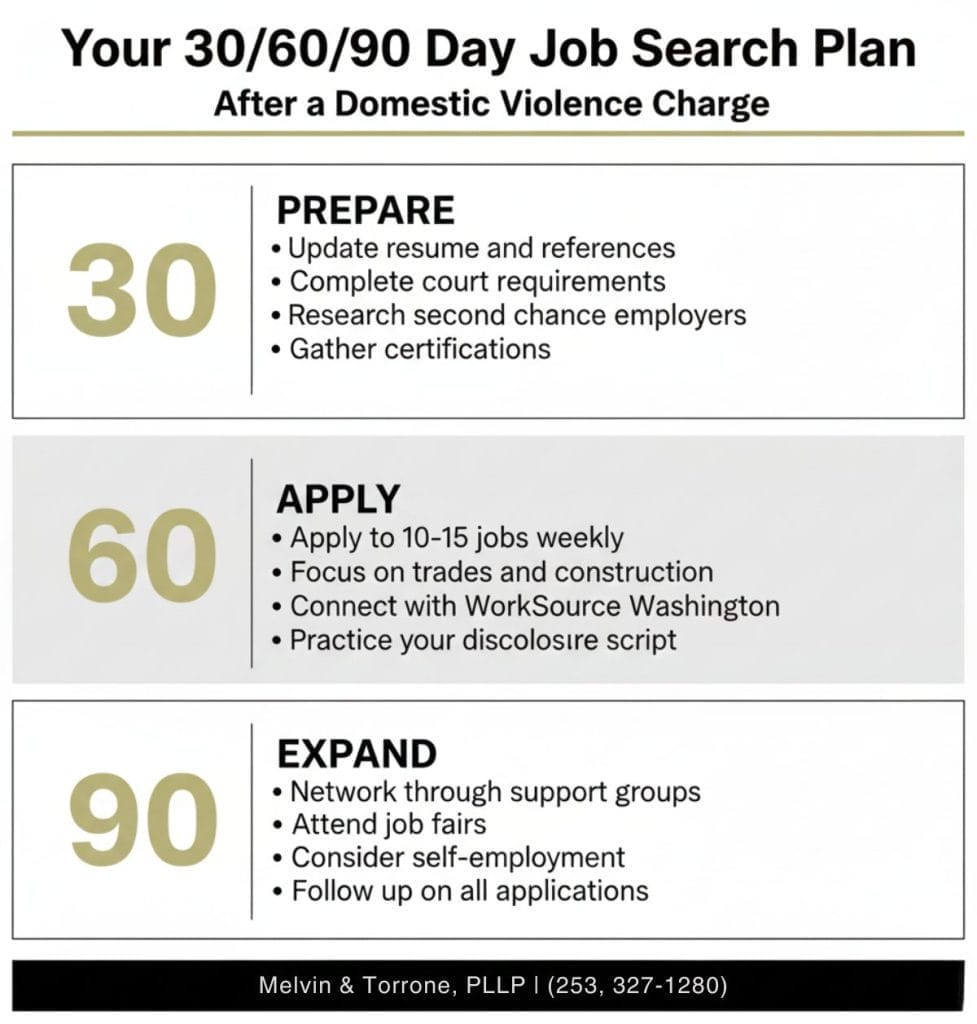
Your 30/60/90 Day Job Search Plan After a Domestic Violence Charge
Break your job search into manageable phases. Days 1-30 focus on preparation. Update your resume, gather references, complete any outstanding court requirements, and research second chance employers. Days 31-60 involve active applications. Apply to 10-15 jobs weekly, focusing on industries that hire people with criminal records like manual labor jobs and small businesses. Days 61-90 are for follow-up and expansion. Network through support groups, attend job fairs, and consider career specialists who work with people rebuilding after convictions.
Washington State Resources That Help People with Criminal Records Find Work
WorkSource Washington Programs Specifically for Job Seekers with Records
WorkSource Washington offers free career counseling, resume workshops, and job placement services designed for people with criminal histories. They connect you with employers who participate in the Fair Chance to Compete Act and understand Ban the Box policies. Visit the Tacoma WorkSource center at 1313 Pacific Avenue for an initial case evaluation and access to their employment restrictions database.
Pioneer Human Services and Goodwill Job Training in Tacoma
Pioneer Human Services runs job training programs in Pierce County specifically for people rebuilding after felony convictions and misdemeanor convictions. They offer paid training in warehousing, food service, and manufacturing. Goodwill operates similar programs with certifications in retail, customer service, and manual labor skills. Both organizations have direct relationships with second chance employers who actively hire their graduates.
I worked with a 44-year-old client from Hilltop in 2021 who’d been unemployed for 14 months after a domestic violence conviction cost him his delivery job. He enrolled in Pioneer’s forklift certification program, completed it in six weeks, and they placed him with a logistics company in Fife. He’s still there today, now training new hires.
How to Restore Your Rights (Firearm Rights, Voting Rights, Professional Licenses)
Restoring your rights after a domestic violence conviction happens in stages. Voting rights return automatically after you complete your sentence in Washington State. Firearm rights require a separate court petition and proof you’ve completed all court requirements with no new offenses. Professional licenses need individual applications to the licensing board, often requiring evidence of rehabilitation programs and character references. Each restoration process has specific timing requirements and legal procedures, so don’t assume your rights automatically return when your sentence ends.

Melvin & Torrone Can Help Getting a Job with a Domestic Violence Charge
Our 95% Success Rate in Domestic Violence Defense Cases
We’ve defended hundreds of criminal cases in Pierce County with a 95% success rate. Our criminal defense attorneys know how to challenge evidence, negotiate reduced charges, and fight for dismissals that protect your employment prospects and professional licenses.
How We Help Clients Pursue Expungement and Record Sealing
We guide you through the entire record sealing process under RCW 9.96.060, from determining eligibility to filing petitions with the judicial system. Our team has helped clients vacate convictions, pursue deferred prosecution, and restore firearm rights so background checks no longer block job opportunities. We explain complicated legal processes with language that’s easy to understand, and we handle the paperwork while you focus on rebuilding your career.
Why Fighting Your Charge Now Protects Your Career for Decades
A domestic violence conviction follows you for life, affecting job prospects, professional integrity, and even where you can live. Fighting your charge aggressively from the start gives you the best chance to avoid conviction entirely or secure outcomes like deferred prosecution that keep your record clean. We offer free consultations to discuss your case, explain your options, and create a defense strategy that protects your future. Call us at (253) 327-1280 or schedule online. You deserve a fierce advocate in your corner.
Frequently Asked Questions
1. How long does a domestic violence conviction stay on my record in Washington?
A domestic violence conviction stays on your criminal record permanently unless you vacate it under RCW 9.96.060. You can typically petition to vacate after completing all sentencing requirements and waiting three to five years without new offenses.
2. What if my domestic violence charges were dropped or dismissed?
Even if charges were dropped, the arrest still appears on background checks. You’ll need to petition the court for record sealing to remove the arrest from background screenings. Employers see “arrested but not convicted,” which still raises questions during hiring.
3. Can I work in healthcare with a domestic violence charge in Washington?
Healthcare jobs involving vulnerable populations face strict restrictions. Medical licenses require disciplinary proceedings review, and DSHS background checks often disqualify domestic violence convictions for nursing homes and patient care roles. Vacating your conviction improves your chances significantly.
4. Will employers automatically reject me if I have a pending domestic violence case?
Not automatically. Washington’s Fair Chance Act requires employers to consider the nature of your charge and how it relates to job duties. Pending charges give you more flexibility to explain the situation since you haven’t been convicted yet.
5. Can I get a government job in Washington State with a domestic violence conviction?
Most government jobs require background checks that flag domestic violence convictions. Positions involving law enforcement officers, childcare, or vulnerable populations typically disqualify you. Non-sensitive state roles may consider you after completing rehabilitation programs and demonstrating good character.
6. Does a protection order show up on background checks the same way a conviction does?
Protection orders and criminal convictions appear differently on background screenings. A domestic violence protection order shows up in court records but isn’t a criminal conviction. Employers may still ask about it, so prepare an honest explanation about the circumstances.
7. Can I lose my professional license if I’m convicted of domestic violence in Washington?
Yes. Professional licenses for nurses, teachers, lawyers, and contractors all face disciplinary proceedings after domestic violence convictions. The licensing board reviews your case individually, considers rehabilitation efforts, and may suspend or revoke your license depending on severity.
8. What’s the difference between misdemeanor and felony domestic violence for employment?
Felony domestic violence convictions create far more employment restrictions than misdemeanor convictions. Felonies permanently bar you from firearm possession, disqualify most federal jobs, and trigger automatic professional license reviews. Misdemeanors still impact employment but offer more second chances.
9. If I complete deferred prosecution, will my domestic violence charge disappear from background checks?
Yes. Successfully completing deferred prosecution results in dismissal, and background checks show “charge dismissed” instead of a conviction. This dramatically improves employment prospects since you were never actually convicted of domestic violence.
10. How do I explain the employment gaps caused by fighting a domestic violence case?
Be brief and honest without over-explaining. Say you were “resolving a personal legal matter” and immediately redirect to your skills and readiness to work. Focus on any training, certifications, or volunteer work you completed during that time to show productivity.
Conclusion
A domestic violence charge doesn’t have to destroy your career in Washington State. I’ve spent over two decades helping people in Pierce County fight charges, vacate convictions, and rebuild their professional lives. We understand the fear you’re facing right now because we’ve guided hundreds of clients through this exact situation. Our team knows how to protect your employment prospects while aggressively defending your case.
Schedule your free consultation today, and let’s create a personalized plan to get your life back on track.

Chris Torrone
Founding Partner, Melvin & Torrone PLLP
Chris Torrone is a dedicated advocate for clients facing family crises and criminal charges. With 20 years of experience practicing in Pierce County courts, Chris has built a reputation for meticulous case preparation and creative problem-solving in high-stakes litigation.
Need Legal Help?
Schedule Your Free Consultation
If you're facing a legal issue discussed in this article, our Tacoma attorneys are here to help.
Get Your Free Consultation