
What to Expect in a Washington Family Law Case [2026 Complete Guide]

By Chris Torrone, Founding Attorney, Melvin & Torrone, PLLP
A family law case in Washington moves through five distinct phases over 12 to 18 months, from initial filing through resolution. Most people walking into family court feel terrified because nobody explains what actually happens next. I’ve spent over 20 years guiding families through Pierce County’s family court system, and the biggest relief my clients feel comes when they finally understand the timeline.
You’ll deal with temporary orders, discovery, mediation, and possibly trial. The clerk’s office will assign your case docket number, family court services will offer resources, and if you need help, the self-help center provides free guidance.
Let me walk you through exactly what to expect so you can stop worrying about the unknown.
Torrone’s Takeaways
-
Family law cases take 12-18 months on average, not weeks, because Washington law mandates waiting periods and discovery timelines
-
Temporary order hearings happen fast and often become permanent, so prepare them like you’re going to trial
-
90% of custody cases settle through mediation, saving you thousands in trial costs and months of emotional stress
-
Pierce County requires mediation before trial and uses LINX electronic filing for all family court documents in 2025
-
Organized documents and quick responses to your attorney save you money on every single court filing
-
Judges decide based on evidence you can prove, not stories you tell or how loudly you argue
Table of Contents
- How Family Law Cases Move Through the Court System
- The Month-by-Month Timeline You Can Actually Expect
- Every Type of Hearing Explained
- What Family Law Cases Cost in Washington State
- How Pierce County Family Court Actually Works
- What Your Attorney Should (and Should Not) Do for You
- How to Be the Client Your Attorney Actually Wants to Fight For
- What Judges Want to See (And What Makes Them Frustrated)
- Let Melvin & Torrone Guide Your Family Through This Process
- Frequently Asked Questions
- Conclusion
How Family Law Cases Move Through the Court System
Filing Papers Does Not Mean Court Happens Next Week
Your case begins when someone files paperwork at the clerk’s office and pays the filing fee. The other party gets 20 days to respond in Washington. No judge reviews anything yet. Courts process thousands of family law cases simultaneously, and yours joins a queue. Expect your first court date 4-6 weeks after filing, not days.
The Reason Cases Take Months (Not Lawyer Delays)
Family court operates on mandatory timelines built into Washington law. Discovery alone takes 30-90 days so both sides can exchange financial records, parenting plans, and evidence. Pierce County requires mediation before trial through family court services. We can’t skip these steps even when both parties agree. A 32-year-old Tacoma mother filed for custody modification in March, frustrated that her hearing wasn’t scheduled until June. The delay wasn’t her attorney dragging feet. The court docket was simply full, and mandatory mediation had to happen first per local rules.
What Judges Actually Do With Your Paperwork Before You Ever See Them
Judges review your file number and case docket number to confirm proper filing. They read initial petitions, responses, and any requests for order to identify immediate safety concerns. Temporary order requests get priority review within days. Everything else waits for scheduled hearings. The court assigns your case to a specific judge who handles it from start to finish. According to data from state courts nationwide, 3.8 million family law cases flow through this system annually, which explains why judges can’t personally review every document the day it arrives.
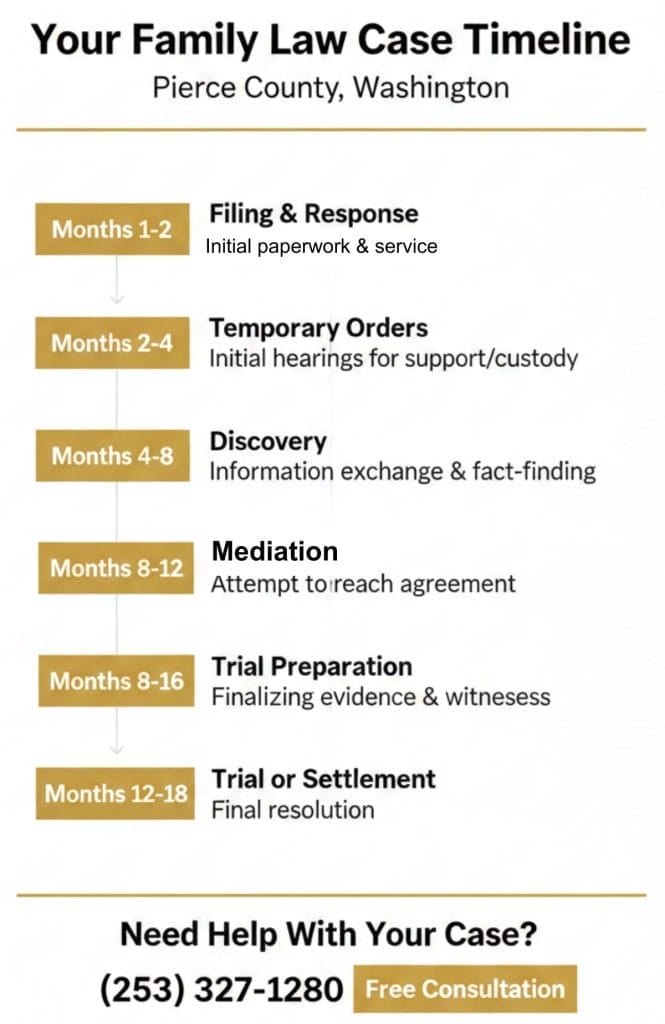
The Month-by-Month Timeline You Can Actually Expect
Months 1-2: When Filing and Response Paperwork Controls Everything
Someone files a petition at family court and serves the other party. You have exactly 20 days to file a response, or the court proceeds without your input. Washington law requires a mandatory 90-day waiting period before finalizing any divorce, so nothing moves quickly regardless of agreement between parties.
Months 2-4: When Temporary Orders Hearings Stabilize Your Situation
Temporary orders address immediate needs like who stays in the house, parenting time, and bill payments. These hearings happen fast because families can’t wait months in limbo. Judges issue findings and order after hearing that control your life until the final decree. We prepare heavily for these because temporary arrangements often become permanent.
Months 4-8: When Discovery Uncovers Financial and Custody Details
Discovery means exchanging every financial document, tax return, bank statement, and pay stub. Both sides submit interrogatories and requests for production. This process reveals hidden assets, actual income, and spending patterns. Courts need complete financial pictures before dividing anything. Discovery takes months because gathering years of records from banks, employers, and the division of child support services requires time.
Months 8-12: When Mediation Attempts Settlement Before Trial
Pierce County mandates mediation through family court services or private mediators before you can schedule a trial. Statistics show 93% of divorcing parents try alternative dispute resolution, and mediation settles 60-75% of family law cases successfully. When both parties have attorneys, settlement rates jump to 86%. A 45-year-old Puyallup father facing a contentious custody battle in 2024 dreaded mediation, assuming it would waste time. His case settled in a single four-hour session, saving him $15,000 in trial costs and months of emotional strain.
Months 12-18: When Trial Preparation and Court Dates Finally Arrive
Trial requires witness lists, exhibit preparation, subpoenas, and pre-trial motions. We submit proposed parenting plans and financial declarations weeks before your court date. Trials rarely happen on the first scheduled date because court calendars shift constantly. Family law trials typically last 1-3 days depending on complexity. Only 10% of custody cases actually reach trial, but preparing as though you will protects your position.
Why Some Cases Resolve in Weeks While Others Drag Past Two Years
Simple agreements between cooperative parties close in 90 days. High-conflict cases involving child protective services, domestic violence allegations, or hidden assets stretch past two years. Cases also stall when parties can’t afford retainer agreements or when one side deliberately delays responding to discovery. Court availability matters too since Pierce County family court handles thousands of cases annually with limited judge availability.
Factors that accelerate resolution include:
-
Both parties agreeing on major issues
-
Complete financial disclosure up front
-
Willingness to compromise in mediation
-
Organized documentation provided quickly
-
Realistic expectations about outcomes
Table: Pierce County Family Law Case Timeline Breakdown
| Case Phase | Timeline | What Happens | Action Required |
|---|---|---|---|
| Filing & Response | Months 1-2 | Petition filed, other party served, 20-day response deadline | File response or petition, pay filing fees |
| Temporary Orders | Months 2-4 | Emergency hearing for immediate needs (custody, support, housing) | Prepare declarations, attend hearing |
| Discovery | Months 4-8 | Exchange financial documents, interrogatories, depositions | Gather 3 years tax returns, bank statements, pay stubs |
| Mediation | Months 8-12 | Required settlement attempt through Pierce County Family Court Services | Attend in good faith, bring settlement proposals |
| Trial Preparation | Months 12-16 | Witness lists, exhibits, pre-trial motions, settlement conferences | Finalize evidence, prepare testimony |
| Trial or Settlement | Months 12-18 | Final resolution through trial or negotiated agreement | Attend trial or sign settlement documents |

Every Type of Hearing Explained
Temporary Order Hearings
These hearings happen within weeks of filing when immediate decisions can’t wait months. Judges decide parenting schedules, who stays in the house, child support amounts, and bill payment responsibilities. You present evidence through declarations and brief testimony. The judge issues temporary orders that control your daily life until final resolution. We prepare these like mini-trials because what starts temporary often becomes permanent.
Show Cause Hearings
Someone violated a court order, and now they must show cause why they shouldn’t face consequences. Common violations include withholding parenting time, hiding income, or refusing to pay support. The violating party gets served with a request for order and must appear before the judge. Consequences range from makeup parenting time to contempt findings, fines, or even jail in extreme cases. These hearings move quickly and judges take violations seriously.
Settlement Conferences
A settlement conference involves both attorneys, clients, and sometimes a judge or mediator facilitating negotiation. Everyone sits in the same room or connects via video testimony options now available in 2025. The goal is resolving disputes before spending money on trial. We discuss realistic outcomes based on Washington law and your specific facts. National data shows 90% of custody cases resolve without trial, and settlement conferences make that happen by forcing realistic conversations.
Pre-Trial Conferences
Judges use pre-trial conferences to review your case status, confirm trial readiness, and identify remaining disputes. You’ll discuss witness lists, exhibit numbers, estimated trial length, and procedural issues. The judge often pressures both sides toward last-minute settlement. We file final declarations and proposed parenting plans beforehand. Most cases settle at this stage once parties realize trial costs and risks outweigh compromise benefits.
Trial Day
Forget dramatic cross-examinations and surprise witnesses. Family court trials are methodical presentations of financial documents, parenting history, and witness testimony. You sit at a table, not a witness stand, for most of it. A single mother from Lakewood, age 38, walked into her 2023 custody trial expecting courtroom theatrics. Instead, she spent six hours calmly answering questions about school pickup schedules, household budgets, and her children’s medical history. The judge issued a decision three weeks later based purely on evidence presented, not emotional appeals.
Post-Judgment Hearings
Life changes after divorce. Job losses, relocations, remarriages, and children’s evolving needs require order modifications. You file a petition for modification showing substantial change in circumstances since the original order. The family court services evaluates your request. Judges won’t modify orders for minor inconveniences, but legitimate changes like income loss or safety concerns get serious consideration. These hearings follow the same evidence rules as original trials.
Table: Pierce County Family Court Hearing Types & What to Expect
| Hearing Type | When It Happens | How Long | What Gets Decided | Preparation Level |
|---|---|---|---|---|
| Temporary Orders | Weeks 2-6 after filing | 30-60 minutes | Immediate custody, support, housing arrangements | High - prepare like mini-trial |
| Show Cause | After order violation | 15-30 minutes | Consequences for breaking court orders | Medium - bring violation evidence |
| Settlement Conference | Months 8-12 | 2-4 hours | Negotiate resolution with mediator or judge | High - know your bottom line |
| Pre-Trial Conference | 2-4 weeks before trial | 30-45 minutes | Confirm trial readiness, identify remaining disputes | High - finalize witness/exhibit lists |
| Trial | Months 12-18 | 1-3 days | Final orders on all disputed issues | Very High - full evidence presentation |
| Post-Judgment Modification | After case closes | 30-60 minutes | Modify existing orders due to changed circumstances | High - prove substantial change |
What Family Law Cases Cost in Washington State
Attorney Hourly Rates Run $200 to $500 in Pierce County
Family lawyers in Washington charge approximately $340 per hour on average according to 2025 data. Pierce County rates typically range from $200 for newer attorneys to $500 for experienced trial lawyers. Most firms require initial retainers between $2,500 and $7,500 before starting work. You pay the retainer upfront, and we bill against it as work progresses. Simple uncontested divorces cost $3,000-$5,000 total, but contested custody battles easily reach $15,000-$30,000.
When You Can Ask the Judge to Make Your Ex Pay Your Legal Bills
Washington courts can order one party to pay the other’s attorney fees when there’s significant income disparity. You file a motion requesting fee awards and show the judge why it’s fair. Courts consider each party’s financial resources, who caused unnecessary litigation, and whether one side has far greater ability to pay. We’ve successfully recovered thousands in fees for clients who couldn’t afford to fight wealthy spouses attempting to bury them in legal costs.
The Hidden Costs Nobody Warns You About Until Bills Arrive
Court filing fees start at $280-$350 depending on case type. You’ll pay for certified copies of orders, usually $5 per document. Process servers charge $50-$100 for personal service of papers. Expert witnesses like custody evaluators cost $3,000-$8,000 for complete reports. Mediation runs $150-$400 per hour split between parties.
A 29-year-old Gig Harbor teacher budgeted $5,000 for her 2024 divorce, thinking that covered everything. She forgot about parenting class fees ($50), name change filing costs ($150), and three separate trips to the clerk’s office for documents she needed notarized. The extras added $800 she hadn’t planned for.
Payment Plans and Retainer Agreements
A retainer agreement is your contract with your lawyer explaining rates, billing practices, and payment expectations. We bill in six-minute increments for every phone call, email, document review, and court appearance. You receive monthly statements showing exactly how your retainer was spent. When the retainer depletes, you replenish it to continue representation. Some firms offer payment plans spreading costs over several months.
Typical billing activities include:
-
Court appearances and hearings
-
Document preparation and review
-
Client communication via phone or email
-
Legal research and case strategy
-
Negotiation with opposing counsel
Table: What Family Law Cases Cost in Washington State
| Expense Category | Low Range | High Range | Notes |
|---|---|---|---|
| Attorney Hourly Rate | $200/hour | $500/hour | Pierce County average is $340/hour (2025 data) |
| Initial Retainer | $2,500 | $7,500 | Paid upfront, billed against as work progresses |
| Uncontested Divorce (Total) | $3,000 | $5,000 | Both parties agree on all terms |
| Contested Custody Case (Total) | $15,000 | $30,000+ | Includes discovery, mediation, trial preparation |
| Court Filing Fees | $280 | $350 | Varies by case type and county |
| Mediation (Per Hour) | $150 | $400 | Cost typically split between parties |
| Custody Evaluator | $3,000 | $8,000 | Complete evaluation and court report |
| Process Server | $50 | $100 | Per service of documents |
| Certified Copies | $5 each | $5 each | From clerk’s office for official records |
| Parenting Class | $50 | $75 | Required by Pierce County for custody cases |

How Pierce County Family Court Actually Works
Pierce County Requires Mediation Before Most Family Law Trials
You cannot schedule a trial date in Pierce County family court until you’ve attempted mediation through family court services or a private mediator. This mandatory requirement exists to reduce court congestion and encourage settlement. Both parties must attend in good faith and genuinely try to resolve disputes. If mediation fails, the mediator issues a statement allowing you to proceed to trial. We prepare clients thoroughly for mediation because settling there saves months of waiting and thousands in legal fees.
Family Court Services Provides Free Resources You Should Use
Pierce County’s family court services offers parenting classes, mediation services, and self-help center assistance at no cost or reduced fees. The self-help center helps you complete local forms, understand court procedures, and file documents correctly. They provide fee schedules, parenting plan templates, and case access systems tutorials. I always direct clients there for notary services and form reviews before filing. These resources exist specifically to help families through the process without paying attorneys for every single step.
Electronic Filing in 2025 Changed How You Submit Every Document
Pierce County uses the LINX electronic filing system for all superior court family law cases now. You create an account, upload documents as PDFs, pay filing fees online, and receive instant confirmation. No more driving to the clerk’s office during business hours or waiting in line. The system assigns your case docket number immediately and timestamps everything. We still keep paper copies for our records, but courts now operate almost entirely digitally for family law case management efficiency.
Local Court Locations and Which Building Handles Your Case Type
Pierce County Superior Court sits at 930 Tacoma Avenue South in the County-City Building downtown Tacoma. As of August 2025, Pierce County added Family Court 3, expanding capacity for family law cases. All divorce, custody, and domestic relations matters go through superior court, not district court. The clerk’s office on the main floor processes all filings.
A 51-year-old Spanaway grandfather confused superior court with district court of appeals and filed his custody modification in the wrong building. He lost two weeks getting paperwork transferred to the correct court location.
How to Access Your Case Information Online Through Court Portals
Pierce County offers family law case access through their online portal using your case docket number or file number. You can view filed documents, upcoming hearing dates, and judge assignments without calling the clerk’s office. The system updates daily but not in real-time, so fresh filings may take 24 hours to appear. You’ll need your case number from initial filing paperwork to search. We check this portal regularly to catch any motions or requests for order filed by opposing counsel.
What Your Attorney Should (and Should Not) Do for You
How Often Your Lawyer Should Update You on Case Progress
Expect updates when something actually happens, not daily check-ins about nothing. We contact you immediately after hearings, when receiving documents from opposing counsel, before filing deadlines, and when strategic decisions need your input. Between major events, cases sit waiting for court dates or responses. Calling your attorney every other day asking “what’s happening” wastes your retainer on reassurance conversations. Good lawyers proactively communicate when there’s news worth sharing, not just to bill time.
Why Billing Statements Matter More Than You Think They Do
Your monthly billing statement shows exactly how your retainer gets spent in six-minute increments. Review every line item because billing errors happen, and patterns reveal efficiency. If you’re getting charged for five separate two-minute calls that could’ve been one ten-minute conversation, we need to adjust communication methods. Billing statements also help you budget for remaining case costs. We’ve seen clients shocked at trial because they never reviewed statements showing depleted retainers months earlier.
Strategy Discussions Protect You From Expensive Surprises Later
Before filing motions, requesting hearings, or pursuing discovery, we discuss costs versus benefits with you. Maybe that deposition feels satisfying but costs $2,000 and yields nothing useful. A 44-year-old University Place contractor hired an attorney in 2024 who filed seven motions without discussing strategy first. He spent $8,500 on legal fees before his first actual hearing. When he came to us, we explained that most of those motions accomplished nothing except generating billable hours. Strategy discussions mean you approve spending before it happens, not after.
Your attorney should discuss:
-
Estimated costs for each legal action
-
Realistic outcomes based on facts and law
-
Alternative approaches that cost less
-
Timeline implications of different strategies
-
When fighting costs more than compromising

How to Be the Client Your Attorney Actually Wants to Fight For
Responding Quickly to Your Lawyer’s Requests Speeds Everything Up
When we ask for tax returns, pay stubs, or answers to interrogatories, respond within 48 hours if possible. Court deadlines don’t wait for your schedule, and last-minute scrambling costs you extra fees. Every day you delay gathering documents pushes back filing dates and extends your case timeline. We can’t file your financial declaration until you send the bank statements we requested three weeks ago. Quick responses show judges and opposing counsel you’re serious about resolving things efficiently.
Organized Documents Save You Money on Every Single Court Filing
Send us documents organized by category with clear labels and dates. We bill hourly to sort through boxes of random papers, match bank statements to months, and decode your filing system. Create folders for financial records, parenting communication, medical records, and court documents. A retired nurse from Bonney Lake, age 67, brought us three years of financial records in labeled binders organized by month and category for her 2023 spousal support case. We prepared her financial declaration in two hours instead of eight, saving her over $2,000 in attorney fees just from her organizational skills.
Honest Disclosure Means Your Lawyer Can Defend What They Know About
Tell us everything bad before opposing counsel does. That DUI from five years ago, the tax returns you filed late, the argument where police came but didn’t arrest anyone. We can’t defend facts we discover for the first time in court documents. Judges forgive past mistakes explained honestly but crucify parties who hide things. Full disclosure during initial consultations lets us build strategy around reality, not fantasy versions of events that crumble under cross-examination.
What Judges Want to See (And What Makes Them Frustrated)
Judges Decide Cases Based on Evidence, Not Who Talks the Loudest
Bring documented proof for every claim you make. Bank statements prove income, text messages show parenting communication, police reports verify incidents. Your passionate testimony about being a great parent means nothing without evidence supporting it. Judges have heard every story imaginable and trust documents over words. We prepare exhibits, declarations, and witness testimony that builds a factual foundation judges can legally rely on when issuing findings and order after hearing documents.
Video Testimony in 2025 Makes Some Hearings Easier to Attend
Washington courts now allow video testimony for many hearings through secure platforms. You can attend temporary order hearings, settlement conferences, and some motions from home or work. Trial testimony still happens in person for most cases. Video options reduce time off work, childcare struggles, and parking nightmares at the courthouse. Check with your attorney which hearings qualify for remote attendance under current court location policies and family court case management rules for your specific situation.
How to Present Yourself in Court So the Judge Actually Listens
Dress like you’re going to a job interview, not a barbecue. Answer questions directly without rambling stories. Say “yes, Your Honor” and “no, Your Honor” instead of arguing with opposing counsel. Stay calm even when your ex lies on the stand. A 26-year-old Parkland father lost his cool during his 2024 custody hearing, interrupting the judge twice and calling his ex a liar directly. The judge warned him once, then limited his testimony time and ruled against him on three disputed issues. Judges reward composure and punish emotional outbursts because they see conflict as harmful to children.
Let Melvin & Torrone Guide Your Family Through This Process
We’ve Walked Hundreds of Pierce County Families Through What You’re Facing Right Now
You’re not the first person to feel terrified, confused, or overwhelmed by a family law case. We’ve spent decades helping parents protect their children during CPS investigations, spouses navigate complex divorces, and families stay together against impossible odds. Our 96% success rate in CPS cases and 1,345 closed cases prove we know how to win in Pierce County courts. You deserve an advocate who treats you like family, not a case number.
Clear Communication Means You’ll Actually Understand What’s Happening in Your Case
Most people tell us they finally felt relief when someone explained the legal process in language that made sense. We don’t hide behind legal jargon or bill you for confusing conversations. You’ll know exactly what to expect at every hearing, what documents we need, and what realistic outcomes look like based on your specific facts. We return calls promptly, explain billing statements clearly, and discuss strategy before spending your money on motions that won’t help.
Schedule Your Free Consultation and Start Building Your Defense Strategy Today
Call Melvin & Torrone at (253) 327-1280 or book online for a 30-minute consultation where we listen to your situation without judgment. You’ll learn what timeline to expect, estimated costs for your case type, and whether we’re the right fit to fight for you. No pressure, no sales pitch, just honest guidance from attorneys who genuinely care about protecting your family and your future. Our office is located at 950 Pacific Ave, Suite 720, Tacoma, and we’re ready to start defending your rights today.
Frequently Asked Questions
1. How long does a typical family law case take in Washington State?
Most family law cases take 12 to 18 months from filing to final resolution. Simple uncontested divorces can close in 90 days due to Washington’s mandatory waiting period, but contested custody battles often extend past two years depending on discovery complexity and court availability.
2. Do I have to appear in court for every hearing in my family law case?
You must attend hearings where testimony is required, like temporary orders and trial. Video testimony options now allow remote attendance for some hearings in 2025. Settlement conferences and mediation sessions require your presence but happen outside the courtroom in conference rooms.
3. Can my family law case settle without going to trial?
Absolutely. Statistics show 90% of custody cases resolve through negotiation and mediation without trial. Pierce County requires mediation before trial specifically to encourage settlement. Most cases close through agreed parenting plans and property division after productive mediation sessions with both attorneys present.
4. How much do family law attorneys cost in Pierce County?
Family lawyers in Pierce County charge between $200 and $500 per hour, with the average around $340 hourly. Initial retainers typically run $2,500 to $7,500. Uncontested cases cost $3,000-$5,000 total, but contested custody battles can reach $15,000-$30,000 depending on complexity.
5. What happens if I can’t afford an attorney for my family law case?
Pierce County’s self-service center offers free resources including form assistance and legal information. You can request the judge order your spouse to pay your attorney fees if significant income disparity exists. Some attorneys offer payment plans spreading costs over months, making representation more accessible.
6. Can temporary orders from my family law case become permanent?
Yes, temporary orders often become the basis for final orders. Judges see what’s been working for months and hesitate to disrupt stability. We prepare temporary order hearings like mini-trials because these early decisions frequently control the final outcome of your entire case.
7. What documents do I need to gather for my family law case?
You’ll need three years of tax returns, six months of pay stubs and bank statements, mortgage or lease documents, vehicle titles, retirement account statements, credit card statements, and children’s school and medical records. Organized documentation speeds up discovery and reduces attorney fees spent sorting paperwork.
8. How does child support get calculated in Washington family law cases?
Washington uses a standard calculation based on both parents’ gross monthly income, number of children, and residential schedule. The department of child support services provides worksheets and calculators. Courts rarely deviate from the calculated amount unless extraordinary circumstances exist like special medical needs.
9. Can I modify custody or support orders after my family law case closes?
Yes, through post-judgment modification petitions showing substantial change in circumstances. Income changes, relocations, or children’s evolving needs qualify. You must prove conditions changed significantly since the original order. Courts won’t modify orders for minor inconveniences, only legitimate substantial changes affecting children’s welfare.
10. What happens if my ex violates the court orders from our family law case?
File a show cause motion requiring them to explain the violation to the judge. Consequences range from makeup parenting time to contempt findings, fines, or jail in extreme cases. Document every violation with dates, times, and evidence. Courts take order violations seriously and will enforce compliance.
Conclusion
Family law cases feel overwhelming when you don’t understand the process. Now you know the timeline, costs, hearing types, and what judges expect. You don’t have to face this alone. We’ve guided hundreds of Pierce County families through divorce, custody battles, and CPS investigations with a proven track record of success. Our team explains everything in plain language and fights aggressively for your rights and your family.
Schedule your free 30-minute consultation** and build your personalized defense strategy today.**

Chris Torrone
Founding Partner, Melvin & Torrone PLLP
Chris Torrone is a dedicated advocate for clients facing family crises and criminal charges. With 20 years of experience practicing in Pierce County courts, Chris has built a reputation for meticulous case preparation and creative problem-solving in high-stakes litigation.
Need Legal Help?
Schedule Your Free Consultation
If you're facing a legal issue discussed in this article, our Tacoma attorneys are here to help.
Get Your Free Consultation