

Pierce County Divorce Attorneys
Divorce Lawyers
Compassionate Guidance Through One of Life's Most Difficult Transitions
Divorce is overwhelming. You're facing legal complexity, financial uncertainty, and emotional turmoil—all while trying to protect your children, your assets, and your future.
Melvin & Torrone, PLLP has guided hundreds of clients through divorce in Pierce County. Our Tacoma divorce attorneys understand Washington State dissolution law, Pierce County Superior Court procedures, and the judges and commissioners who will decide your case. Whether your divorce is amicable or high-conflict, straightforward or complex, we provide strategic legal counsel and aggressive advocacy when necessary.
You don't have to navigate this alone.
Free Case ReviewWhy Choose Melvin & Torrone for Your Divorce?
Divorce is one of the most stressful experiences you'll face. You need attorneys who combine legal skill with genuine empathy—who will fight for your interests while guiding you through the process.
We've tried hundreds of family law cases in Pierce County and know what it takes to protect your future.
Get Your Free ConsultationDecades of Combined Experience
We've handled hundreds of Pierce County divorces—uncontested, contested, high-conflict, and complex property.
Trial-Tested
We don't just settle—we win at trial when necessary.
Local Knowledge
Daily practice in Pierce County Superior Court; we know judges, commissioners, and procedures.
Compassionate Counsel
We guide you through emotional turmoil while fighting for your interests.
Dual Family/Criminal Practice
Critical when cases overlap—DV charges during divorce, CPS and criminal investigations running simultaneously.
Strategic Approach
We know when to fight and when to settle.
Transparent Billing
Clear fee agreements, itemized invoices, and payment plans available.
What to Bring to Your Divorce Consultation

Existing Court Orders
Divorce decrees, parenting plans, support orders, protection orders.
Marriage Certificate
And children's birth certificates.
Financial Documents
Including pay stubs, tax returns, bank statements, credit card statements, and retirement accounts.
Communication Logs
Texts, emails showing co-parenting issues, abuse, or violations.
Police Reports
Especially if DV or criminal charges are involved.
CPS Documents
Investigation letters, service plans, court orders, founded findings.
Timeline of Events
Documented dates of separation, incidents, and violations.
Even if you don't have all documents, come to the consultation—time is often critical.
Protecting Yourself During Divorce
Property and Debt Division
Washington is a community property state. All property and debts acquired during the marriage are presumed community property, owned equally by both spouses. However, the court divides property "fairly and equitably"—which does not always mean 50/50. Separate property (owned before marriage or received as a gift or inheritance) is generally awarded to the owning spouse, but courts have discretion to divide separate property as well.
Complex property division may involve Qualified Domestic Relations Orders (QDROs) for retirement accounts, business valuations, forensic accounting, and expert testimony. Real estate, stock options, deferred compensation, and cryptocurrency all require careful characterization and valuation.
Support, Custody, and Dispute Resolution
Spousal maintenance (alimony) may be awarded based on the length of the marriage, each spouse's income and earning capacity, the standard of living during the marriage, and other factors under RCW 26.09.090. Child custody is determined by "parenting plans" under the best interests of the child standard. Pierce County Superior Court often requires mediation before contested custody matters can be set for trial.
Financial Protection During Divorce +
Protect your financial interests from the moment you decide to file:
- Open individual bank accounts in your name only
- Obtain credit in your own name (credit card, small loan)
- Close or freeze joint credit cards to prevent new charges
- Document all assets: bank accounts, retirement accounts, investments, real estate, vehicles, valuables
- Document all debts: mortgages, car loans, credit cards, student loans, personal loans
- Gather tax returns for the last 3-5 years
- Secure important documents (birth certificates, passports, insurance policies, estate planning documents)
- Do NOT hide assets, destroy documents, or make large purchases or transfers—this will damage your credibility with the court
Spousal Maintenance (Alimony) +
When Maintenance Is Awarded
Washington courts consider the factors in RCW 26.09.090 when determining spousal maintenance, including:
- The financial resources of each spouse
- The time needed to acquire education or training for employment
- The standard of living established during the marriage
- The duration of the marriage
- The age and physical/emotional condition of each spouse
- The ability of the paying spouse to meet their own needs while paying maintenance
Types of Spousal Maintenance
Temporary Maintenance: Awarded during the divorce process to maintain the status quo. Ends when the final decree is entered.
Short-Term (Rehabilitative) Maintenance: Awarded for a set period to allow the receiving spouse to become self-supporting through education, training, or work experience.
Long-Term Maintenance: Awarded in longer marriages (typically 20+ years) or when the receiving spouse cannot become fully self-supporting due to age, health, or other factors.
Lump-Sum Maintenance: A one-time payment instead of ongoing monthly payments. May be used when the paying spouse has significant assets but limited income.
Calculating Amount
Washington does not have a statutory formula for calculating maintenance. However, a common rule of thumb used by attorneys and judges is:
Amount: 25-35% of the income disparity between spouses
Duration: 30-50% of the length of the marriage
Example: In a 20-year marriage where Spouse A earns $120,000/year and Spouse B earns $40,000/year, the income disparity is $80,000. Maintenance might be $20,000-$28,000/year (25-35% of $80,000) for 6-10 years (30-50% of 20 years).
This is a guideline, not a guarantee. Judges have broad discretion, and the actual amount will depend on the specific facts of your case.
Modification
Maintenance can be modified if there is a substantial change in circumstances, such as job loss, significant income change, retirement, remarriage of the receiving spouse, or cohabitation. The party requesting modification bears the burden of proof.
Tax Treatment
Post-2018 divorces: Maintenance is NOT deductible by the payer and NOT taxable to the recipient (Tax Cuts and Jobs Act).
Pre-2019 divorces: Maintenance is deductible by the payer and taxable to the recipient, unless the decree has been modified to adopt the new rules.
Child Custody (Parenting Plans) +
Parenting Plan Components
Washington does not use the term "custody." Instead, the court enters a "parenting plan" that addresses:
- Residential schedule: Where the child lives on each day, including weekdays, weekends, holidays, school breaks, and summer
- Decision-making authority: Which parent makes major decisions about education, healthcare, and religious upbringing
- Dispute resolution: How parents resolve disagreements (mediation, arbitration, court)
- Transportation and exchange: How and where children are transferred between homes
- Communication: Phone, video, and electronic contact with the non-residential parent
- Relocation provisions: Notice requirements if either parent plans to move
Best Interests Standard (RCW 26.09.187)
The court considers:
- The strength, nature, and stability of the child's relationship with each parent
- Each parent's past and potential future performance of parenting functions
- The child's emotional needs and developmental level
- The child's relationship with siblings and other significant adults
- The child's involvement in school and community activities
- The wishes of the parents and the child (if the child is mature enough)
- Any history of domestic violence, abuse, or neglect
Common Residential Schedules
- Every-other-weekend: Primary parent has child most of the time; other parent has every other weekend and one midweek evening
- 5-2-2-5: One parent has Monday-Tuesday, other has Wednesday-Thursday, weekends alternate
- 2-2-3: Similar to 5-2-2-5 but with shorter rotations for younger children
- Week-on/week-off: Children alternate full weeks with each parent
- School year/summer split: One parent during school year, other during summer (common for long-distance arrangements)
Child Support +
Washington State Child Support Schedule (WSCSS)
Washington uses a standardized formula under RCW 26.19 to calculate child support based on:
- Combined net income of both parents
- Number of children
- Each parent's proportionate share of income
- Residential schedule (credit for overnights)
- Healthcare costs and childcare expenses
- Other children from different relationships
Deviation from Standard Calculation
Courts may deviate from the standard calculation based on:
- Sources of income and tax planning affecting income
- Non-recurring income (bonuses, overtime)
- Debt and high expenses
- Residential schedule (more than standard credit)
- Children from other relationships
- Special needs of the child
Modification
Child support can be modified if there has been a substantial change in circumstances, such as a significant change in either parent's income, changes in the residential schedule, or changes in the child's needs. Generally, a change of 25% or more in the support amount qualifies for modification.
The Washington State child support calculator is available online at www.courts.wa.gov to estimate your potential support obligation or entitlement.
Domestic Violence & Protective Orders +
Impact on Divorce Proceedings
Domestic violence affects virtually every aspect of a divorce case:
- Custody: A finding of domestic violence creates a rebuttable presumption against awarding primary residential time to the abusive parent (RCW 26.09.191)
- Property Division: Courts may award a larger share of community property to the victim spouse
- Maintenance: DV history is a factor in spousal maintenance determinations
- Protection Orders: Can restrict the abusive spouse's contact, possession of firearms, and access to the family home
Domestic Violence Protection Orders (DVPOs)
A DVPO can order the respondent to:
- Stay away from the petitioner and children
- Move out of the shared residence
- Surrender firearms
- Have no contact by any means (phone, text, email, social media, third parties)
- Attend treatment programs
- Temporarily award custody to the petitioner
Criminal DV Charges During Divorce
When domestic violence charges coincide with divorce proceedings, having attorneys who handle both family law and criminal defense is critical. Statements made in one proceeding can affect the other. We coordinate strategy across both cases to protect your interests.
If you are in immediate danger, call 911. The National Domestic Violence Hotline is 1-800-799-7233.
Alternatives to Traditional Divorce Litigation +
Mediation
A neutral third-party mediator helps both spouses reach agreement on contested issues. The mediator does not make decisions—they facilitate negotiation.
Benefits:
- Less expensive than litigation
- Faster resolution
- More control over the outcome
- Confidential (not public record)
- Less adversarial—better for co-parenting relationships
Drawbacks: Not appropriate when there is a significant power imbalance, domestic violence, hidden assets, or when one party refuses to negotiate in good faith. Each party should still have their own attorney to review any mediated agreement.
Collaborative Divorce
Each spouse hires a collaboratively trained attorney, and both parties sign an agreement to resolve all issues without going to court. If the collaborative process fails, both attorneys must withdraw and the parties must hire new counsel for litigation. This creates a strong incentive to reach agreement. The process may also involve financial specialists, child specialists, and divorce coaches.
Arbitration
A private arbitrator (often a retired judge or experienced family law attorney) hears both sides and makes binding decisions on contested issues. Arbitration is faster than trial, more private, and allows the parties to choose their decision-maker. However, the right to appeal is limited.
Types of Divorce We Handle
Uncontested Divorce
Both spouses agree on all terms: property division, custody, support, and debts.
Learn more +
Requirements
- Both parties agree on all issues
- At least one spouse is a Washington resident
- The marriage is "irretrievably broken"
Process
- File Petition for Dissolution
- Serve the other spouse (or obtain a joinder/acceptance of service)
- Complete required financial declarations
- Draft settlement agreement and parenting plan (if children)
- Wait 90-day cooling-off period
- Finalize decree (may not require a court hearing)
Timeline: 90-120 days
Cost: $2,500-$5,000 (attorney fees) + court filing fee (~$314)
What We Do
Even in an uncontested divorce, an attorney ensures your rights are protected, the agreement is fair and enforceable, and all required documents are properly prepared and filed. We handle the paperwork, court filings, and finalization so you can focus on moving forward.
Contested Divorce
Spouses disagree on one or more major issues and cannot reach agreement without court intervention.
Learn more +
Common Disputed Issues
- Division of the family home
- Retirement account division
- Business ownership and valuation
- Spousal maintenance amount and duration
- Residential schedule for children
- Decision-making authority
- Child support calculation deviations
- Debt allocation
Process
- File Petition and serve the other party
- Temporary orders hearing (custody, support, restraining orders)
- Discovery (financial disclosures, depositions, subpoenas)
- Mandatory mediation (Pierce County requirement)
- Settlement conference with the court
- Trial preparation (witnesses, exhibits, expert reports)
- Trial before a Pierce County Superior Court judge
Timeline: 6 months to 2+ years
Cost: $10,000-$50,000+ depending on complexity and whether the case goes to trial
High-Conflict Divorce
Characterized by extreme disagreement, accusations, and inability to co-parent or communicate.
Learn more +
Characteristics
- Frequent motions and court appearances
- Allegations of abuse, neglect, or substance abuse
- Refusal to follow temporary orders
- Use of children as leverage
- Parental alienation behavior
- False allegations to gain tactical advantage
- Hiding or dissipating assets
- Violation of protection orders
- Involvement of CPS, law enforcement, or GAL
Our Approach
- Aggressive protection of your rights from day one
- Immediate temporary orders to establish structure
- Detailed documentation of violations and bad behavior
- Strategic use of contempt motions to enforce orders
- Coordination with criminal defense when DV charges overlap
- GAL management and custody evaluation preparation
- Trial preparation from the start—we assume it will go to trial
- Post-decree enforcement and modification as needed
Same-Sex Divorce
Same-sex divorce follows the same legal process, but presents unique issues that require experienced counsel.
Learn more +
Parentage Issues
When children are born or adopted during a same-sex marriage, parentage may need to be established or confirmed. Washington's Uniform Parentage Act (RCW 26.26A) provides mechanisms for establishing parentage, but the analysis can be complex—particularly for children born before marriage equality or through assisted reproduction.
Property Division
For couples who were in committed intimate relationships (CIRs) before marriage became legally available, property acquired during the CIR may be treated as community property. Establishing the date of the CIR and characterizing property acquired during that period requires careful legal analysis.
Committed Intimate Relationship (CIR) Claims
Washington courts recognize CIRs (formerly "meretricious relationships") and may divide property acquired during the relationship equitably. This is particularly important for same-sex couples who were together before Washington recognized same-sex marriage in 2012. Factors include the duration of the relationship, the purpose of the relationship, continuous cohabitation, and pooling of resources.
Complex Property Division
Divorces involving substantial assets, businesses, or complicated financial structures require specialized expertise.
Learn more +
Complex Asset Types
- Family businesses and professional practices
- Stock options and restricted stock units (RSUs)
- Deferred compensation and executive benefits
- Retirement accounts (401(k), IRA, pension plans)
- Real estate portfolios and investment properties
- Cryptocurrency and digital assets
- Intellectual property (patents, trademarks, royalties)
- Trust interests and inherited assets
- Military retirement and benefits
- Professional licenses and advanced degrees
- Collections, art, antiques, and luxury items
Characterization Issues
Determining whether an asset is community property or separate property is often the most contested issue. Assets that were separate property before marriage can become "commingled" with community property, making characterization difficult. We work with forensic accountants to trace the character of disputed assets.
Common Disputes
- Business valuation methodology (income approach vs. market approach vs. asset approach)
- Date of valuation (date of separation vs. date of trial)
- Goodwill (personal vs. enterprise)
- Hidden assets and income
- Dissipation of community assets (gambling, affairs, excessive spending)
- Tax consequences of property division
Our Approach
We work with a network of experts including:
- Forensic accountants
- Business valuation experts
- Real estate appraisers
- Pension and retirement plan analysts
- Tax advisors
- Financial planners (for post-divorce financial modeling)
Legal Separation
A legal alternative to divorce that resolves all financial and custody issues while maintaining the legal marriage.
Learn more +
Why Choose Legal Separation
- Religious beliefs prohibit divorce
- Maintain health insurance coverage through a spouse's employer
- Preserve military benefits that require 10+ years of marriage
- Preserve Social Security benefits (requires 10+ years of marriage)
- Provide a trial period before making a final decision about divorce
- Protect yourself financially while remaining legally married
How It Compares to Divorce
Legal separation addresses all the same issues as divorce—property division, spousal maintenance, custody, and child support—but the marriage is not dissolved. The court enters a "decree of legal separation" instead of a "decree of dissolution." Either party can later petition to convert the legal separation into a divorce.
The legal process, filings, and court procedures are substantially similar to divorce. The same 90-day waiting period applies.
Key Divorce Issues
Property Division +
Community vs. Separate Property
Washington is a community property state. Property acquired during the marriage is presumed to be community property. Property owned before marriage, or received as a gift or inheritance during marriage, is generally separate property. However, separate property can become commingled with community property if not carefully maintained.
The Marital Home
The family home is often the most significant asset and the most emotionally charged issue. Options include: selling the home and dividing proceeds, one spouse buying out the other's interest, or one spouse retaining the home (often the primary residential parent) with an offset from other assets. The court considers the children's stability and each spouse's ability to maintain the home.
Retirement Accounts (QDRO)
Dividing retirement accounts (401(k), pension plans, 403(b)) requires a Qualified Domestic Relations Order (QDRO)—a court order that directs the plan administrator to divide the account. IRAs are divided by "transfer incident to divorce" and do not require a QDRO. The portion of retirement benefits earned during the marriage is community property; benefits earned before or after the marriage are separate property.
Debt Division
Community debts incurred during the marriage are divided equitably, just like assets. This includes mortgages, car loans, credit card debt, student loans (if used for community benefit), and tax obligations. A spouse may be responsible for debts they did not personally incur if the debt was for community benefit.
Custody Protection +
5 Tips to Protect Your Custody Rights
- Stay involved in your child's life. Attend school events, doctor's appointments, extracurricular activities, and parent-teacher conferences. Document your involvement.
- Follow all court orders exactly. Do not deviate from temporary orders, even if you believe they are unfair. Violations undermine your credibility with the court.
- Keep communication civil and documented. Use email or a co-parenting app (OurFamilyWizard, TalkingParents) for all communication with your spouse. Never disparage the other parent in front of the children.
- Do not move out of the family home without legal advice. Leaving the home can affect your custody position. Consult with an attorney before making any changes to the living situation.
- Avoid social media posts about your case. Anything you post online can and will be used against you in court. This includes photos, check-ins, complaints about your spouse, and comments about the case.
Safety (If Domestic Violence Is Involved) +
If you are in an abusive relationship and considering divorce, your safety is the first priority. Before taking any legal action:
- Create a safety plan with a domestic violence advocate
- Secure important documents (IDs, financial records, children's records) in a safe location outside the home
- Contact the National Domestic Violence Hotline: 1-800-799-7233
- Consider obtaining a Domestic Violence Protection Order (DVPO) before or simultaneously with filing for divorce
- Do not tell your abuser you are planning to leave until you have a safety plan in place
Our attorneys handle DVPOs and divorce simultaneously. We understand the intersection of family law and criminal law when domestic violence is involved, and we coordinate both sides of your case.
If you are in immediate danger, call 911.
Mistakes to Avoid During Divorce +
- Moving out without legal advice. Leaving the home can affect your custody position and your claim to the property. Always consult an attorney first.
- Hiding assets or income. Courts take financial dishonesty extremely seriously. If discovered (and forensic accountants usually find hidden assets), you will lose credibility and may face sanctions.
- Posting on social media. Photos, check-ins, comments, and complaints can all be used as evidence. Assume opposing counsel is monitoring your accounts.
- Involving children in the conflict. Using children as messengers, interrogating them about the other parent, or disparaging the other parent in front of children will damage your custody case.
- Refusing to follow temporary orders. Even if you disagree with temporary orders, violating them can result in contempt of court and will undermine your position.
- Making major financial decisions without legal advice. Do not sell property, empty accounts, take on debt, or make large purchases during divorce proceedings without consulting your attorney.
- Dating before the divorce is finalized. While Washington is a no-fault state, introducing a new partner can complicate custody disputes and inflame settlement negotiations.
- Representing yourself in a contested divorce. The financial and custodial consequences of divorce are too significant to navigate without experienced legal counsel. What you don't know can cost you.
The Divorce Process & Timeline in Washington State
Full 14-Step Divorce Process +
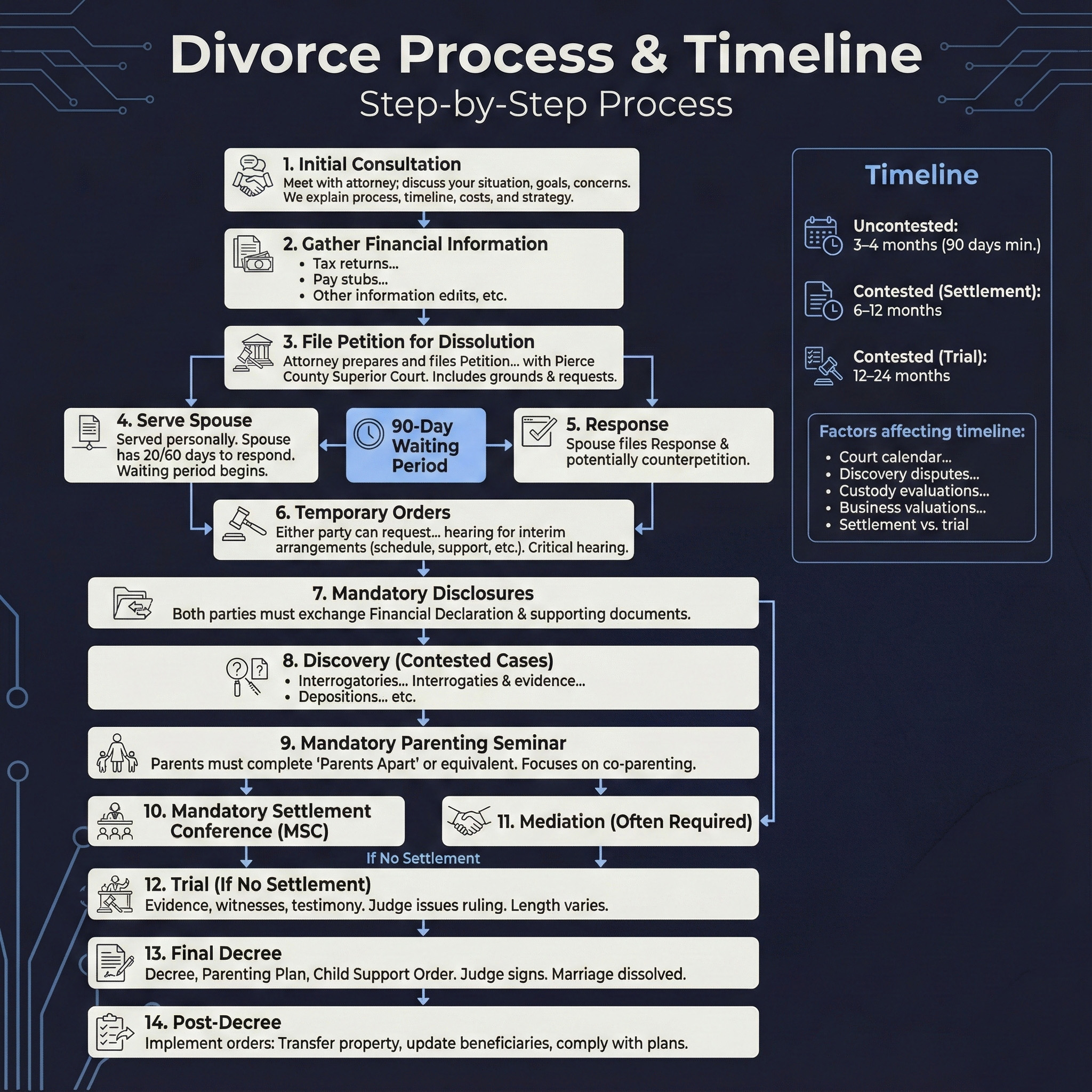
- 1.
Initial Consultation with Attorney
Discuss your situation, goals, and legal options. Understand the process, timeline, and estimated costs. Timeline: Same week as contact.
- 2.
File Petition for Dissolution
The petitioner (spouse who files) submits the Petition for Dissolution of Marriage to Pierce County Superior Court. Filing fee is approximately $314. Timeline: Within 1-2 weeks of retaining counsel.
- 3.
Serve the Other Spouse
The petition must be personally served on the other spouse (the respondent) by someone over 18 who is not a party. Service can also be completed by acceptance/joinder if both parties agree. Timeline: Within days of filing.
- 4.
Response
The respondent has 20 days to file a response (60 days if served out of state). If no response is filed, the petitioner may seek a default judgment. Timeline: 20-60 days after service.
- 5.
Temporary Orders
Either party can request temporary orders for custody, child support, spousal maintenance, use of property, and restraining orders. These orders remain in effect during the divorce. Timeline: 2-4 weeks after filing.
- 6.
Financial Declarations
Both parties must complete and exchange financial declarations disclosing all income, assets, debts, and monthly expenses. Timeline: Within 30 days of filing.
- 7.
Discovery
Formal exchange of information: interrogatories, requests for production, depositions, and subpoenas. May include hiring forensic accountants or other experts. Timeline: 2-6 months.
- 8.
Mediation
Pierce County requires mediation for contested custody disputes before trial. Many couples also mediate property and support issues. Timeline: 1-3 months (scheduling dependent).
- 9.
Guardian ad Litem (if appointed)
In contested custody cases, the court may appoint a GAL to investigate and recommend a parenting plan. The GAL interviews parents, children, teachers, and other relevant parties. Timeline: 2-4 months for investigation and report.
- 10.
Settlement Conference
A conference with a judge or commissioner to attempt to resolve remaining issues. The court may provide feedback on how it would likely rule at trial. Timeline: 1-2 months before trial date.
- 11.
Trial Preparation
Prepare witness lists, exhibit binders, trial briefs, and proposed findings of fact and conclusions of law. Timeline: 4-6 weeks before trial.
- 12.
Trial
A bench trial (no jury) before a Pierce County Superior Court judge. Both sides present evidence and testimony. The judge issues a ruling on all contested issues. Timeline: 1-5 days depending on complexity.
- 13.
Final Decree of Dissolution
The judge signs the final decree, which includes orders on property division, maintenance, parenting plan, and child support. The decree cannot be entered until at least 90 days after filing and service. Timeline: 90 days minimum from filing.
- 14.
Post-Decree Implementation
Transfer property titles, divide retirement accounts (QDRO), refinance mortgages, update insurance and estate planning documents. Timeline: 30-90 days after decree.
Visit Our Office
Office Location
Melvin & Torrone, PLLP
950 Pacific Ave, Suite 720
Tacoma, WA 98402
Phone
Office Hours
Monday - Friday: 9:00 AM - 5:00 PM
Weekends: By appointment
Parking
Paid parking is available in the Pacific Plaza parking garage adjacent to the building. Street parking is also available on Pacific Avenue and surrounding streets. We validate parking for client appointments.
Getting Here
Our office is located in the Pacific Plaza building in downtown Tacoma, between South 9th and South 11th Streets on Pacific Avenue. The building is a short walk from the Tacoma Link Light Rail and multiple bus routes.
Serving Tacoma & Pierce County Divorce Clients
Cities We Serve
Courts
- Pierce County Superior Court
- Tacoma Municipal Court
- Lakewood Municipal Court
- Puyallup Municipal Court
- Pierce County District Courts
Tacoma Neighborhoods
- North End
- South Tacoma
- Hilltop
- Stadium District
- Lincoln District
- Eastside
- West End
- McKinley Hill
- Proctor
- Old Town
Pierce County Divorce Procedures
Where to File
Divorce cases are filed in Pierce County Superior Court. There are two courthouse locations:
- Pierce County Superior Court — County-City Building: 930 Tacoma Ave S, Room 110, Tacoma, WA 98402
- Pierce County Superior Court — South County Annex: 2401 S 35th St, Suite 200, Tacoma, WA 98409
Local Rules
Pierce County has local rules that supplement the Washington State court rules. Attorneys practicing in Pierce County must comply with:
- PCLR (Pierce County Local Rules): General civil rules governing motions, hearings, and trial procedures
- PCLSPR (Pierce County Local Special Proceedings Rules): Rules specific to family law proceedings, including mandatory requirements for divorce, custody, and support cases
- Family Law Local Rules: Specific procedures for family law matters including filing requirements, mandatory forms, and scheduling
Mandatory Requirements
- 90-day waiting period: No divorce can be finalized until 90 days after the petition is filed and served
- Financial declarations: Both parties must file complete financial declarations
- Mandatory mediation: Required for contested custody disputes before the matter can be set for trial
- Parenting seminar: Both parents must complete an approved parenting seminar within 60 days of filing (when minor children are involved)
- Settlement conference: The court may require a settlement conference before scheduling trial
- Proposed parenting plan: Each party must file a proposed parenting plan
- Child support worksheets: Completed WSCSS worksheets must be filed with any proposed order for child support
Divorce FAQ
How long does it take to get divorced in Washington? +
Washington requires a minimum 90-day waiting period from the date the petition is filed and served. An uncontested divorce where both parties agree on all terms can be finalized shortly after that 90-day period—typically within 90 to 120 days total.
Contested divorces take significantly longer. If there are disputes over property, custody, or support, the case may take 6 months to over a year. Cases involving complex property (businesses, retirement accounts, multiple real estate holdings) or high-conflict custody disputes can take 12-24 months or longer.
Pierce County Superior Court's calendar and mandatory requirements (mediation, settlement conference, GAL investigation) also affect the timeline. Our attorneys work to resolve cases as efficiently as possible while protecting your interests.
Do I have grounds for divorce? +
Yes. Washington is a no-fault divorce state. The only ground for divorce is that the marriage is "irretrievably broken." You do not need to prove adultery, abuse, abandonment, or any other fault. If one spouse believes the marriage is irretrievably broken, that is sufficient.
You also need to meet the residency requirement: at least one spouse must be a Washington State resident (or a member of the military stationed in Washington) at the time of filing.
Can I stop my spouse from divorcing me? +
No. Because Washington is a no-fault state, only one spouse needs to want the divorce for it to proceed. You cannot prevent your spouse from filing for divorce, and you cannot force them to reconcile.
If you refuse to participate in the proceedings—for example, by not responding to the petition—the court can enter a default judgment and grant the divorce without your input. It is always better to participate, retain an attorney, and protect your rights rather than ignore the process.
How is property divided in Washington divorce? +
Washington is a community property state. All property and debt acquired during the marriage is presumed to be community property owned equally by both spouses. Separate property (owned before marriage, or received as a gift or inheritance during marriage) is generally awarded to the owning spouse.
However, the court divides property "fairly and equitably"—which does not always mean 50/50. The court considers the length of the marriage, each spouse's financial situation and earning capacity, and the nature of the property. In some cases, the court may even award a portion of separate property to the other spouse.
Complex assets such as businesses, retirement accounts, stock options, and real estate require careful valuation and division. Our attorneys work with forensic accountants and valuation experts to ensure accurate asset characterization and fair division.
Will I get alimony? +
Washington calls it "spousal maintenance" rather than alimony. Whether you receive maintenance depends on several factors under RCW 26.09.090: the length of the marriage, the standard of living during the marriage, each spouse's income and earning capacity, age and health, and the time needed to acquire education or training for employment.
Maintenance is more likely in longer marriages where there is a significant income disparity between spouses. Short marriages with both spouses working typically do not result in maintenance awards. There is no statutory formula—judges have broad discretion.
A common guideline (not a rule) is 25-35% of the income disparity for 30-50% of the marriage length, but actual awards vary widely. Our attorneys can evaluate your specific situation and provide a realistic assessment of your maintenance prospects.
Can I date during divorce? +
We strongly advise against it. While Washington is a no-fault state and dating during divorce is not technically illegal, it can create significant problems:
- It can inflame settlement negotiations and make your spouse less willing to compromise
- It can affect custody proceedings—introducing a new partner to children during divorce is viewed unfavorably by judges
- It can be used to argue dissipation of community assets (spending money on a new partner)
- It can damage your credibility with the court
- If a temporary restraining order is in place, introducing a new partner to children may violate the order
Wait until the divorce is finalized. The short-term cost of patience is far less than the long-term consequences of complicating your case.
Who gets the house? +
There is no automatic rule about who gets the house. If the home is community property (purchased during the marriage), the court has several options:
- Sell the home and divide the proceeds
- Award the home to one spouse with an offset from other assets (or a buyout)
- Allow one spouse to remain in the home for a set period (often until children finish school), then sell
The court considers which parent has primary residential custody of the children, each spouse's ability to afford the home (mortgage, taxes, maintenance), and the overall property division. The parent who lives with the children most of the time is often awarded the home to maintain stability, but only if they can afford it.
If one spouse owned the home before marriage, it may be characterized as separate property—but mortgage payments made during the marriage with community funds may give the other spouse a community interest in the equity.
Can my spouse hide assets? +
They can try, but the discovery process is designed to uncover hidden assets. Both parties are required to file complete financial declarations under penalty of perjury. Beyond that, your attorney can:
- Subpoena bank records, tax returns, and financial statements
- Hire forensic accountants to trace money and identify hidden accounts
- Depose your spouse under oath about their financial situation
- Request production of documents (business records, investment statements, cryptocurrency wallets)
- Issue subpoenas to third parties (banks, brokerages, employers)
If the court finds that a spouse has intentionally hidden assets, the consequences are severe: the court may award a larger share of property to the other spouse, impose sanctions, hold the hiding spouse in contempt, and even refer the matter for criminal prosecution (perjury). Courts take financial dishonesty very seriously.
What if my spouse doesn't follow temporary orders? +
Temporary orders are court orders with the full force of law. If your spouse violates them—by failing to pay support, refusing to follow the residential schedule, violating a restraining order, or dissipating assets—you can file a motion for contempt of court.
Consequences of contempt can include:
- Jail time (up to 6 months per violation)
- Fines
- Payment of your attorney fees
- Modification of orders to further restrict the violating party
- Negative impact on the final outcome (judges remember who followed the rules)
Document every violation carefully. Keep texts, emails, and records of missed payments or schedule changes. We use this evidence to build a strong contempt case and protect your interests.
How much does divorce cost? +
Divorce costs in Pierce County vary significantly based on the complexity of the case:
- Court filing fee: Approximately $314
- Uncontested divorce (both parties agree): $2,500-$5,000 in attorney fees
- Contested divorce (moderate complexity): $10,000-$25,000
- High-conflict or complex property divorce: $25,000-$50,000+
- Trial: Adds $5,000-$15,000+ to total costs
Additional costs may include mediator fees ($150-$400/hour), GAL fees ($3,000-$10,000), forensic accountant fees ($5,000-$15,000), real estate appraisals ($300-$500), and business valuations ($5,000-$25,000).
The biggest factor in controlling costs is the level of conflict. Couples who can agree on most issues spend far less than those who litigate every point. Our attorneys always look for opportunities to resolve issues efficiently.
At Melvin & Torrone, we provide transparent fee agreements upfront. We also offer payment plans for qualifying clients. Contact us for a free consultation to discuss your situation and get a realistic estimate of costs.
Protect Your Future
Schedule Your Free Divorce Consultation
Divorce is time-sensitive. Temporary orders set early in the case often shape the final outcome. The sooner you have an experienced attorney on your side, the stronger your position. Every consultation starts with listening to your situation, explaining your options, and outlining a strategic plan.
What to Bring to Your Divorce Consultation
Documents
- Marriage certificate and children's birth certificates
- Existing court orders (if any)
- Financial documents (tax returns, pay stubs, bank statements)
- Property records and mortgage information
- Retirement account statements
- Prenuptial or postnuptial agreements
Information
- Timeline of key events and date of separation
- List of all assets and debts
- Communication records related to your case
- Police reports or CPS documents (if applicable)
- Names and ages of children
- Questions and concerns you want to discuss
Even if you don't have all documents, come to the consultation—time is often critical.
The information on this page is for general informational purposes only and does not constitute legal advice. No attorney-client relationship is formed by visiting this website. Each case is unique, and past results do not guarantee future outcomes. Contact Melvin & Torrone for a consultation regarding your specific situation.