
Child Support for Adults With Disabilities in Washington State: Complete Guide

By Chris Torrone, Founding Attorney, Melvin & Torrone, PLLP
Yes, Washington State allows child support obligations to continue past age 18 for adults with mental or physical disability who cannot support themselves. I’ve handled family law cases in Pierce County for over 14 years, and I can tell you that most custodial parents don’t realize they can petition for extended support. The catch is you need to act before your child turns 18, or the process gets more complicated.
Let me explain exactly how child support for adults with disabilities works in Washington State.
Torrone’s Takeaways
-
Washington law allows child support beyond age 18 for adults with disabilities under RCW 26.09.170
-
File your petition before your child turns 18 to avoid complications and gaps in support payments
-
Courts need proof your child cannot work or live independently, not just a medical diagnosis
-
Special needs trusts protect SSI and Medicaid benefits while your child receives support payments
-
Pierce County filing fees are $200, and the process typically takes 90 to 180 days from start to finish
-
Coordinate your support order with DSHS DDA services to maximize resources for your child
-
Guardianship gives you legal authority to manage funds and make decisions for your adult child
Table of Contents
- Washington Law Lets You Extend Child Support Beyond Age 18
- Does Your Adult Child Qualify for Extended Support Under Washington Law
- Process to File for Adult Child Support in Washington
- How Special Needs Trusts Protect Your Child’s Benefits While Receiving Support
- What Your Adult Child Will Receive in Support Payments
- Why Guardianship Matters When Your Child Turns 18
- Washington Programs and Resources Every Parent Should Know About
- How Melvin & Torrone Protects Your Adult Child’s Financial Future
- Frequently Asked Questions
- Conclusion
Washington Law Lets You Extend Child Support Beyond Age 18
What RCW 26.09.170 Actually Says About Adult Child Support
Washington’s statute is clear but specific. RCW 26.09.170 allows courts to order support for adult children who are “dependent” due to a mental or physical disability. The law doesn’t define every qualifying condition. Courts look at whether your child can work, live independently, and handle daily tasks without substantial care.
How Pierce County Family Court Handles These Cases
I’ve filed dozens of these petitions in Pierce County over the years, and I can tell you the court system takes them seriously. Judges want proof your child truly cannot support themselves. You’ll need medical documents showing the disability is permanent or long-term. The court also examines both parents’ income to calculate fair support payments.
Sarah (anonymized) called our office two weeks before her daughter Emma’s 18th birthday. Emma had been diagnosed with Down syndrome at birth and attended special education programs through high school graduation. Sarah had been receiving $800 monthly in support payments from Emma’s father for years. She panicked when she realized the payments would automatically stop once Emma turned 18.
We immediately filed a petition under RCW 26.09.170, documented Emma’s intellectual disability and daily care needs, and presented evidence that Emma would never be able to work full-time or live independently. Pierce County Family Court extended the support obligation indefinitely. Emma now receives continued financial support while also qualifying for DSHS services. The key was acting before Emma’s 18th birthday, not after.
Why DSHS Developmental Disabilities Administration Matters for Your Case
DSHS DDA provides services to Washington residents with developmental disabilities, and connecting with them strengthens your child support case. Across the United States, 23.6% of young adults aged 18-44 live with disabilities, yet many families don’t realize DDA enrollment proves your child meets Washington’s disability definition. DDA also offers home and community services that coordinate perfectly with court-ordered support.

Does Your Adult Child Qualify for Extended Support Under Washington Law
Medical Conditions That Meet Washington’s Disability Threshold
Washington courts accept a wide range of conditions, but they all share one thing in common. Your child’s disability must prevent them from earning enough income to support themselves. I’ve seen successful petitions for intellectual disability, autism spectrum disorder, cerebral palsy, traumatic brain injuries, and severe mental health conditions. The court doesn’t require a specific diagnosis, just proof of limitation.
What “Unable to Support Themselves” Really Means to the Court
Marcus (anonymized) was 19 when his mother Linda contacted us. He had graduated from Wilson High School with a modified diploma after struggling with a learning disability and ADHD his entire life. Marcus could work part-time at a grocery store bagging items, earning about $600 monthly. His father argued Marcus was “employed” and didn’t need support.
We presented evidence showing Marcus couldn’t manage his paycheck, missed shifts without reminders, and still needed Linda’s help with transportation, cooking, and medical appointments. The court ruled Marcus qualified for extended support because his disabilities prevented him from living independently, even though he had some employment. His father was ordered to pay $450 monthly to cover the gap between Marcus’s limited income and his actual living costs.
This phrase confuses most parents I talk to in family law consultations. Courts don’t expect your child to live in poverty just to avoid support obligations. They look at whether your adult child can maintain gainful employment and handle basic life skills without substantial care. According to the U.S. Bureau of Labor Statistics, the employment rate for people with disabilities is just 22.7% compared to 65.5% for those without disabilities. The court considers factors like your child’s ability to manage finances, prepare meals, maintain hygiene, and access medical care independently.
The Documentation You Need Before Filing Your Petition
Strong medical documents make or break these cases in my experience. Gather these essential items before you file:
-
Diagnostic evaluations from medical professionals or psychologists
-
Treatment records showing ongoing care needs
-
School records including IEP documents and high school transcripts
-
Statements from therapists, case workers, or vocational specialists
-
Documentation of any public benefits like Supplemental Security Income or Medicaid
You’ll also need proof of your child’s daily care requirements. Write down who helps with meals, transportation costs, medication management, and personal care. The Court of Appeals has consistently ruled that courts must consider the child’s actual functional limitations, not just their medical diagnosis.
Table: Complete Document Checklist for Your Adult Child Support Petition
| Document Category | What You Need | Where to Get It |
|---|---|---|
| Medical Documentation | Diagnostic evaluations, treatment records, prognosis statements | Your child’s doctors, psychologists, specialists |
| School Records | IEP documents, high school transcripts, special education reports | School district records office |
| Disability Verification | DDA enrollment confirmation, SSI award letter, disability determination | DSHS DDA office, Social Security Administration |
| Care Cost Documentation | Receipts for therapy, medical expenses, adaptive equipment, transportation costs | Keep all receipts and billing statements |
| Functional Assessments | Daily living skills evaluation, vocational assessments, needs-based assessment | Therapists, case workers, vocational specialists |
| Financial Records | Both parents’ tax returns, pay stubs, financial disclosure forms | Your own records and employer |
| Support History | Existing child support orders, payment records, modification history | Court records, payment processor statements |
Process to File for Adult Child Support in Washington
Filing Your Petition in Pierce County Family Court and What It Costs
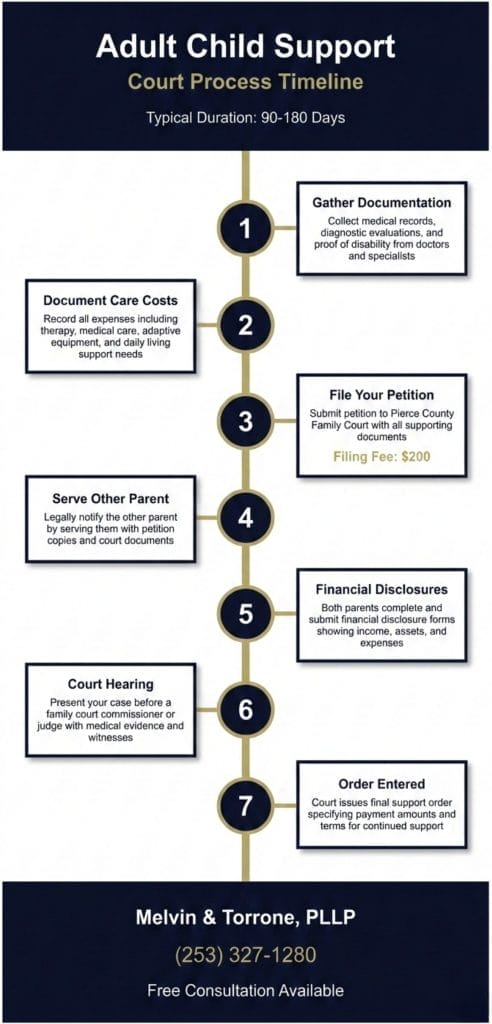
You’ll start by filing a petition for child support modification with Pierce County Family Court. Under Washington law (RCW 36.18.020), the filing fee is $200 for civil actions, though you may qualify for a fee waiver if you receive public benefits. The seven-step process looks like this:
-
Gather medical documentation proving your child’s disability
-
Document your child’s care needs and associated costs
-
File your petition with Family Court and pay the $200 fee
-
Serve the other parent with petition copies
-
Complete financial disclosures from both parents
-
Attend your hearing before a commissioner or judge
-
Receive your court order (typically within 90-180 days)
Serving the Other Parent and Completing Financial Disclosures
After filing, you must serve the other parent with copies of your petition and supporting documents. I always tell clients this step is non-negotiable in family law. You can’t skip it. Both parents must complete financial disclosure forms showing income, assets, and expenses. Washington courts calculate support payments based on both parents’ ability to pay and the child’s actual care needs.
What Happens at Your Hearing and How Long the Process Takes
At your hearing, a family court commissioner or judge will review your evidence and hear from both parents. You’ll present medical testimony, care cost breakdowns, and proof your child cannot work or live independently. Bring witnesses like therapists or case workers if possible. The judge wants to see your child’s real-world limitations, not just paperwork.
Jennifer’s 17-year-old son Alex (anonymized) had autism and required around-the-clock supervision. She filed her petition three months before his 18th birthday. Her ex-husband initially refused to complete his financial disclosure, claiming Alex should “figure it out on his own” after high school graduation.
We filed a motion to compel, and the court ordered him to comply within 14 days. At the hearing, Jennifer brought Alex’s speech therapy provider and his DDA case manager as witnesses. Both testified about Alex’s daily care needs and inability to live independently. The court ordered continued support of $1,200 monthly, covering the gap between Alex’s care costs and Jennifer’s income. The entire process took 120 days from filing to final order.
How Special Needs Trusts Protect Your Child’s Benefits While Receiving Support
First-Party vs Third-Party Trusts and Which One You Need
Special needs trusts are game-changers for families receiving child support for disabled adult children. A first-party trust holds money that belongs to your child, like an inheritance or personal injury settlement. A third-party trust holds money from parents or relatives. The difference matters because first-party trusts require Medicaid payback after your child dies. Third-party trusts don’t. For child support payments, we typically recommend a third-party trust funded by both parents to protect public benefits.
Coordinating Your Trust with DDA Home and Community Services
When you coordinate your special needs trust with DSHS Developmental Disabilities Administration services, you maximize resources without losing benefits. DDA provides residential services, employment support, and case management based on need. Your trust can pay for expenses DDA doesn’t cover, like entertainment, clothing, or specialized personal care. I’ve worked with families who use DDA funding for basic care and trust funds for quality-of-life expenses. This combination gives your child the best possible support.
Michael’s (anonymized) parents divorced when he was 15. At 18, Michael had cerebral palsy and qualified for DDA services covering his residential care. His father was ordered to pay $900 monthly in extended support. Instead of giving Michael direct cash payments (which would disqualify him from Supplemental Security Income), we established a third-party trust. The trust paid for Michael’s assistive devices, transportation costs, and recreational activities. Michael kept his SSI eligibility and Medicaid benefits while still receiving financial support from both parents.
How to Preserve Medicaid and SSI Eligibility in Washington
Medicaid benefits and SSI have strict income and asset limits. Direct support payments to your child could disqualify them from these programs. That’s why special needs trusts exist. Money held in a properly structured trust doesn’t count as your child’s income or assets. The trust pays for supplemental needs like medical expenses not covered by Medicaid, therapy sessions, or adaptive equipment. You can also consider an ABLE account for smaller amounts.

What Your Adult Child Will Receive in Support Payments
How Courts Calculate Support When Your Child Receives SSI or SSDI
Washington courts don’t reduce your support obligation just because your child gets federal benefits. In 2025, the federal SSI benefit rate is $967 monthly for an individual. That’s barely enough to survive in Pierce County. Courts calculate support based on both parents’ income and your child’s actual care costs. The judge subtracts SSI or Social Security Disability Income from total expenses, then divides the remaining obligation between both parents proportionally.
Washington Cases and What Parents Were Ordered to Pay
I’ve seen support orders range from $300 to $2,000 monthly depending on the child’s needs and parents’ income. One case involved a father earning $120,000 annually who was ordered to pay $1,400 monthly for his daughter’s medical and therapeutic care. Another case had both parents earning modest incomes, and the non-custodial parent paid $450 monthly. Courts look at your child’s specific needs, not a standard formula.
David’s daughter Rachel (anonymized) had Down syndrome and received $967 monthly in SSI. Her actual care costs totaled $2,400 monthly when you factored in home modifications, specialized transportation, and therapy not covered by Medicaid. The court ordered David to pay $850 monthly and Rachel’s mother to cover the remaining gap from her income. Rachel kept her full SSI benefits because the support went into a special needs trust.
When Support Covers Medical Costs vs Daily Living Expenses
Support payments can cover a wide range of expenses beyond basic needs. I’ve successfully argued for payments covering speech therapy, occupational therapy, adaptive equipment, and even vehicle modifications. Courts also consider vocational needs like job coaching or supported employment programs. The more detailed your documentation of care costs, the better. Medical expenses typically get priority, but daily living support matters too when your child cannot work.
Table: How SSI, SSDI, and Child Support Work Together in Washington
| Benefit Type | 2025 Monthly Amount | Counts as Income? | How Child Support Affects It |
|---|---|---|---|
| SSI (Supplemental Security Income) | $967 for individual | Yes, strictly limited | Direct payments reduce SSI dollar-for-dollar. Use special needs trust to avoid this. |
| SSDI (Social Security Disability Income) | Varies by parent’s work history | Partially | Child support doesn’t affect SSDI, but combined income may affect other benefits. |
| Medicaid | Full medical coverage | Asset-tested | Keep assets under $2,000. Special needs trusts don’t count toward this limit. |
| DDA Services | Varies by need | No | Support payments don’t affect DDA eligibility or service levels in Washington. |
| ABLE Account | Up to $18,000/year contribution | No (up to limit) | Safe place for child support funds. Doesn’t count toward SSI asset limit. |
Why Guardianship Matters When Your Child Turns 18
The Difference Between Guardianship and Power of Attorney in Washington
Most parents get confused about these two legal tools. A power of attorney only works if your adult child can understand what they’re signing and consent to it. Guardianship is a court order that gives you legal authority to make decisions when your child lacks the mental capacity to do so themselves. Power of attorney is voluntary. Guardianship is court-mandated and requires proving your child cannot manage their own affairs.
How to Establish Legal Authority to Make Decisions for Your Adult Child
Filing for guardianship in Washington involves several steps through the family law court system. You’ll need to prove your adult child has an intellectual disability or mental disability that prevents independent decision-making. The process typically includes:
-
File a petition for guardianship with your county court
-
Provide medical evidence of your child’s incapacity
-
Notify your adult child and other interested parties
-
Attend a court hearing with your child present
-
Receive letters of guardianship if approved
The court may appoint a guardian ad litem to investigate and report on your child’s best interests. This process protects your child’s rights and ensures guardianship is truly necessary.
When You Need Both a Support Order and Guardianship
Child support obligations and guardianship serve different purposes in family law. Support payments provide financial maintenance for your child’s care costs. Guardianship gives you legal authority to manage those funds and make life decisions. I’ve seen too many custodial parents assume a support order is enough. It’s not. You need guardianship to open bank accounts, sign medical consent forms, and handle custody arrangements for your adult child who cannot do these things independently.
Washington Programs and Resources Every Parent Should Know About
DSHS Developmental Disabilities Administration Services You Can Access
DSHS DDA is Washington’s primary resource for families with adult children who have developmental disabilities. As of July 2024, DDA serves 58,068 enrolled clients with 680 case managers across the state. Services include residential support, employment assistance, family caregiver support, and case management. Enrollment proves your child meets Washington’s disability definition, which strengthens your child support case. Contact DDA early because waitlists can be long for certain programs.
Washington ABLE Accounts and How They Work With Child Support
An ABLE account lets your adult child save money without losing Supplemental Security Income or Medicaid benefits. You can contribute up to $18,000 annually for disability-related expenses like education, housing, transportation costs, and assistive devices. The account doesn’t count toward SSI’s $2,000 asset limit. ABLE accounts work well alongside special needs trusts for smaller, more accessible funds. Your child can use ABLE money for daily needs and keep the trust for major expenses like medical care or home modifications.
Disability Rights Washington and Where to Get Free Legal Help
Disability Rights Washington is our state’s protection and advocacy system for people with disabilities. They offer free legal help for disability-related issues, including benefits appeals and discrimination cases. You can also contact Northwest Justice Project for free family law assistance if you meet income requirements. Other resources include the Special Needs Alliance for finding attorneys experienced in disability planning and Washington’s Protection & Advocacy System for rights violations. I always tell clients to explore these options before assuming they can’t afford legal representation.

How Melvin & Torrone Protects Your Adult Child’s Financial Future
Our Experience With Adult Disability Support Cases in Pierce County
We’ve spent decades handling family law cases in Pierce County, and adult disability support is one of our core practice areas. I’ve personally guided hundreds of parents through the RCW 26.09.170 process, from initial petition to final court order. Our 96% success rate in CPS custody cases and 94% success rate in child support cases reflects our deep understanding of Washington courts. We know the judges, the commissioners, and exactly what evidence Pierce County Family Court needs to see.
How We Coordinate Support Orders With Special Needs Trusts and State Benefits
Getting a support order is only half the battle. We coordinate with estate planning attorneys to establish special needs trusts that protect your child’s public benefits. We also work directly with DSHS DDA to ensure your child’s support payments don’t disqualify them from Medicaid benefits or Supplemental Security Income. This comprehensive approach means your child gets financial support without losing essential state services. Most family law firms stop at the court order. We make sure everything works together.
What to Expect During Your Free Consultation With Our Team
Call us at (253) 327-1280 or schedule your 30-minute free consultation. We’ll review your situation, explain your options under Washington law, and create a plan to protect your child’s future. You’ll talk directly with an attorney, not a paralegal or legal assistant. We explain complicated legal processes with language that’s easy to understand. You deserve to be known by your name, not a case number. Let us fight for your family.
Frequently Asked Questions
1. At what age can I petition to end adult child support in Washington?
There’s no automatic end date for adult child support when disability is involved. Support continues as long as your child remains unable to support themselves due to their mental or physical disability. You’d need to prove their condition has improved.
2. Can Child Support for Adults With Disabilities be modified in Washington?
Yes, either parent can petition for child support modification if circumstances change significantly. Examples include changes in the child’s care needs, parent income changes, or new medical expenses. Pierce County Family Court reviews modification requests regularly.
3. What if my adult child lives in a group home?
Group home placement doesn’t eliminate your support obligation. Courts still consider costs not covered by state funding, like personal items, therapy, recreational activities, and medical expenses. We help families calculate fair support amounts in these situations.
4. How does DDA funding affect child support?
DDA services reduce but don’t eliminate parental support obligations. Courts subtract DDA-covered expenses from total care costs, then divide the remaining amount between parents. Your child can receive both DDA services and court-ordered support payments simultaneously.
5. Can I be required to pay for past care costs?
Washington courts can order retroactive support, but it’s limited. Generally, you can only be ordered to pay back to the date you filed your petition, not years prior. We always tell clients to file as soon as possible to maximize financial support.
6. What happens when the paying parent retires?
Retirement changes income but doesn’t automatically end support obligations. The paying parent can petition for modification based on reduced retirement income. Courts balance the child’s ongoing needs against the parent’s actual ability to pay after retirement.
7. Does my adult child need to attend court hearings?
Your adult child should attend unless their disability prevents meaningful participation. Courts want to see the person they’re making decisions about. We prepare families for what to expect and how to present your child’s situation respectfully and effectively.
Conclusion
Washington law gives you the right to secure financial support for your adult child with disabilities, but only if you act. I’ve guided hundreds of Pierce County families through this exact process. You don’t have to figure out RCW 26.09.170, special needs trusts, or DSHS coordination alone.
Schedule a free 30-minutes consultation with Melvin & Torrone today. We’ll explain your options in plain language, create a personalized plan, and fight to protect your child’s future.

Chris Torrone
Founding Partner, Melvin & Torrone PLLP
Chris Torrone is a dedicated advocate for clients facing family crises and criminal charges. With 20 years of experience practicing in Pierce County courts, Chris has built a reputation for meticulous case preparation and creative problem-solving in high-stakes litigation.
Need Legal Help?
Schedule Your Free Consultation
If you're facing a legal issue discussed in this article, our Tacoma attorneys are here to help.
Get Your Free Consultation