
Can You Be a Teacher If You Have a DUI in 2026?

By Chris Torrone, Founding Attorney, Melvin & Torrone, PLLP
Yes, you can still teach in Washington State after a DUI conviction, but you must report it to OSPI within 30 days or risk losing your teaching license permanently. I’ve represented educators throughout Pierce County for over 20 years, and many of them come to me asking the same question: Can You Be A Teacher If You Have A DUI.
The good news is that first-time offenders who act quickly, complete rehabilitation, and hire a skilled DUI attorney typically keep their teaching credential. Multiple DUI convictions or a high blood alcohol content make things harder, but not impossible. Your next move determines whether you stay in the classroom or lose everything you’ve worked for.
Torrone’s Takeaways
-
Report your DUI to OSPI within 30 days or face harsher penalties than the conviction itself
-
First-time offenders with low blood alcohol content and immediate rehabilitation typically keep their teaching licenses
-
OSPI investigates every teacher DUI case but treats honesty better than hiding criminal records
-
Deferred prosecution avoids a conviction but still counts as a prior offense for future DUI charges
-
You cannot expunge a DUI in Washington, but reduced charges like reckless driving can be vacated after 10 years
-
Hire a DUI attorney immediately who understands both criminal defense and teaching credential protection
-
Early action and strong rehabilitation evidence make the difference between a reprimand and losing your teaching career
Table of Contents
- OSPI Reporting Requirements Can Make or Break Your Teaching Career
- How Washington State Reviews DUI Cases for Teachers Under WAC 181-86
- Possible Outcomes for Your Washington Teaching Certificate After a DUI
- How First-Time DUI Offenders Can Protect Their Teaching Certificate in Washington
- The Deferred Prosecution Option That Could Save Your Teaching Career
- Why You Cannot Expunge a DUI in Washington (And What You Can Do Instead)
- Your Step-by-Step Action Plan After Getting a DUI as a Washington Teacher
- How Melvin & Torrone Protects Teaching Careers After DUI Charges in Pierce County
- Frequently Asked Questions
- Conclusion
OSPI Reporting Requirements Can Make or Break Your Teaching Career
The 30-Day Window That Every Washington Teacher Must Know About
The moment you receive a DUI conviction, the clock starts ticking. Washington law requires you to report any criminal conviction to OSPI within 30 days. Miss this deadline, and you’ve just committed a second violation that’s often worse than the DUI itself. I’ve seen teachers lose their teaching credential permanently not because of the drunk driving charge, but because they failed to disclose it.
School districts receive notification from law enforcement officials, and when OSPI discovers you didn’t report, they view it as dishonesty. Washington State recorded 4,982 alcohol-related crashes through December 2025, including 121 fatal collisions, which is why OSPI takes these cases seriously.
What Happens After You Report Your DUI to OSPI
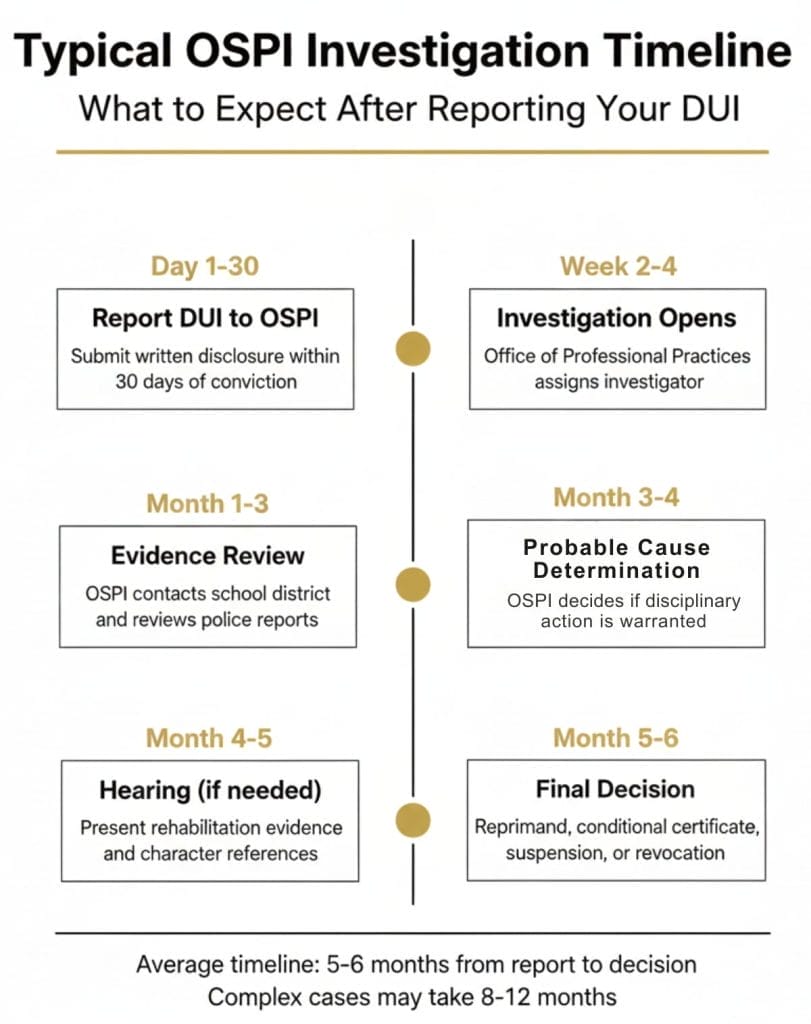
Once OSPI receives your disclosure, the Office of Professional Practices launches an investigation into your criminal record. An investigator reviews your blood alcohol content, field sobriety tests results, and any aggravating factors like accidents or children in the vehicle. They contact your school district to assess your teaching performance and check for prior law violations.
This process typically takes three to six months, during which you can continue teaching if your employment contract allows it. OSPI then decides whether to issue a reprimand, place conditions on your teaching license, suspend you temporarily, or revoke your credential permanently.
The Consequences of Failing to Disclose Your DUI Conviction
A 32-year-old middle school teacher in Puyallup learned this lesson the hard way in 2023. She received a DUI conviction in Pierce County after registering a blood alcohol concentration of .11, but she convinced herself that since it was her first offense and happened during summer break off school property, she didn’t need to report it. Six months later, during a routine background screening for a field trip, the school district discovered her criminal charge. OSPI launched an investigation not for the DUI itself, but for failure to disclose.
The result was a two-year suspension of her teaching license, far harsher than the reprimand she would have received had she reported within 30 days. When you hide a DUI conviction, you transform a manageable situation into a career-ending crisis. OSPI views dishonesty as a greater threat to students than a single mistake with alcohol.
How Washington State Reviews DUI Cases for Teachers Under WAC 181-86
The Office of Professional Practices Investigation Process Explained
WAC 181-86 gives OSPI the authority to investigate any educator who commits a criminal offense, including DUI convictions. The Office of Professional Practices assigns an investigator to your case within weeks of receiving your report or discovering your criminal charge through background checks. This investigator contacts your principal, reviews your personnel file, and interviews colleagues about your character and teaching performance. They examine police reports detailing your blood alcohol content and whether you completed standard field sobriety tests.
What OSPI Actually Considers When Evaluating Your DUI
OSPI doesn’t treat all DUI convictions the same way. They evaluate how high your blood alcohol concentration measured during chemical testing, whether children were in your vehicle, if you caused property damage or injuries, and whether this happened during school hours near school property. Your prior criminal record matters tremendously. A first-time offense with a .08 BAC and full cooperation with law enforcement officials typically results in a written reprimand.
Timeline From Report to Final Decision on Your Teaching Certificate
A high school science teacher from Tacoma faced this process in early 2024 after his second DUI conviction in seven years. He reported to OSPI immediately, hired criminal defense representation, and enrolled in an intensive outpatient program before his hearing. OSPI’s investigation took four months, during which his school district placed him on paid administrative leave per his employment contract. At his hearing, he presented completion certificates from his treatment program and letters from his principal. OSPI suspended his teaching license for 18 months rather than revoking it permanently.

Possible Outcomes for Your Washington Teaching Certificate After a DUI
Written Reprimands and How They Affect Your Teaching Record
A written reprimand is the mildest disciplinary action OSPI can impose on your teaching credential after a DUI conviction. This formal letter becomes part of your permanent educator file but doesn’t prevent you from teaching or applying to other school districts. Most first-time offenders with a blood alcohol content below .10, no accident, and immediate cooperation receive this outcome. The reprimand stays in OSPI records indefinitely, so any future criminal convictions will show a pattern of behavior that triggers harsher consequences.
Conditional Certificates and What Restrictions You Might Face
OSPI may place specific conditions on your teaching license rather than suspending it completely. Common restrictions include mandatory alcohol treatment monitoring, random drug testing, prohibition from driving students during school hours, and regular check-ins with your local school board. I’ve seen conditional certificates require teachers to attend victim impact panel sessions and complete additional community service beyond court requirements. These conditions typically last one to three years, and violating any term results in immediate suspension or revocation of your teaching credential.
When OSPI Suspends or Revokes Teaching Licenses for DUI Convictions
An elementary teacher in her late fifties from Gig Harbor received her third DUI conviction in 2023, this time with a blood alcohol concentration of .18 and minor property damage. Her first two DUI convictions from 2015 and 2019 had each resulted in conditional certificates with treatment requirements. OSPI suspended her teaching license for three years, effectively ending her career since she was approaching retirement age.
The suspension meant she couldn’t work in any public school or private school requiring state certification. Her case demonstrates that OSPI shows patience with first offenses but treats repeat DUI convictions as evidence you’re not fit to serve as a role model. Permanent revocation typically occurs when teachers have multiple DUI convictions within a decade, cause serious injuries, or commit additional criminal charges during the investigation process.
Table: OSPI Disciplinary Outcomes for Teachers with DUI Convictions
| Factor | Written Reprimand | Conditional Certificate | Suspension (1-3 Years) | Permanent Revocation |
|---|---|---|---|---|
| Blood Alcohol Content | .08 - .10 | .11 - .14 | .15 - .19 | .20+ or refusal |
| Prior DUI History | None | None | One prior (5+ years ago) | Two or more priors |
| Aggravating Factors | None | Minor property damage | Accident with injuries | Child in vehicle or serious injury |
| Location/Timing | Off school property, non-school hours | Off school property | Near school or during school hours | On school property |
| Rehabilitation Effort | Immediate enrollment in treatment | Court-ordered minimum only | Delayed or incomplete | None or repeated failures |
| Cooperation Level | Full disclosure within 30 days | Late disclosure (31-60 days) | Disclosure after 60 days | Failure to disclose |
| Teaching Record | Excellent performance | Good performance | Average with prior concerns | Poor or additional misconduct |
| Typical Timeline | 4-6 months | 5-7 months | 6-9 months | 8-12 months |
How First-Time DUI Offenders Can Protect Their Teaching Certificate in Washington
What Makes Your DUI Case “Low-Risk” in OSPI’s Eyes
OSPI treats first-time DUI offenses with blood alcohol content between .08 and .10 as the most favorable cases for keeping your teaching license. If you cooperated fully during the traffic stop, completed field sobriety tests without incident, caused no property damage, and had no children in your vehicle, you’re looking at a written reprimand in most situations. The timing matters too. A DUI conviction that occurs off school property during summer break raises fewer concerns than one happening during school hours or near students.
Rehabilitation Evidence That Actually Convinces OSPI Investigators
OSPI wants to see immediate action, not just court-ordered minimums. Enroll in outpatient alcohol treatment before your hearing, attend support group meetings, and document every session. Complete a victim impact panel even if the judge didn’t require it. Obtain a substance abuse evaluation from a licensed provider and follow all recommendations.
Install an ignition interlock device on your vehicle voluntarily if you haven’t lost your driver’s license. I’ve watched teachers present thick folders of completion certificates, attendance records, and counselor letters that transformed potential suspensions into conditional certificates.
Character References That Carry Weight in Certificate Reviews
A 28-year-old first-year teacher in Puyallup got a DUI conviction in December 2023 with a blood alcohol concentration of .09 after a holiday party. She panicked about losing her teaching career before it even started. Within two weeks, she enrolled in an intensive outpatient program, reported her conviction to OSPI, and began gathering character references. Her principal wrote a detailed letter describing her exceptional classroom management and dedication to students.
Three veteran teachers from her building provided statements about her professionalism and role model behavior. Her college advisor from her teaching credential program contributed a reference highlighting her academic excellence and commitment to education. When OSPI reviewed her case four months later, they issued only a written reprimand with no restrictions on her teaching license. The combination of immediate rehabilitation efforts and strong character references from education professionals made the difference between a reprimand and a conditional certificate with ongoing monitoring requirements.
Table: First DUI vs Multiple DUI Outcomes for Washington Teachers
| Category | First DUI Offense | Second DUI Offense | Third DUI Offense |
|---|---|---|---|
| Criminal Penalties | 1-364 days jail (typically 1 day), $350-$5,000 fines | 30-364 days jail (minimum 30 days), $500-$5,000 fines | 90-364 days jail (minimum 90 days), $1,000-$5,000 fines |
| Driver’s License Suspension | 90 days to 2 years | 2 years to 3 years | 3 years to 4 years |
| Ignition Interlock Device | 1 year minimum | 5 years minimum | 10 years minimum |
| OSPI Likely Outcome | Written reprimand or conditional certificate | Conditional certificate or 1-2 year suspension | 2-3 year suspension or permanent revocation |
| Deferred Prosecution Option | Available (once per lifetime) | Not available if prior deferred prosecution | Not available if prior deferred prosecution |
| Teaching Career Impact | Minimal with immediate action and rehabilitation | Significant but recoverable with strong defense | Career-ending in most cases |
| School District Response | Usually retain position with good performance | May face administrative leave or termination | Termination likely under at-will employment |
| Recovery Timeline | 6-18 months to full resolution | 2-4 years to return to normal status | 3-5+ years if license restored at all |
The Deferred Prosecution Option That Could Save Your Teaching Career
How Washington’s Deferred Prosecution Program Works for Teachers
Deferred prosecution lets you avoid a DUI conviction on your criminal record if you complete a rigorous five-year treatment program. Your DUI attorney files a petition with the court before trial, and if approved, the criminal charge gets dismissed after successful completion. This program is only available once in your lifetime for alcohol-related offenses. Teachers benefit because technically you have no criminal conviction to report to OSPI, though you still must disclose the deferred prosecution itself.
The Five-Year Treatment Plan and Why It’s Worth Considering
Research shows that alcoholic convicted drivers were more than twice as likely as deferred drivers to recidivate within four years, with 48% of convicted drivers reoffending compared to only 22% of deferred prosecution participants. The program requires intensive outpatient treatment, regular attendance at support meetings, random alcohol testing, and complete abstinence from alcohol for five years.
You’ll also face a driver’s license suspension and ignition interlock device requirements. The commitment feels overwhelming, but teachers who complete it successfully have no DUI conviction limiting their teaching credential applications.
Why Deferred Prosecution Counts as a Prior Offense (Even After Dismissal)
A 35-year-old middle school PE teacher from Lakewood learned this harsh reality in 2024. He completed a deferred prosecution successfully in 2019 after his first DUI arrest, celebrating when the charge got dismissed. Five years later, he received another DUI conviction with a blood alcohol content of .12.
He assumed his clean criminal record meant this would be treated as a first offense by both the criminal justice system and OSPI. Wrong. Washington law treats deferred prosecution as a prior DUI for sentencing purposes on any future offense. The court imposed harsher penalties, and OSPI viewed him as a repeat offender despite having technically zero convictions on his record. His teaching license received a one-year suspension rather than the reprimand a true first-time offender would receive.

Why You Cannot Expunge a DUI in Washington (And What You Can Do Instead)
What RCW 9.96.060 Actually Says About Vacating DUI Convictions
Washington State law explicitly prohibits vacating DUI convictions under RCW 9.96.060. The statute lists specific criminal convictions that can never be erased from your criminal record, and DUI sits at the top of that list. This means your DUI conviction remains permanently visible on background checks conducted by school districts and OSPI. However, a 2024 law change eliminated the three-year wait after paying legal financial obligations for eligible misdemeanor convictions, making it faster to vacate other offenses.
The 10-Year Pathway for Reduced Charges Like Reckless Driving
If your DUI attorney negotiates your charge down to reckless driving or negligent driving, you gain a significant advantage for your teaching career. These reduced charges can be vacated after 10 years under Washington law, completely removing them from your criminal record. You must complete all court requirements, pay fines and penalty assessments, avoid new criminal convictions during the waiting period, and demonstrate rehabilitation. Once vacated, you can honestly answer “no” when teaching credential applications ask about criminal convictions.
How Reduced Charges Affect Your Teaching Certificate Application
A music teacher in his early forties from Tacoma had his DUI reduced to reckless driving back in 2013 through skilled criminal defense work. He completed all court requirements, maintained a clean record, and waited exactly 10 years before petitioning to vacate the conviction. In 2023, he successfully vacated the reckless driving charge and applied for a teaching position at a new school district.
His background screening came back completely clean. When he disclosed the vacated conviction to OSPI as a precaution, they confirmed it required no reporting since vacated convictions are treated as though they never occurred. His teaching license application processed without delays or conditions. The decade-long wait felt frustrating, but the clean criminal record opened doors that would have remained closed with a permanent DUI conviction affecting his teaching career prospects.

Your Step-by-Step Action Plan After Getting a DUI as a Washington Teacher
Immediate Actions in the First 24-48 Hours After DUI Arrest
Hire a DUI attorney immediately who understands both criminal defense and teaching credential protection. Request a hearing with the Department of Licensing within seven days to challenge your driver’s license suspension. Document everything from your arrest, including the blood alcohol content results and field sobriety tests administered. Notify your principal or human resources department before they hear about it through other channels.
What to Do Within the Critical 30-Day Reporting Window
Report your DUI conviction to OSPI in writing as soon as you receive it, never waiting until day 29. Review your employment contract to understand whether your school district can terminate you or place you on leave during the investigation. Begin gathering character references from administrators, veteran teachers, and community members who can speak to your professionalism. Enroll in alcohol treatment immediately, even before the court orders it.
Long-Term Strategy for Maintaining Your Teaching License and Employment
A sixth-grade teacher in her mid-thirties from University Place received a DUI conviction in March 2024 and followed this exact strategy. She hired criminal defense representation within 24 hours, reported to OSPI on day 12, and enrolled in outpatient treatment on day 15. She maintained excellent teaching performance throughout the investigation, documented every rehabilitation step, and kept open communication with her principal.
Her local school board supported keeping her employed under her at-will employment status. When OSPI completed their review five months later, they issued a written reprimand with no restrictions. She continued teaching without interruption, completed two years of treatment, and used the experience to become a more empathetic educator and stronger role model for students facing their own mistakes.

How Melvin & Torrone Protects Teaching Careers After DUI Charges in Pierce County
Why Teachers Need Specialized DUI Defense for Both Criminal and Career Protection
Most DUI attorneys focus solely on your criminal case, but we understand that your teaching license is equally at risk. We develop defense strategies that minimize both your criminal conviction consequences and the impact on your teaching credential. Our approach includes challenging blood alcohol content results, questioning field sobriety tests procedures, and building rehabilitation evidence that convinces both Pierce County courts and OSPI investigators that you deserve a second chance.
Our Proven Track Record Defending Educators Throughout Tacoma and Pierce County
We’ve successfully defended teachers, administrators, and prospective teachers facing DUI charges across Pierce County for over two decades. Our 99% success rate in DUI cases means we know how to fight aggressively for reduced charges, deferred prosecution options, and dismissals when evidence doesn’t hold up.
We help educators by:
-
Minimizing DUI impact on teaching credentials and OSPI reviews
-
Navigating reporting requirements and disciplinary hearings
-
Pursuing deferred prosecution when eligible for first-time offenders
-
Preparing strong disclosure statements that show accountability
-
Representing you throughout the criminal justice system and OSPI proceedings
Schedule Your Free Consultation to Protect Your Teaching Career Today
Call us at (253) 327-1280 or schedule online for a confidential consultation about your DUI charge and teaching license. We’ll review your case, explain your options for both criminal defense and OSPI compliance, and create a strategic plan to protect what matters most. Our office is located at 950 Pacific Ave, Suite 720, Tacoma, where we’ve helped hundreds of educators maintain their teaching credentials after DUI arrests. Early intervention makes all the difference between a manageable setback and a career-ending crisis.
Frequently Asked Questions
1. Can You Be A Teacher If You Have A DUI?
Yes, you can still teach in Washington State after a DUI conviction, but you must report it to OSPI within 30 days or you risk permanently losing your teaching license. First-time offenders who act quickly and complete rehabilitation typically keep their teaching credential.
2. Will a DUI show up on a teaching background check in Washington?
Yes, your DUI conviction will appear on every background screening conducted by school districts in Washington State. Even if you don’t report it to OSPI, the background check system will reveal your criminal record, and failure to disclose creates a worse problem than the DUI itself.
3. Can I get a teaching certificate with a DUI in Washington?
Yes, you can obtain a teaching credential with a DUI conviction on your criminal record in Washington. OSPI evaluates each case individually, considering factors like your blood alcohol content, rehabilitation efforts, and time since the conviction. First-time offenders with strong character references typically receive approval with conditions or a written reprimand.
4. Do I have to tell my school district about my DUI?
Yes, you must notify both OSPI and your school district about your DUI conviction. Your employment contract likely requires immediate disclosure of any criminal charge. Hiding it from your district creates trust issues that often result in termination under at-will employment policies, even if OSPI allows you to keep your teaching license.
5. Can I get my DUI expunged in Washington State?
No, Washington law under RCW 9.96.060 explicitly prohibits vacating DUI convictions. Your DUI remains permanently on your criminal record. However, if your DUI attorney negotiated a reduced charge like reckless driving, you can vacate that conviction after 10 years of maintaining a clean record.
6. Will a DUI affect my substitute teaching eligibility?
Yes, a DUI conviction affects substitute teaching positions because substitute teachers must pass the same background screening as full-time educators. School districts review your criminal record and OSPI status before approving you for their substitute pool. Most districts allow substitutes with a single DUI and clean OSPI record to continue working.
7. What if my DUI was in another state but I teach in Washington?
You must still report out-of-state DUI convictions to OSPI within 30 days. Washington conducts national background checks that reveal criminal convictions from any state. OSPI treats out-of-state DUI convictions the same as Washington convictions when evaluating your teaching credential, so the reporting requirements and potential disciplinary actions remain identical.
8. Can I teach at a private school with a DUI in Washington?
Private schools set their own hiring standards and don’t always require state teaching credentials. However, most reputable private schools conduct thorough background checks and may still discover your DUI conviction. Some private schools have stricter policies than public schools about teachers serving as role models, so your DUI could affect employment opportunities in both sectors.
9. How long does an OSPI investigation take after reporting a DUI?
OSPI investigations typically take three to six months from the time you report your DUI conviction. The Office of Professional Practices contacts your school district, reviews police reports including your blood alcohol concentration and field sobriety tests results, and evaluates your rehabilitation efforts. Complex cases with multiple criminal convictions or aggravating factors may take longer.
10. Will deferred prosecution help my teaching career more than a conviction?
Yes, deferred prosecution helps because you avoid having a DUI conviction on your criminal record if you complete the five-year treatment program successfully. However, you must still disclose the deferred prosecution to OSPI, and Washington law counts it as a prior offense for any future DUI. The intensive treatment requirement demonstrates serious commitment to rehabilitation.
11. Can I continue teaching while my DUI case is pending in court?
Yes, you can typically continue teaching while your criminal case moves through the court system. You must report the arrest to OSPI and your school district immediately. Most school districts allow teachers to work under their employment contract until a conviction occurs, though some districts may place you on administrative leave depending on the circumstances surrounding your arrest.
Conclusion
Yes, you can teach in Washington State after a DUI conviction, but your response in the first 30 days determines whether you keep your teaching career or lose it permanently. We’ve helped hundreds of educators throughout Pierce County protect both their criminal records and teaching credentials after DUI charges. With our 99% DUI success rate and deep understanding of OSPI reporting requirements, we’ll create a personalized defense strategy that saves your teaching license.
Schedule your free consultation today** to protect what matters most.**

Chris Torrone
Founding Partner, Melvin & Torrone PLLP
Chris Torrone is a dedicated advocate for clients facing family crises and criminal charges. With 20 years of experience practicing in Pierce County courts, Chris has built a reputation for meticulous case preparation and creative problem-solving in high-stakes litigation.
Need Legal Help?
Schedule Your Free Consultation
If you're facing a legal issue discussed in this article, our Tacoma attorneys are here to help.
Get Your Free Consultation